The 37 organizational controls in ISO 27001:2022 Annex A.5 cover how a business manages information security. Some concern policies and responsibilities; others address access, suppliers, incidents or continuity. This library follows their control numbers, so you can go directly to the duty you need to review.
Organizational control library
A.5.1
Security policies
Security policies explain how staff should handle information and provide the agreed rules against which reviewers assess practice.
A.5.2
Security responsibilities
Defined roles connect security duties to the people who perform them, make decisions and resolve problems.
A.5.3
Separation of duties
Separating conflicting duties gives sensitive actions an independent check before one person can complete them alone.
A.5.4
Management responsibilities
Managers turn security requirements into expectations that staff understand and follow in their daily work.
A.5.5
Authority contacts
Current contact details and assigned responsibility help the company communicate with relevant authorities when needed.
A.5.6
Security community contacts
Relationships with security groups give the team relevant advice and information about developments affecting its work.
A.5.7
Threat information
Teams assess relevant threat information and use their findings to decide which security measures need attention.
A.5.8
Project security
Project decisions account for information security risks as teams plan, develop and change the work.
A.5.9
Asset ownership
An inventory connects information and related assets to owners, so responsibility remains clear as assets change.
A.5.10
Acceptable use
Use rules explain how people may handle company information and assets, including the responsibilities that accompany access.
A.5.11
Asset returns
Return arrangements account for company assets when a person's employment, contract or role changes.
A.5.12
Information sensitivity
Information owners use classification to group information by its protection needs and decide how to handle it.
A.5.13
Information labels
Labels communicate an information item's classification where people store, use or share it during their work.
A.5.14
Information transfers
Transfer rules protect information as it moves between people, systems and organizations through agreed routes.
A.5.15
Access rules
Access rules connect business needs and information sensitivity to decisions about who may use each resource.
A.5.16
Identity lifecycle
Identity management tracks each person or service across account creation, changes of role and eventual removal.
A.5.17
Authentication secrets
Controlled handling protects passwords and other authentication information during issue, use, replacement and withdrawal.
A.5.18
Access permissions
Permission reviews connect each grant of access to approval, continuing need and timely adjustment or removal.
A.5.19
Supplier risks
Supplier assessments address the risks each relationship creates for company information, systems and services.
A.5.20
Supplier security agreements
Written agreements establish the security responsibilities that the company and its suppliers accept for their relationship.
A.5.21
Technology supply chains
Supply-chain reviews examine security risks in the dependencies behind technology products and services the company uses.
A.5.22
Supplier service reviews
Ongoing reviews assess supplier performance and service changes against the security requirements agreed for that relationship.
A.5.23
Cloud service responsibilities
Cloud arrangements establish security responsibilities when the company selects, operates, changes or leaves a service.
A.5.24
Incident preparation
Incident plans establish responsibilities and procedures before a security event puts the response team under pressure.
A.5.25
Security event assessment
Assessment criteria help the responsible team decide whether a reported event requires an incident response.
A.5.26
Incident response
Response procedures coordinate the actions, decisions and communication needed to handle an information security incident.
A.5.27
Incident lessons
Reviews of incidents identify changes that can improve security measures and reduce the chance of recurrence.
A.5.28
Evidence handling
Evidence procedures preserve relevant material and document its collection and handling so reviewers can assess its integrity.
A.5.29
Security during interruptions
Continuity arrangements maintain appropriate information protection when an interruption changes how the company normally operates.
A.5.30
Technology recovery readiness
Recovery arrangements prepare technology services to support business continuity priorities when normal operation is interrupted.
A.5.31
Applicable obligations
A current register of legal, regulatory and contractual duties connects security decisions to the company's obligations.
A.5.32
Intellectual property use
Rules for protected material help staff respect the rights attached to software, content and other intellectual property.
A.5.33
Record protection
Record controls preserve information against loss, damage and unauthorized use for the period the company must retain it.
A.5.34
Personal information protection
Privacy arrangements address the duties that apply to personal information the company collects, uses and holds.
A.5.35
Independent security reviews
Independent reviewers assess the company's approach to security with sufficient separation from the work they examine.
A.5.36
Internal compliance reviews
Reviews compare actual practices with company security policies and rules to identify where corrective work is needed.
A.5.37
Operating instructions
People use written procedures to repeat security tasks consistently, including when someone else takes over the work.
Missed work between audits
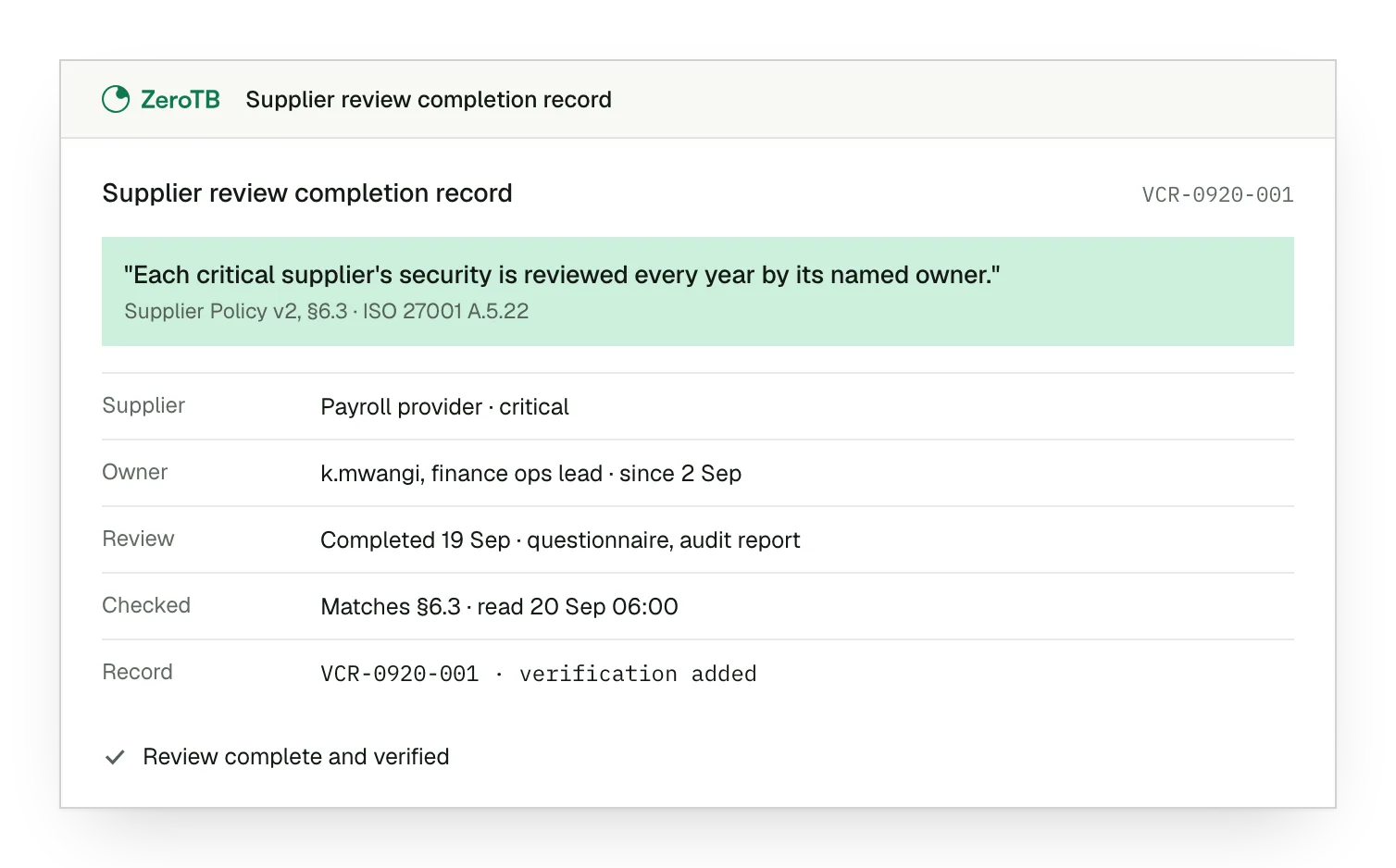
An organizational control depends on someone continuing to do the work as the company changes. A supplier review can become overdue because its owner changed roles and the assignment never moved. The schedule still exists, but the review has stopped happening.
Review owner changes roles
Responsibility stays with former owner
Supplier review becomes overdue
Ongoing control work with ZeroTB
ZeroTB turns the company's commitments into work that can be checked and completed. We read each requirement and check current practice, then draft a correction where needed. People approve material actions. ZeroTB verifies the completed work and preserves a signed Verified Control Record.
Scheduled reviews have owners and due dates
Overdue work reaches the responsible person
Control records stay in ZeroTB
Talk to our team
Talk with us about how organizational controls are working today, where reviews are overdue and which responsibilities keep needing attention.
FAQ
How do we decide which organizational controls apply?
Selection starts with the risks and obligations of the business. The Statement of Applicability explains which controls are necessary, why they were included and whether they are implemented. It also explains any Annex A exclusions. The ISO auditing practices note describes the comparison with Annex A as a way to check for missing controls.
Where can we find implementation guidance for an individual control?
Follow the control number to its guide, or consult ISO/IEC 27002:2022 for guidance on applying the controls. The wider management system is covered on our ISO 27001 framework page. That context matters when a question concerns how the company manages risk across several controls.
How do organizational controls connect to technical safeguards?
A technical safeguard can enforce a decision made under an organizational control. Consider access: a policy sets who may use company information, and account permissions implement that decision. When someone changes roles, the permissions should reflect their approved access. Our technological controls library covers safeguards that operate within systems.
What evidence helps show that these controls are operating?
Useful evidence shows what happened for the duty under review. A completed supplier assessment answers a different question from an incident exercise. When ZeroTB repairs a control, its Verified Control Record keeps the commitment with the before-and-after state, action, approval and verification. That gives the reviewer a record of the correction and its result.
Can ZeroTB help with controls that depend on people?
Yes. ZeroTB can operate recurring tasks such as policy reviews, vendor reviews and incident exercises. The commitment determines the schedule, owner and work to verify. ZeroTB escalates late tasks and checks completion. Decisions about the requirement, approval of material actions and legitimate exceptions remain with people. We agree which commitments to cover.
How does ZeroTB connect control requirements with repair evidence?
ZeroTB keeps the program commitments and repair records together. ZeroTB operates the agreed controls and keeps the evidence of completed repairs. In ZeroTB, a compliance reviewer can see what the control requires and what work restored it after a failure.
Start with the Pilot
The eight-week Pilot maps up to 25 commitments from your report and takes two real control gaps through verified restoration. You get working controls and portable evidence records that show the completed repairs.