Home / Organizational controls
What does ISO 27001 A.5.34 require for protecting personal data?
ISO 27001 A.5.34 requires an organization to identify and meet its obligations for protecting personal data. Those obligations depend on what the organization does with the information. Review the purpose, recipients and storage, then check the safeguards against the applicable privacy requirements whenever that arrangement changes.
The supplier has changed, but the export still runs each Friday. Its fields and transfer settings look exactly as they did at the last review. A.5.34 raises a question beyond those settings: does the new recipient have an approved reason to receive this personal data?
Personal data in use
A privacy review needs to follow personal data through the work that uses it. That includes personally identifiable information, often shortened to PII. The starting point is the activity: what information it uses, why it needs that information and who receives it.
A system inventory helps locate the data, but the review also needs its purpose and the people responsible for its use. Follow copies and transfers far enough to identify the safeguards that each recipient or storage location needs. The reviewer can then identify which uses and locations the assessment covers.
Applicable privacy obligations
The obligations attached to personal data determine the protection it needs. They may appear in a contract, a regulation or a law that applies to the activity. The privacy or legal owner interprets them so the people operating the system know what conditions to enforce.
A.5.34 within ISO 27001 connects this work with the security program. A successful control review alone cannot demonstrate compliance with every privacy law. It should explain the decision that permits the processing and show the safeguards used to carry that decision out.
Changes in processing
A new purpose or recipient can change a privacy obligation while the system's security settings stay the same. Approval to send service data to one supplier may depend on that supplier's role. A replacement supplier needs assessment even when it receives exactly the same fields.
The reviewer needs the proposed purpose, recipients and storage arrangements alongside the approved ones. That comparison identifies what the privacy owner has to decide. Checking the transfer settings is useful, but it cannot explain whether the information may be used in the proposed way.
Privacy decisions and ownership
Privacy, legal and system owners contribute different decisions to a correction. The privacy or legal owner interprets the applicable obligation. The system owner explains how the proposed restriction will affect the service and which changes can put the decision into practice.
The approval should identify the affected activity and the action authorized for it. An approved exception records its purpose, owner and review conditions. This gives the person making the change a defined decision to implement and a boundary for that action.
Requirements that systems can enforce
An approved privacy decision needs a specific condition that the affected system can meet. "Restrict this export" leaves too much open. Naming the fields and recipients it may include gives the system owner a condition to implement and the reviewer something to test.
A retention decision needs similar detail about the records covered and when the action applies. ZeroTB uses approved commitments in its control operation workflow to check systems and propose corrections. Privacy and legal owners decide whether the processing itself is permitted.
Access and sharing boundaries
A restriction on personal data needs to cover the ways people and systems can obtain it. Someone with no application account may still receive a regular export. Removing an account will have little effect on that route if the export continues to arrive.
The evidence needs to match the route being reviewed. Account permissions explain direct access; export settings explain the fields and destination of a transfer. Once a recipient has received the information, the review also needs to address its copy, separately from access to the source.
Retention and existing copies
Changing a retention setting does not establish what happened to copies already held elsewhere. A revised setting may govern future handling in the source system. The privacy review also needs to account for records already stored, including those received through earlier transfers.
The correction record should identify which copies the action affects. For each remaining location, the owner needs to decide what happens next and what confirmation is needed. A result from the source system can establish only the part of the correction tested there.
Verification after a correction
Verification should test the privacy condition that prompted the change. If an export included fields outside its approved purpose, inspect the next transfer. Confirm that it excludes those fields, reaches only the approved recipients and still supplies what the permitted activity needs.
Keep the date and scope of the test beside its result. An observation from another system or an earlier configuration cannot resolve the current gap. Missing or stale evidence leaves the result unknown, even when the change request has been marked complete.
Evidence with less personal data
A privacy-control record should explain the decision without collecting unnecessary personal information. The requirement, affected system, approval and verification result may establish the correction without including the underlying records. Evidence should contain enough detail for a reviewer to understand what was checked.
When a sample is necessary, the review should consider which fields it needs and who can access it. The evidence store then holds a further copy of that information. Its access and retention therefore need to reflect the information included, alongside the reason for keeping the evidence.
Ongoing control ownership
A privacy control needs review when its processing changes, even after a correction has passed. The next export revision, supplier change or new use can alter the conditions behind the earlier decision. A dated verification result describes the arrangement checked at that time.
An agreed owner and review schedule connect later changes to the privacy decision. Routine checks can watch defined safeguards, while changes in purpose or obligations need review by the responsible owners. That division lets technical checks continue without treating an old approval as permission for new processing.
Evidence for a privacy review
The evidence should connect each privacy requirement to an approved decision and the safeguard that carries it out.
| Requirement | What an auditor asks for | Where it comes from |
|---|---|---|
| Defined processing scope | Personal data used, its purpose, recipients and storage locations within the activity under review | Processing records and information flows checked with the activity owner |
| Applicable obligations | The requirements that govern the activity and the decisions that explain their application | Relevant policies, contractual requirements and documented privacy or legal reviews |
| Approved safeguards | The access, sharing or retention conditions selected for the activity and who approved them | Owner decisions linked to system configurations and operating procedures |
| Assessed processing changes | The changed purpose, recipient or location and the decision about its continued protection | Change records, supplier reviews and updated processing decisions |
| Verified correction | The affected requirement, authorized action and dated evidence that the intended safeguard now operates | System observations and approvals linked in the Verified Control Record |
Related controls across frameworks
| Framework | Control | What it covers |
|---|---|---|
| ISO 27001 | A.5.34 | The privacy requirements for personal data and the protection needed to meet them |
| SOC 2 | CC6.1 | The controls that restrict logical access to systems and the information they hold |
| HIPAA | 164.308(a)(4) | The policies and procedures used to authorize access to electronic protected health information |
Example of restricting a data export
A corrected export should contain only the personal data approved for its purpose. In this example, a changed export includes contact fields outside the agreed supplier use. The review follows the correction through approval and testing, with the supplier's existing copy tracked separately.
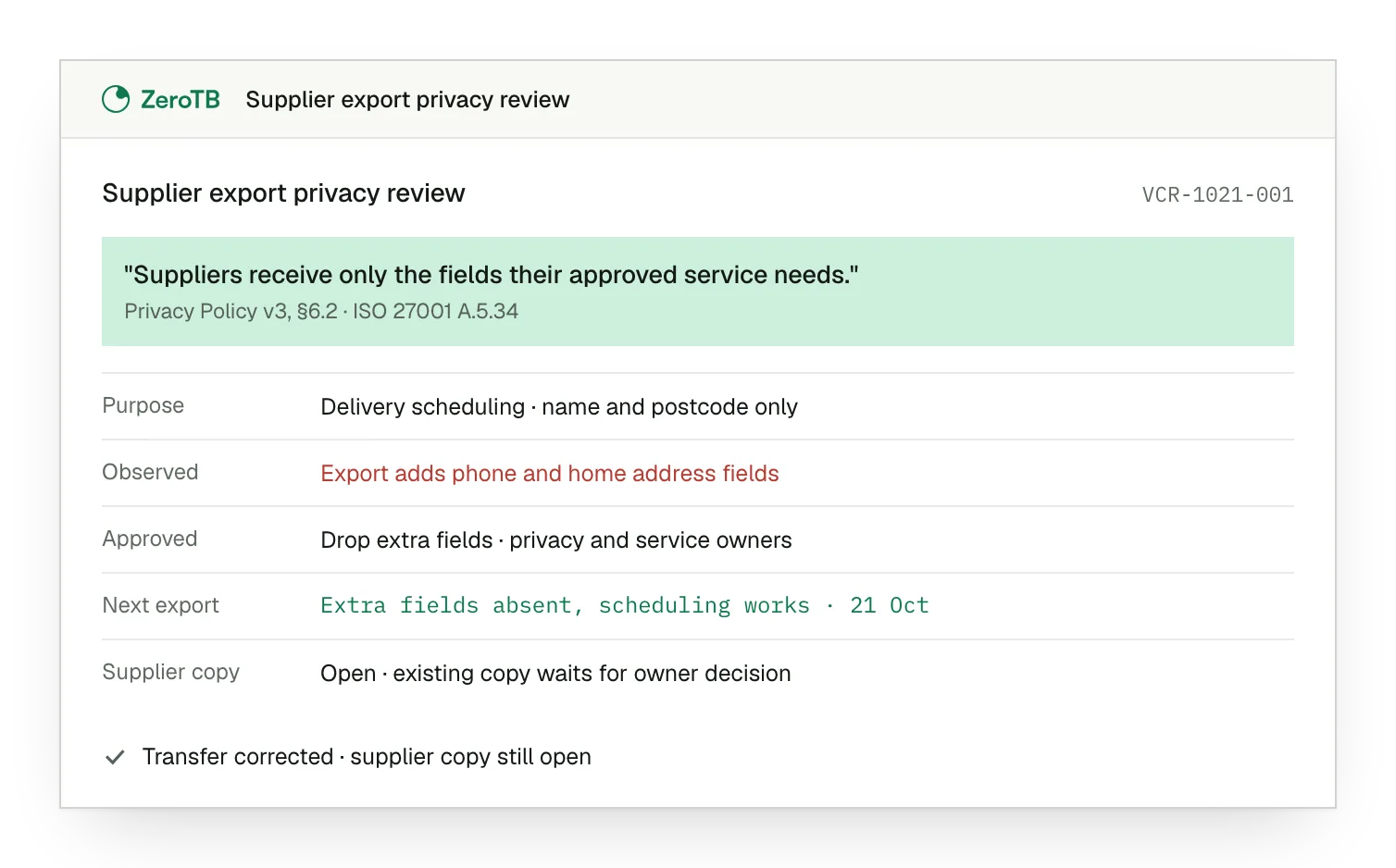
Changed export. The observed transfer includes contact fields beyond those approved for the supplier's service.
Approved field restriction. The responsible owners approve removing the extra fields and assign review of the existing supplier copy.
Transfer checked. A test confirms the next export excludes those fields and still supports the approved service.
Separate copy review. The transfer check passes while the supplier's existing copy remains open for an owner decision.
Personal data review checklist
Follow one activity from its source data to its recipients, including any copies outside the original system.
Have the responsible owner assess the changed use against its requirements and decide which safeguards it needs.
Inspect how the system implements the accepted access, sharing or retention condition, and record any difference.
Test the changed arrangement against the accepted condition, including whether the approved activity can still continue.
Record the decision and test result together, with only the personal information needed to explain what passed.
Sources
- ISO, ISO/IEC 27001:2022, 2022, information security management system requirements.
- ISO, ISO/IEC 27002:2022, 2022, guidance for information security controls.
- AICPA & CIMA, Trust Services Criteria with revised points of focus, 2022 revision.
- HHS, HIPAA audit protocol, information access management, 2018 update.
Related pages
Organizational controls
Explore the responsibilities that connect privacy protection with the other organizational controls in ISO 27001.
ISO 27001
Place personal data protection within the wider information security management system and its control requirements.
Compliance frameworks
Find guidance for the other frameworks that apply to the systems and information under review.
Start with the Pilot
Talk with our team about keeping personal data protections working as systems change. The eight-week Pilot maps up to 25 commitments and takes two real control gaps through approved correction and verified restoration, with evidence of the results.