Choose compliance management software by the work it completes between audits: keeping requirements current, checking controls, completing repairs and preserving evidence. For a SaaS company that has completed SOC 2, the useful test is one failed control. Follow it through each candidate to see who corrects it and how they establish that the repair worked.
After the audit, people still change roles, engineers deploy code and teams add systems. Those changes can affect controls whose records look complete. A software evaluation should show how the provider handles that continuing work and what decisions remain with your team.
Compliance software categories
Compliance software can organize a program, coordinate an audit or help keep controls operating. Those jobs require different capabilities. A program record holds requirements, policies and owners; audit management connects tests with evidence requests. Monitoring checks actual conditions, and restoration addresses the failures those checks find.
A single product may cover several jobs. A compliance management system can include monitoring, while a compliance automation platform may collect evidence and leave repairs with engineers. During selection, establish where each candidate's work ends. That boundary matters more than the category on its website.
Regulatory coverage
Regulatory coverage has to match the obligations and jurisdictions in the company's program. Regulatory compliance tracking software should connect a changed requirement to the affected policy, control and owner. The applicability decision needs a person who understands the obligation and the business it affects.
The best regulatory compliance software for a program with changing legal obligations may differ from software chosen to maintain technical security controls. Compare the actual requirements each candidate handles. Framework labels alone give little indication of how the product manages changes, exceptions or supporting evidence.
Checks against live systems
To detect a broken control, software must compare an observation from the system with the approved rule. A tool that sends review reminders may need another connection to obtain that data. During evaluation, follow the observation to its source and inspect the condition used to judge it.
NIST's monitoring guidance treats observations of control effectiveness as information for responding to risk. An evaluation should therefore include the response to failure. Have the provider demonstrate both a failed check and a disconnected source, with the person responsible for investigating each.
Testing frequency and audit periods
Quarterly testing and automated monitoring give different views of the same control. A quarterly review captures selected moments and can include judgments that software cannot make. Repeated system checks add observations between reviews, making changes visible sooner when the relevant data is available.
Compliance tracking software should retain those observations across the audit period, including failures, repairs and intervals without data. The history lets a reviewer assess what the checks covered. A passing result today cannot establish that a control held throughout an earlier period with missing observations.
Dashboard status criteria
A dashboard's green status needs an explanation of what passed. A policy upload confirms that a document exists; a system check can establish whether a setting matches the rule. Software should make that difference visible beside the status, with the observation's date and scope.
An auditor may examine a broader requirement than the dashboard's test. When their conclusions differ, compare the systems covered and the passing condition before treating either result as an error. A disconnected or stale source also needs its own status, because it cannot supply a current observation.
Evidence for audit review
IT audit software reduces repeated evidence requests when it collects material that a reviewer can interpret without an engineer's explanation. The source, date, scope and requirement give that material context. Evaluate the collected record from the reviewer's position: can they tell what happened and where?
Compliance audit tools also need to preserve earlier versions of the requirement and the observations made against them. A current record alone may leave an older finding unexplained. Follow such a finding through the proposed tool, including the access an auditor receives to review it.
Responsibility for repairs
The provider's responsibility after a failed check should be explicit in the proposal. Assigning a ticket leaves someone to investigate the cause, prepare a correction and establish that it worked. Compare which activities the provider handles, along with the decisions that remain with the control owner.
For teams that need help with those activities, ZeroTB combines software with a service that prepares corrections and verifies approved repairs. The restoration process follows the commitment into the affected system. Compliance receives evidence of the result without having to reconstruct the work across IT and engineering.
Approval and access
The software needs enough access to observe a control, with separate authority for changes. A read-only connection can support the initial assessment. Any write permissions should have a defined scope and be revocable, so the owner can control what the service may change.
Approval should identify the proposed correction and its expected effect. A legitimate exception needs an owner's decision before automation removes access or changes a setting. Compare how each provider presents those decisions, records approval and responds when the proposed action falls outside its agreed permissions.
Control work and records
ZeroTB keeps the program record and handles recurring control repairs. Its requirements and responsibilities still form the program record. The purchase decision is whether the additional service completes work that the current arrangement leaves with an already busy team.
Reviewers need a clear route from that record to the repair evidence. The Verified Control Record holds the commitment, before-and-after state, action, approval and verification together. Agree where each record will be read, while retaining broader risk decisions in the existing GRC program.
Setup and continuing work
The checks need maintenance after an integration connects. A new application or repository can change which systems a commitment covers. Someone must extend the checks, investigate lost connections and adjust them when the approved requirement changes. The proposal should identify who performs that continuing work.
Ask the provider to explain what happens after setup, including investigation, correction and evidence retention. Software alone can suit a team able to handle those activities. Service support becomes useful when a failure repeatedly passes between compliance, IT and engineering because nobody carries the repair through.
Comparing the complete cost
Compare proposals against the same control workflow and the same division of responsibility. Ask for subscription, setup and ongoing service costs separately. Include the work left with internal teams when assessing the proposal, especially investigation and repairs that recur after the initial implementation.
A useful evaluation ends with an observed result and a clear account of who produced it. Choose the option that covers the missing work at a sustainable cost. Adding another tool helps when it removes a recurring burden or gives the team evidence it could not obtain reliably.
Example of verifying a restored branch rule
A branch-rule evaluation should end with evidence that required review works again. In this example, the production branch has lost that setting. The record follows the finding through a proposed correction and the owner's approval, then retains the result of checking the restored rule.
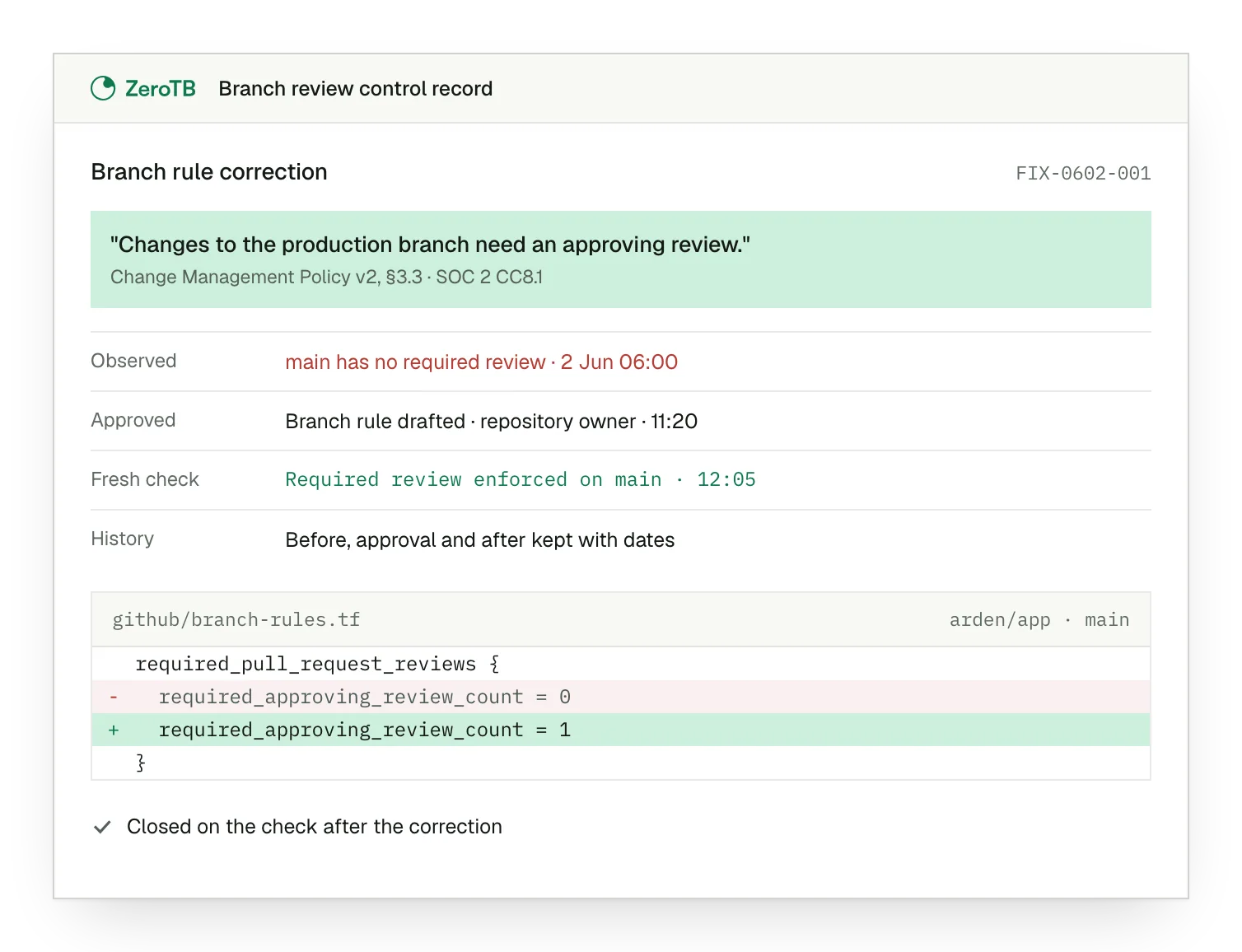
Required review missing. Changes can enter the production branch without the review specified in the company's approved rule.
Approved rule correction. The proposed setting change has the repository owner's approval before the provider applies the correction.
Review requirement restored. The check after the correction shows that required review is enforced on the production branch.
Complete correction history. Dates connect the initial observation with the approved correction and the check that supports closure.
Compliance software selection checklist
Establish which requirements and systems the provider covers, including the work needed when either of them changes.
Follow a failed check through the proposed correction and result, noting which activities the provider actually performs.
Read the observations and repairs across a review period, with particular attention to missing data and its treatment.
Examine an approval decision and a retained exception, including the permissions that limit what the provider can change.
Compare the work included after setup with its cost, then identify any recurring responsibilities left with internal teams.
Related pages
Coding agent compliance
Read about the control changes that can follow when engineering teams use coding agents.
Healthtech compliance
See the ongoing work behind keeping healthtech systems aligned with the company's compliance commitments.
Compliance monitoring tools
Examine what a monitoring tool observes and the response available when one of its checks fails.
Start with the Pilot
Talk with our team about the control work that keeps returning between audits. Our eight-week Pilot maps up to 25 commitments and takes two real control gaps through approved repairs to verified restoration, producing evidence from that work.