Home / Organizational controls
How does ISO 27001 A.5.28 cover collecting and keeping evidence?
ISO 27001 A.5.28 covers the procedures for collecting and keeping evidence about information security events. Preserve the material together with records of its source, collection and subsequent handling. When the process changes, check that a reviewer can still trace an item and that its storage protects it.
The evidence file and its handling history belong together. A log export without a collection time leaves the investigator unsure when it was obtained. If responders also edited that file, the investigation has to establish what changed. A collection procedure should prevent those questions from arising.
Evidence handling scope
A.5.28 concerns evidence about information security events and the procedures used to handle it. Within an ISO 27001 program, those procedures explain how relevant material is identified, collected and preserved. Their scope should follow the event being examined and the systems involved.
A useful procedure connects each item to the investigation it supports. An exported log, an incident ticket and a device copy can serve different purposes. Keeping that context with the item helps the reviewer decide what questions it can answer and what further material is needed.
Collection authority
The person collecting evidence needs authority to obtain it and a suitable collection method. The procedure should settle who approves access to each source. This matters when an incident spans teams: the responder may know which material is needed but depend on another owner to release it.
Some investigations may lead to legal or disciplinary proceedings. NIST's forensic guidance recommends considering that use before collection begins. Appropriate specialists can then advise on the method while the relevant material is still available, and before handling decisions limit its use.
Source context
A reviewer needs to know what a collected item represents before drawing conclusions from it. Record the source, collector, collection method and time. For an export, the record should also explain which period and system the collected material covers.
A missing event in a filtered export may sit outside the selected period. Keeping the export scope with the file lets another reviewer distinguish that possibility from an absence in the source. Preserve the collection details alongside the item so interpretation does not depend on the collector's memory.
Preserved material and working copies
Analysis should leave the preserved material available for another examination. Keep working copies distinguishable from the material retained at collection. Sorting, annotating or filtering a working copy then has a clear place in the investigation without obscuring what was originally collected.
An integrity check can help establish whether a working copy matches the preserved material. Record that comparison and when it happened. Its result supports the handling record; the investigator still needs the source and collection history to understand what the file represents.
Chain of custody
Chain of custody records who handled evidence and how it moved between them. The NIST definition includes the person, collection or transfer time, and purpose of the transfer. These details let a later reviewer follow the item through the investigation.
Each handoff should refer to the same identifiable item. If a responder transfers a working copy, the record should make that relationship clear. Otherwise, a reviewer may follow a complete sequence of transfers while remaining unsure which version each person received or examined.
Evidence storage
The storage permissions should match the way investigators are meant to use the evidence. An investigator may need to examine a working copy, while only the custodian can manage the preserved material. The storage owner needs to establish which actions each role can perform.
Inspect the location that actually holds the files. Permissions inherited from a shared folder may give a larger group access than the procedure allows. NIST's evidence management guidance covers protection throughout handling and storage, including the period after the initial collection is complete.
Drift between incidents
Changes between incidents can leave a collection procedure out of date. Moving evidence to a different storage location may change its permissions. Replacing a system owner may leave the procedure pointing to someone who can no longer approve collection or arrange a transfer.
A check should follow the route people now use. Trace an item through that route and compare its handling with the approved procedure. If the two differ, the control owner needs someone responsible for the correction and an agreed test of whether it worked.
Recovery after a handling gap
Correcting a handling gap starts with protecting the files and records that remain. Establish what is still available and prevent further alteration or loss. The incident record should describe the gap as it was found, including any uncertainty about what happened to the material.
An authorized collector may be able to obtain another copy if the source still exists. That copy needs its own collection time and method. It may help the investigation, but the earlier copy still has a separate history that the investigator must assess.
Verification of the correction
The reviewer needs to see the corrected process work before accepting the repair. For a storage permission change, test both sides of the access decision. The restricted group cannot alter preserved files, and the investigator can still use the agreed examination route.
Keep the dated test results with the change and its approval. An unreachable storage location leaves the result unknown, even if the change request is complete. Keep the gap open until a check establishes the intended state, and record what remains unresolved.
The control restoration record
A control restoration record explains the correction and the checks used to accept it. ZeroTB's Verified Control Record connects the commitment, before-and-after state, action, approval and verification. It lets a reviewer trace why the team accepted a repaired control.
Investigative evidence also needs its collection and custody history. A verified storage correction establishes the tested state after the change; it cannot establish how a file was handled beforehand. Keep the preserved incident material and its handling records available alongside the record that explains the repair.
Records for reviewing evidence handling
For an A.5.28 review, follow a selected item through the procedure and the records below.
| Requirement | What an auditor asks for | Where it comes from |
|---|---|---|
| Defined handling procedure | Collection responsibilities, approved methods and conditions for specialist involvement | Approved incident procedures and assigned evidence handling roles |
| Traceable collection | The item's source, collector, method, time and collection scope | Collection records linked to the preserved material |
| Protected material | How preserved material is distinguished from working copies and protected against alteration | Storage permissions, copy identifiers and recorded integrity checks |
| Recorded custody | Who handled or transferred the item, when and for what purpose | Custody records tied to the same evidence identifier |
| Verified correction | The handling gap, approved correction, observed result and any remaining uncertainty | Change approvals and dated verification records linked to the control commitment |
Related framework requirements
| Framework | Control | What it covers |
|---|---|---|
| ISO 27001 | A.5.28 | Procedures for collecting and preserving evidence about information security events |
| SOC 2 | CC7.3 | Evaluation of security events to determine their implications and the need for action |
| HIPAA | 164.308(a)(6) | Security incident response, mitigation and documentation of incidents and their outcomes |
Example of restoring evidence protection
The correction in this example removes unintended edit access to a preserved log export. A check finds that the incident response group can change the file. The storage owner approves removing that permission, with the investigator continuing to examine a working copy.
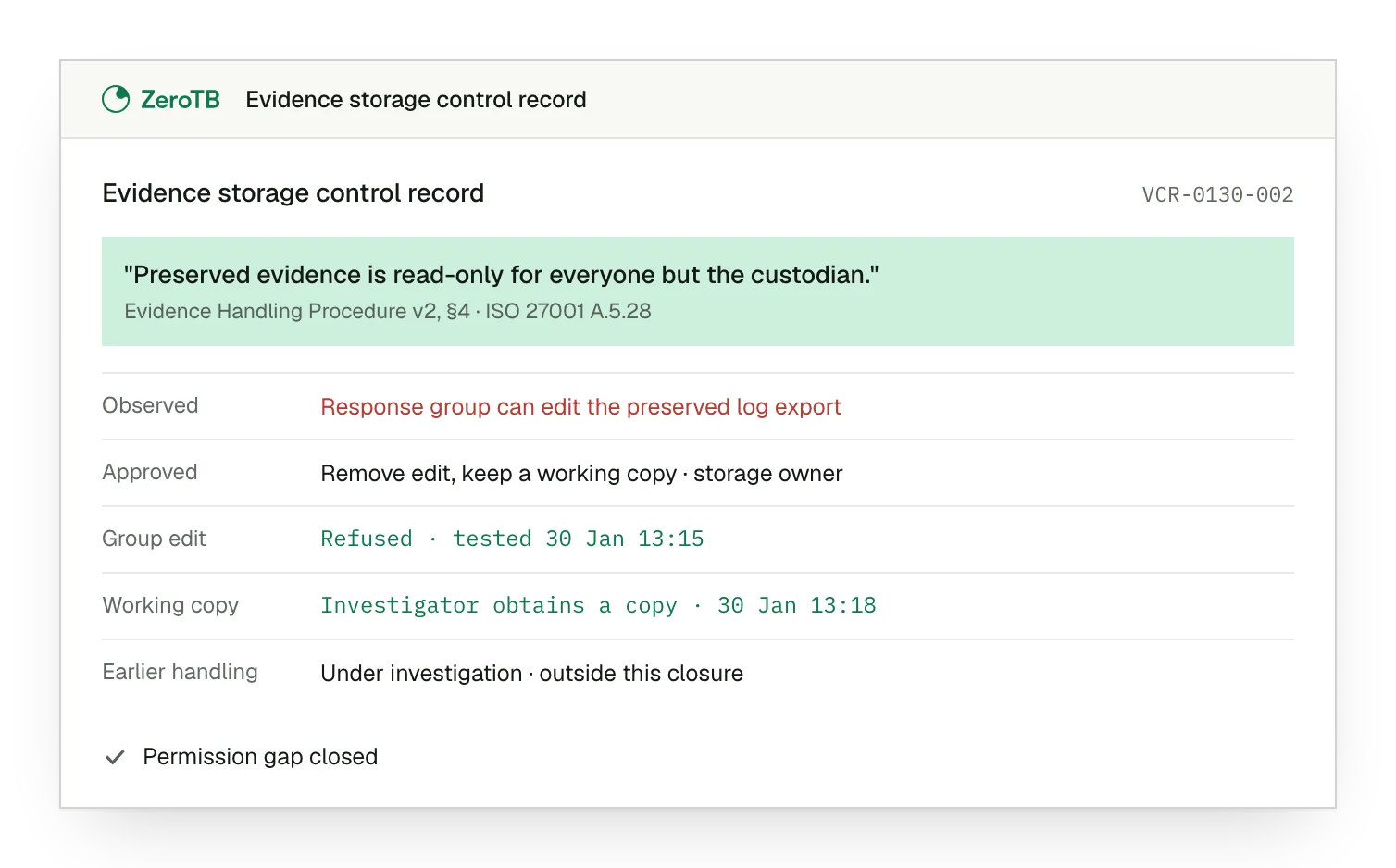
Editable preserved file. The incident response group has edit permission on the export held as preserved evidence.
Approved access change. The owner approves removing that permission while keeping the investigator's agreed access to a working copy.
Protection checked again. A group member's edit attempt fails, and the investigator can still obtain a working copy.
Historical limit retained. The dated access test supports closure of the permission gap; earlier handling remains under investigation.
Evidence handling review checklist
Identify the approved collection or preservation procedure and the incident material to which the rule applies.
Follow one item from its source through storage and transfers, checking whether its handling history is understandable.
Agree a change with the responsible owner that protects available material and preserves the investigator's authorized access.
Test the corrected handling arrangements and retain dated observations before accepting the control as restored.
Keep known limits in the incident record so a repaired control does not obscure uncertainty about earlier handling.
Sources
- ISO, ISO/IEC 27002:2022, 2022. Information security control guidance.
- NIST, Guide to integrating forensic techniques into incident response, 2006. Collection, preservation and forensic practice.
- NIST, Chain of custody, accessed November 4, 2026. Handling and transfer records.
- NIST, Evidence management, accessed November 4, 2026. Protection during handling and storage.
- HHS, Security incidents involving a cloud service provider, accessed November 4, 2026. HIPAA incident documentation.
- AICPA & CIMA, Trust Services Criteria with revised points of focus, 2022 revision.
Related pages
Organizational controls
Find the responsibilities around incident response, evidence handling and other organizational security controls.
ISO 27001
See how individual controls support the organization's wider information security management system.
Compliance frameworks
Explore related requirements across the frameworks covered by the control library and guidance.
Start with the Pilot
Talk with our team about keeping evidence handling controls in operation. The eight-week Pilot maps up to 25 commitments and takes two real control gaps through approved correction and verified restoration, with a record of the work.