Home / Organizational controls
What does ISO 27001 A.5.10 require for information and asset use?
ISO 27001 A.5.10 addresses acceptable use of information and the assets used to handle it. Define permitted uses, tell people which rules apply to their work, and implement those rules. Review changes in tools and working habits so the company can identify departures, agree corrections and confirm the resulting practice.
A signed policy tells you which instructions someone received. It does not tell you where they sent a file yesterday. If the approved sharing service could not reach the recipient, a personal account may have supplied the missing route. Both the restriction and the work need attention.
Acceptable-use scope
A.5.10 brings information and the assets used to handle it into the same discussion about acceptable use. Consider a file alongside the account holding it and the device used to open it. Employees and contractors need to know which uses the company permits.
The information security management system defines the scope for that discussion. Within it, identify activities that need instructions, including storing records, sharing files and installing software. Connecting these tasks to the ISO 27001 program helps explain where acceptable-use rules apply and who needs to receive them.
Practical handling rules
A useful rule lets a person determine how to do the work. For sharing a file, it should identify the permitted service, account and conditions. Where the usual route cannot complete the task, it should also identify who can decide on another method.
Write handling instructions around the information involved. A destination suitable for public material may be unsuitable for restricted customer records. Explain what that difference means when someone copies, downloads or transfers a file. The instructions need to remain useful after the file leaves its original location.
Communication and responsibility
People need access to the instructions that govern their work, including changes made after they received access. Give them the relevant rules at the start and communicate revisions as practices change. Retain the version linked to each acknowledgement so its meaning remains clear.
An acknowledgement cannot resolve a mismatch between policy and settings. That requires people with authority over each: the policy owner decides acceptable use, and the application owner controls the service. Assign those responsibilities before a gap appears, so there is a clear route to a decision.
Changes in working practices
New tools can move company information beyond the uses described in an existing policy. File-transfer services, browser extensions and AI assistants can each introduce another destination. Review what people intend to send there, which account they will use and who can receive the result.
Approval for one use does not settle every use of the tool. An assistant used with public material presents a different decision when someone wants to supply restricted records. Explain the permitted uses where people choose their working method, and review them when that method changes.
Checks against actual use
A check needs an observation that answers a specific question about the rule. For an approved-work-account requirement, account and access settings can show which routes are available. An acknowledgement shows that someone received the policy, but it cannot explain what those settings currently allow.
Where settings do not answer the question, review an appropriate part of the work. Keep the evidence relevant and restrict it to the people responsible for review. If observations are missing or stale, leave the result unresolved until there is enough information to assess the selected rule.
Workaround causes
The reason for a workaround helps determine which correction will last. Ask what task the person needed to complete and why the approved method failed. The answer may point to missing permissions, an unavailable feature or an instruction that people interpreted differently.
The owner can use that explanation to choose a permitted method that supports the task. Blocking a personal sharing route leaves a problem if the approved service still cannot complete the handoff. Resolve that obstacle as part of the correction, with instructions the team can follow.
Approved exceptions
An exception should give a reviewer enough detail to understand the permission it grants. Record the purpose, affected information and people, safeguards and review conditions. Assign an owner who can decide whether that permission remains appropriate as the work or its circumstances change.
An exception for a particular handoff needs review when the handoff ends. It also needs review if the information or recipients change before completion. Where the same request recurs across the team, examine whether the normal workflow or its rule needs an approved revision.
Corrections that preserve work
A proposed correction needs to say how the legitimate task will continue. Identify the affected account or destination, the change being proposed and the permitted method afterward. With that information, the owner can judge the effect on both information protection and daily work.
Explain a replacement method to the people who will use it. If that method requires a revised policy, obtain approval and communicate the new version through the policy process. The written rule and the system settings should permit the same activity when the change is complete.
Verification after correction
Verification must establish that the corrected practice works and the unwanted route is closed. Test the approved method with the people responsible for the task. Then check the affected settings or activity to establish whether the unauthorized use has stopped within the reviewed scope.
Record what the test establishes and when it ran. A successful setting change may need a later activity review to confirm that people use the replacement method. Keep any unresolved part of the gap visible until the relevant observation supports a closure decision.
Evidence over time
A reviewer should be able to follow a correction from the applicable rule to the observed result. Keep the policy version with the gap, decision and dated verification. That connection explains why the change was made and what evidence supported closing it.
The commitment, before-and-after state, action, approval and verification sit together in ZeroTB's Verified Control Record. Subsequent checks need an owner and a schedule suited to the practice. When a tool or workflow changes, revisit what those checks cover before relying on earlier results.
Evidence for review
These records help a reviewer trace acceptable-use rules into everyday work and examine how identified gaps were resolved.
| Requirement | What an auditor asks for | Where it comes from |
|---|---|---|
| Defined acceptable use | The current rules and the information, assets and activities they cover | Approved policy versions and the relevant asset and process records |
| Communicated responsibilities | Evidence that affected users received the rules applicable to their work | Policy communications, acknowledgements and instructions for changed practices |
| Rules in operation | Observations showing how the selected rule applies to actual use | Account settings, sharing permissions or a relevant review of the work |
| Controlled exceptions | The permitted use, responsible owner, safeguards and conditions for review | Approved exception records and subsequent review decisions |
| Verified correction | The gap, approved response and dated evidence of the resulting practice | Change records and observations retained with the correction's verification results |
Related framework requirements
| Framework | Control | What it covers |
|---|---|---|
| ISO 27001 | A.5.10 | Permitted uses of information and associated assets, supported by rules and handling practices |
| SOC 2 | CC5.3 | Use of policies and procedures to carry out control activities; related implementation evidence |
| HIPAA | 164.310(b) | Functions, working methods and surroundings of workstations that access electronic protected health information; a narrower scope |
Example of restoring approved file sharing
This example follows a customer handoff that the approved sharing service cannot complete. The team has used a personal account to send a restricted file. The owner approves a work-account route for the handoff, and the record shows whether that replacement works.
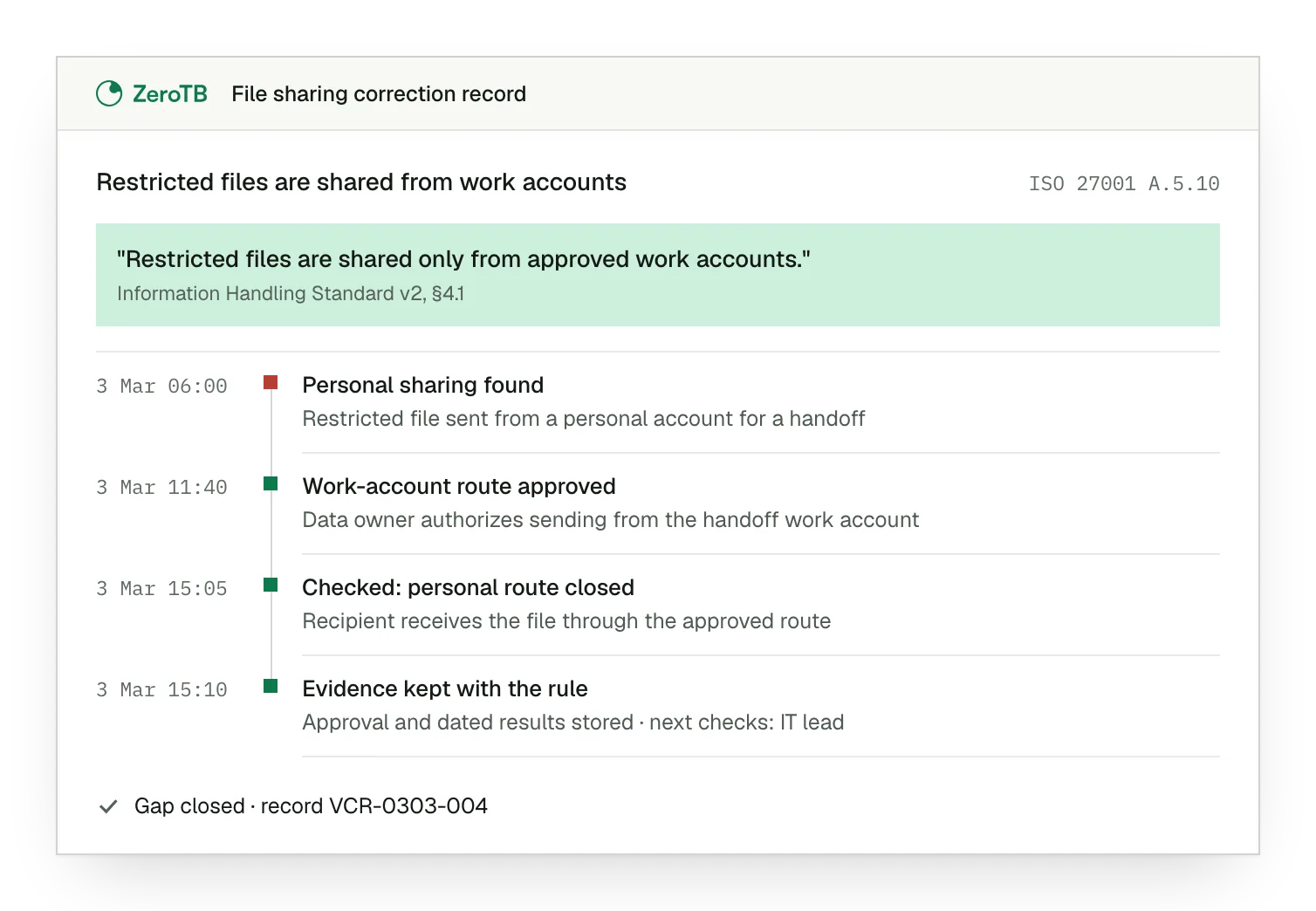
Sharing gap. The team has sent a restricted file from a personal account to complete the handoff.
Replacement method. The owner authorizes a work-account route that lets the team send the file as required.
Verified access. Testing confirms that personal sharing is closed and the recipient can receive the file as approved.
Retained evidence. The approval and dated results remain with the rule, alongside an owner for subsequent checks.
Acceptable-use review checklist
Identify a current acceptable-use rule and the information, accounts and working practices it governs.
Compare the rule with relevant settings or activity, and identify the task behind any observed workaround.
Agree a permitted method or a documented exception, with safeguards that fit the information and task.
Test the approved route and the corrected restriction, then retain the results with ownership of further checks.
Sources
- ISO, ISO/IEC 27001:2022, 2022. Information security management system requirements.
- ISO, ISO/IEC 27002:2022, 2022. Guidance for implementing information security controls.
- AICPA & CIMA, Trust Services Criteria with revised points of focus, 2022 revision. Related policy and procedure criteria.
- HHS, HIPAA audit protocol, 2018 update. Workstation-use requirements and evidence.
Related pages
Organizational controls
Read the neighboring controls that assign responsibilities and govern how the organization protects information.
Compliance frameworks
Browse the framework guides and follow their links to individual controls and related requirements.
Control operation
Follow the work from an approved commitment through a correction to evidence of its result.
Start with the Pilot
Talk with our team about where acceptable-use rules meet daily work. During the eight-week Pilot, we map up to 25 commitments and take two real control gaps through approved correction and verified restoration. The resulting records show the work and its verification.