Home / Organizational controls
What must managers enforce under ISO 27001 A.5.4?
ISO 27001 A.5.4 makes managers responsible for requiring staff to follow the organization's security rules. People need to understand their duties and have the resources and authority to perform them. If work repeatedly goes unfinished, the manager should investigate the cause and check whether the response allows staff to complete the duty.
An overdue security review may be waiting for a decision outside the reviewer's control. The manager needs to find out what is missing and who can resolve it. That is where an assigned responsibility becomes part of supervising the work.
Management responsibility
Managers must see that security rules are followed in the work they supervise. Once a policy reaches a team, the manager needs to explain how it affects their duties. Unanswered questions and unfinished tasks then belong in the manager's ordinary review of that work.
The form of supervision can vary. In a small team, the manager may review a duty directly with the person performing it. Where several reporting levels separate them, the arrangement needs to carry unresolved issues back to someone with authority to act.
Clear security duties
A security duty needs an expected result that the person doing the work can recognize. An instruction to review access should explain the accounts in scope, the decision required and where unresolved questions go. These details let the manager judge whether the review is complete.
The policy and the work instruction should agree about that result. When they differ, the manager needs a decision from the policy owner before giving the team conflicting directions. Record the agreed instruction where staff can find it during the task.
Resources and authority
Before assigning a security duty, establish whether the team can perform it with the time and access available. Some dependencies require an agreement with another manager. The person doing the task needs an expected delivery time and a route to report missing inputs.
Access should fit the duty. An account export may contain everything a reviewer needs, avoiding unnecessary administrator permissions. If the difficulty is time, discuss the work schedule or staffing. A new assignment does little to resolve two tasks that still compete for the same person's time.
Training in daily work
Staff need to understand how a security instruction applies to the task in front of them. Training records help establish what they were taught. Talking through the task with them can reveal a misunderstanding that a completed course record would leave unexplained.
For unfinished work, find out which part the person could not perform. Further instruction helps when the expected decision was unclear. If the person understood the duty but lacked a permission, the manager needs to resolve access before expecting the work to resume.
Delegation and supervision
Delegating a security task leaves a manager with work to supervise. The specialist doing the check may have no authority over the application owner who must approve a change. Agree where that handoff occurs and who receives the result before treating the assignment as settled.
Managers do not need to repeat every technical check. They do need to know what remains unresolved when one team finishes its part. A useful report separates completed work from pending decisions and identifies who can decide the next action for each open item.
Recurring obstacles
Repeated missed duties are a reason to inspect how the work is organized. Compare the unfinished tasks with the instructions, available resources and decisions made about priorities. The same missing input across several tasks can point to a shared process problem.
Ask the people performing the work where it stops and what they need to continue. Their explanation can distinguish unclear instructions, missing authority and conflicting priorities. A reminder helps when someone overlooked a task; a continuing obstacle requires a decision that changes the conditions.
Escalation and exceptions
Staff need a way to raise an obstacle that they cannot resolve themselves. Identify the person who can make the decision and when an unanswered request should go further. Otherwise, a reported problem can remain open even though everyone has followed their immediate instructions.
If the duty must proceed differently for a time, the appropriate owner needs to decide whether to accept that exception. Record the reason, safeguards and conditions for reviewing it. Keep the unresolved duty visible so a temporary arrangement does not become the usual practice.
Corrective decisions
A corrective decision should remove the condition that caused the security duty to fail. Depending on the cause, the action may clarify instructions, provide a missing input or change who performs the work. Agree the expected result before approving the correction.
Connect the decision with the person able to carry it out and the evidence needed afterward. Where several teams are involved, management resolves competing responsibilities. This is part of practical security governance: a decision has an owner and a way to establish its effect.
Verification of later work
Later work shows whether the correction made the duty possible to perform. Check the next time someone performs the duty against the agreed result. The check might examine a completed review, a corrected system condition or the record of an escalation that received a decision.
Choose the check to suit the duty and its risk. A task marked complete can still lack the required result, and an unavailable observation leaves the outcome unresolved. Retain the dated observation so the person closing the gap can explain why the result was accepted.
Changes in team responsibilities
Reassign security duties when the people or systems needed to perform them change. A document can continue to name a former owner after that person has moved teams. The responsibility then appears covered even though the person listed can no longer perform the work.
During the handoff, identify the duties affected and explain any unfinished work to the receiving manager. Include dependencies and exceptions that will need decisions. Check the next scheduled task under the new arrangement to see whether the handoff left anything without an owner.
Evidence of management action
Evidence should connect the manager's decision with the work that followed it. Keep the relevant assignment, instruction, approval and observed result together. A reviewer can then follow the reason for the action and see whether it addressed the condition that prevented completion.
ZeroTB's Verified Control Record connects a commitment with the before-and-after state, action, approval and verification. For management duties, restrict access to personnel details and retain only the information needed to explain the security decision. Related frameworks may use some of the same evidence for different requirements.
Audit evidence
Use these records to connect the applicable duty, management action and observed result.
| Requirement | What an auditor asks for | Where it comes from |
|---|---|---|
| Understood duties | The relevant security requirements and evidence that staff received instructions appropriate to their responsibilities | Approved policies, role descriptions and communications explaining the assigned work |
| Practical support | Evidence that the team had the knowledge, information and authority needed for its assigned duties | Training records, task instructions and decisions providing resources or resolving access dependencies |
| Active supervision | Records showing that managers reviewed unfinished duties and responded to issues raised by their teams | Work reviews, escalation records and assigned actions with responsible owners |
| Corrective action | The cause of the missed duty, the agreed response and the decision authorizing that response | Investigation notes and approved changes to instructions, resources or task ownership |
| Verified result | Dated evidence showing whether subsequent work met the expected result after the correction | Completed task records or system observations linked to the management decision |
Related framework requirements
| Framework | Control | What it covers |
|---|---|---|
| ISO 27001 | A.5.4 | Management responsibility for having personnel follow the organization's security policies and procedures |
| SOC 2 | CC1.5 | Accountability for carrying out internal control responsibilities within the organization |
| HIPAA | 164.308(a)(3) | Workforce authorization, supervision and appropriate access to electronic protected health information |
Example of restoring an overdue review
A missing account export has delayed the review in this example. The manager agrees a delivery arrangement with the application owner. The reviewer then completes the overdue task, and a check of the following review establishes whether the arrangement continued to work.
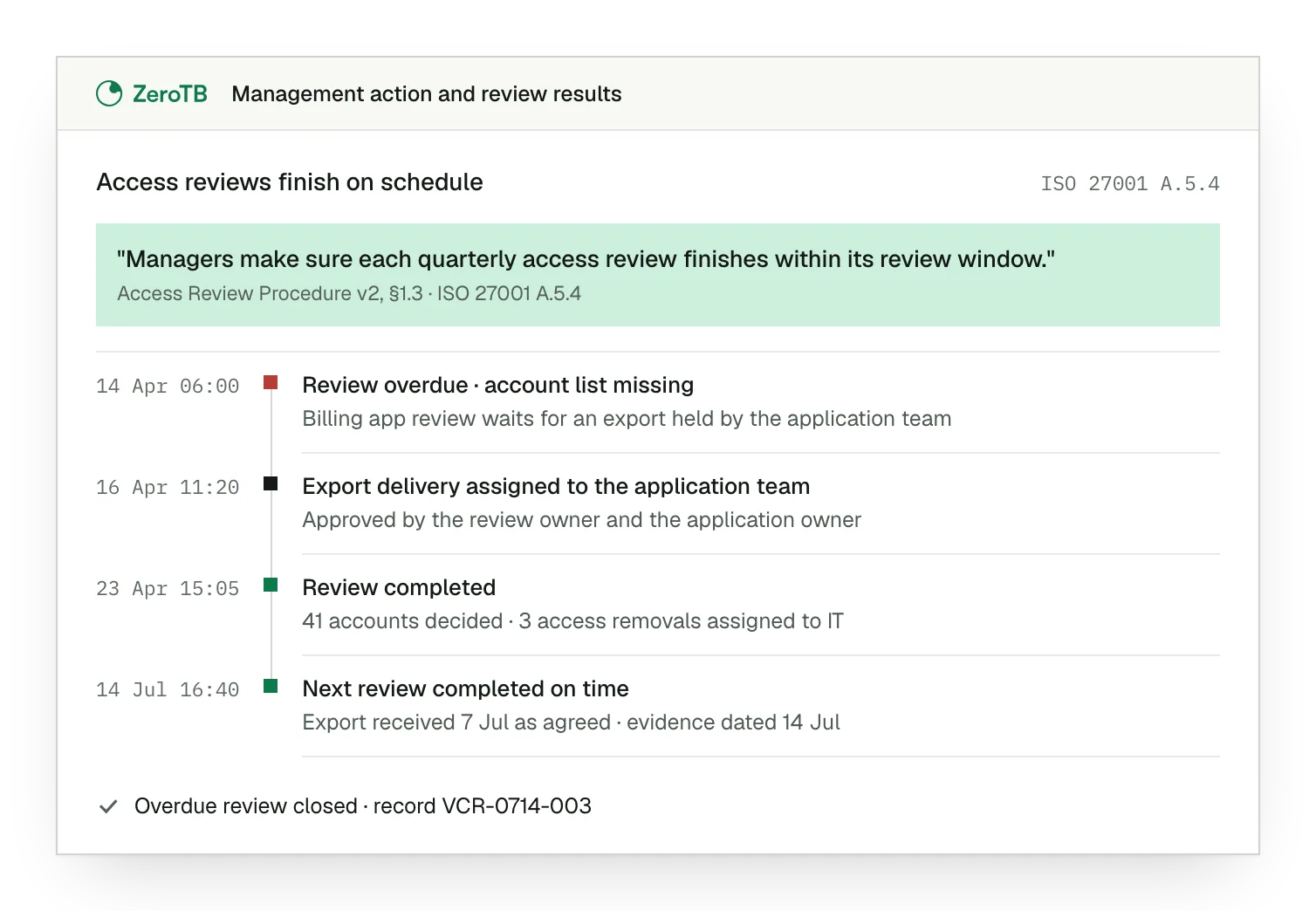
Missed review. The record shows an overdue task waiting for the account list held by the application team.
Approved response. Both owners approve the arrangement for supplying an export before the reviewer starts work.
Completed task. The reviewer records access decisions from the supplied list and assigns any changes required.
Later verification. The following review finishes with recorded decisions after receiving its account list as agreed.
Management responsibility checklist
Compare the approved security requirement with the instruction people use, including the expected result and escalation route.
Examine an unfinished task with the people performing it to distinguish missing knowledge, resources, authority or a decision.
Agree an action that addresses the cause, with an owner able to implement it and a defined result.
Check the next time someone performs the duty and retain a dated observation showing whether the correction worked.
Connect the assignment, management action and verification, with access limited to the personnel information needed for the review.
Sources
- ISO/IEC JTC 1/SC 27, SC 27 Journal, issue 1, 2025, organizational controls discussion, page 4.
- ISO, ISO/IEC 27002:2022, 2022, information security control guidance.
- AICPA & CIMA, 2017 Trust Services Criteria with revised points of focus, 2022 revision.
- HHS, Summary of the HIPAA Security Rule, workforce security section, accessed November 4, 2026.
- ZeroTB, SOC 2 compliance automation, 2026, approved actions and verification of results.
Related pages
Organizational controls
Explore the wider set of organizational responsibilities that support the company's information security work.
ISO 27001
Read how individual controls fit within an information security management system and its continuing operation.
Compliance frameworks
Find related controls and guidance across the frameworks that apply to the company's security commitments.
Start with the Pilot
Talk with our team about keeping security duties working between audits. The eight-week Pilot maps up to 25 commitments and takes two real control gaps through approved correction and verified restoration, with records of the actions and results.