Home / Organizational controls
What does ISO 27001 A.5.25 require when assessing security events?
ISO 27001 A.5.25 concerns assessing security events and deciding whether they require incident handling. Use defined criteria, give an authorized reviewer the relevant facts, and retain the reason for the decision. When monitoring or responsibilities change, check that new events still reach someone who can assess them.
An alert can reach a queue without reaching anyone who can decide what it means. A.5.25 connects the event with that decision. The useful record shows what happened, how the reviewer assessed it and why incident handling did or did not begin.
That process needs attention as systems change. A new source of alerts may expose activity the existing procedure never considered. Keeping the assessment process current helps a team explain its decisions throughout the period covered by its ISO 27001 program.
Event classification
A.5.25 concerns the decision to handle a security event as an incident. Receiving an alert starts the assessment. Someone with the relevant context must decide what the observation means under the organization's criteria and record the basis for that decision.
A closed alert and an escalated alert each need a reason. If incident handling begins, the response record should link to the assessment that prompted it. That link gives responders the original facts and lets a later reviewer follow how the team reached its decision.
Assessment criteria
Useful criteria connect an event with its possible effect on information and systems. They give the reviewer something specific to judge: the service involved, the information at risk and whether the activity was authorized. Those details help explain why similar alerts may receive different classifications.
Urgency needs a decision too. NIST's incident response guidance recommends applying incident criteria and using risk to set priorities. A team can use that guidance when defining how scope and impact affect its decisions, while retaining its own approved assessment procedure.
Relevant context
The reviewer needs enough context to apply the criteria to the affected system. An event reference should lead to the original observation, its time and the activity under review. The assessment should explain which information or service could be affected.
Context can change the meaning of the same alert. An approved maintenance action and an unexplained change may produce similar observations. The reviewer needs the relevant authorization or system history to distinguish them, with assumptions recorded separately from facts already established.
Decision authority
An event needs a reviewer who can make or escalate the classification decision. The first person to receive it may lack access to the system or authority to decide. The procedure needs a route to someone who can resolve that limit.
Check what happens at the other end of that route. A queue can still accept tickets after its owner leaves the team. A test should show that the current reviewer receives the event, can obtain the missing context and knows which decision is theirs.
Uncertain events
Missing information leaves an assessment unresolved. The reviewer may be waiting for a log or an explanation from the service owner. Recording that question and who can answer it helps another reviewer continue the work. A blank status gives them much less to go on.
Some events need escalation while those questions remain open. The reviewer considers the possible impact, the facts available and the risk of delay. The record should explain that judgment. An event should remain visible for assessment when the information needed to close it is still missing.
Decision records
A useful decision record explains why the reviewer chose that outcome. Keep the event reference, relevant facts, criteria used, reviewer and decision time together. The rationale should connect those facts to the classification, so a later review can follow the reasoning.
For an event that becomes an incident, include the response record. For an event closed after assessment, retain the reason for closure and the information that supports it. Both outcomes need enough detail to explain the judgment without relying on the original reviewer's memory.
Reassessment
New information can change an event's classification. A later observation may reveal an effect that was invisible during the first review. Add that observation to the assessment history and explain the new decision. Preserve the earlier entry so readers can see what changed.
The response team needs to know which assessment now governs its work. Link the revised decision to the action that follows, including any incident record opened as a result. The history should make the sequence understandable even to someone who was absent when the decisions were made.
Classification drift
Changes to monitoring and ownership can leave events outside the assessment process. Adding an alert rule changes the work arriving for review. If the criteria and routing stay the same, the new events may reach people who have no agreed way to judge them.
Recent decisions provide a way to check that coverage. Look at dismissed events as well as cases sent for further assessment. Compare the reasons with the criteria in use at the time. Repeated unexplained closures can point to a gap in the process that produced them.
Process correction
Repair the part of the process that prevented a defensible decision. If a reviewer lacked a criterion, clarify the rule they needed. If the event waited in an unowned queue, correct the route. The responsible owner approves the change and what its test must demonstrate.
ZeroTB checks systems against approved commitments, proposes a correction and verifies the result after authorized action. A.5.25 decisions remain with the authorized reviewers. The control design defines what their assessment should establish and which evidence will show whether the repaired process works.
Verification after correction
A process correction needs a test that reaches a recorded decision. Use representative events to check the changed rule or route, including the condition that exposed the gap. The result should show who received the event, which criteria they applied and what they decided.
Keep the test result with the approved change and the earlier failure. If routing fails or the decision remains unexplained, the correction still needs work. A Verified Control Record retains the commitment, before-and-after state, action, approval and verification for review after the gap closes.
Evidence for event assessment
The assessment record should lead a reviewer to the facts, the decision rule and evidence of any process repair.
| Requirement | What an auditor asks for | Where it comes from |
|---|---|---|
| Defined assessment criteria | The rules used to decide whether incident handling was needed | Approved incident procedures and the current escalation route |
| Relevant event context | The original event and the context available to its reviewer | Event references, system logs and supporting change records |
| Explained classification | A dated decision with its reason and responsible reviewer | Assessment records linked to any resulting incident response |
| Traceable reassessment | The later evidence that prompted a different classification | Dated assessment history linked to subsequent actions |
| Verified process correction | A test showing that the repaired process produced an assessment | Change approvals and representative event tests kept with the verification record |
Related framework requirements
| Framework | Control | What it covers |
|---|---|---|
| ISO 27001 | A.5.25 | Assessment of events to decide when incident handling is necessary |
| SOC 2 | CC7.3 | Evaluation of security events, identification of incidents and decisions about further action |
| HIPAA | 164.308(a)(6) | Incident procedures within HIPAA's scope, including identification, response, mitigation and records of outcomes |
Example of repairing event escalation
A repaired route should deliver an event for assessment. Here, a new alert rule sends work to a queue whose owner has left. The example follows the approved change to that route and the test that shows a reviewer can now receive and assess it.
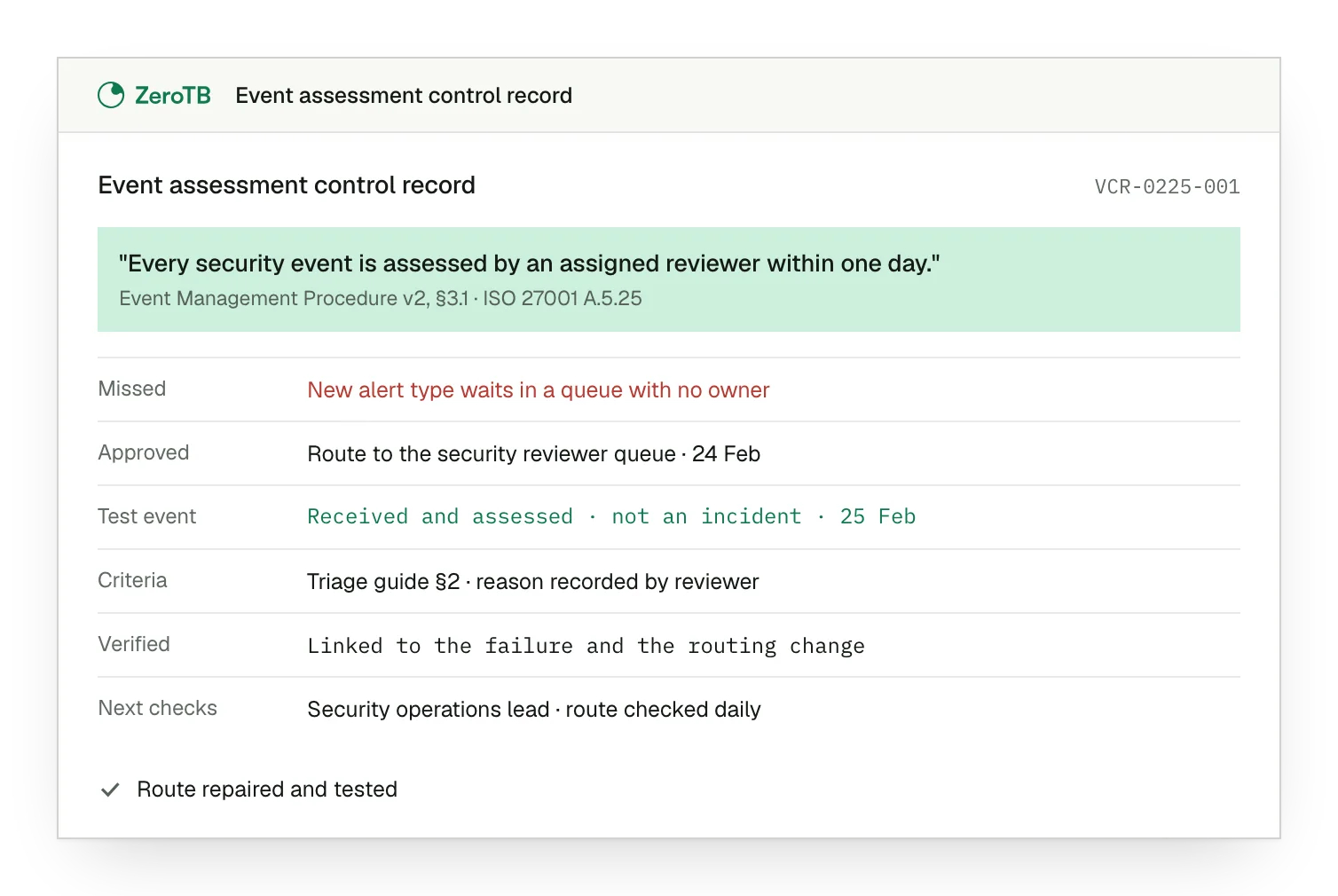
Missed assessment. An event waits for assessment because the queue receiving it has no current owner.
Approved routing change. The owner approves a replacement route that sends these events to the responsible security reviewer.
Completed assessment test. A representative event arrives, and the reviewer records a decision with the criteria they used.
Retained verification record. The successful test remains linked to the earlier failure and the change that corrected it.
Event assessment checklist
Compare recent alert types with the assessment procedure to find events that lack criteria or a responsible reviewer.
Confirm that classification reasons connect the observed facts with the affected information, systems and potential impact.
Follow an event that needed further judgment and check whether it reached someone with authority to decide.
Check whether dismissed events retain a reason for closure and whether later information led to a recorded reassessment.
Review the approved correction alongside a representative event test that shows the intended routing and assessment working.
Sources
- ISO, ISO/IEC 27002:2022, 2022, control implementation guidance.
- NIST, SP 800-61r3: Incident response recommendations, April 2025, incident criteria and prioritization.
- AICPA & CIMA, Trust Services Criteria with revised points of focus, 2022 revision.
- HHS, Summary of the HIPAA Security Rule, accessed November 4, 2026, security incident procedures.
Related pages
Organizational controls
Return to the organizational control library for related responsibilities around information security and incident handling.
ISO 27001
Read how the information security program connects its scope and commitments with individual controls.
Compliance frameworks
Explore requirements from other frameworks that may apply to the same information and systems.
Start with the Pilot
Our team can discuss how controls are working between audits. In the eight-week Pilot, we map up to 25 commitments and take two real control gaps through approved correction and verified restoration. The completed work leaves evidence you can review.