AI governance frameworks help a company govern AI use and manage its risks. NIST AI RMF provides risk guidance; ISO/IEC 42001 defines an AI management system; AIUC-1 addresses agent assurance. Choose according to the decisions and evidence your program needs, then establish how its controls will be checked when systems change.
Approval describes an AI use at a particular time. A coding agent may later gain another repository, a data source or deployment credentials. Its owner then needs to know whether the safeguards agreed during approval still cover what the agent can do.
Framework selection
The reason for choosing a framework should be clear before a team begins mapping controls. Is the immediate job to assess a proposed AI use, establish company-wide responsibilities or demonstrate an agent's safety? Each calls for a different kind of guidance or evidence.
More than one framework may be useful. A risk assessment can sit within an AI management system, and agent testing can support both. The selection should explain what each framework contributes, so overlapping requirements lead to shared work where that work meets both needs.
AI governance regulations
A framework choice leaves a separate question about which laws apply. Under the EU AI Act, rules for developers and deployers depend on risk and use. The company's role and where the system operates therefore belong in the applicability review.
AI governance regulations should be recorded against the uses they affect. That record identifies the obligation, responsible role and evidence required to address it. Voluntary framework adoption can help organize the program, but it cannot by itself establish that applicable legal obligations have been met.
NIST AI RMF
NIST AI RMF provides four functions for managing risk: Govern, Map, Measure and Manage. The published AI RMF 1.0 uses them to connect responsibility with an understanding of the system, evaluation of its risks and decisions about the response.
For coding-agent use, the questions include who approves access, which data the agent reaches, how failures are tested and who handles them. This voluntary NIST AI framework supports repeated review throughout the lifecycle. The controls and tests still have to fit the organization's actual use.
ISO/IEC 42001
ISO/IEC 42001 concerns how an organization manages AI. The standard sets requirements for an AI management system, including the connection between policies, objectives and the processes that support them. It is relevant when responsibility must continue across teams and individual AI uses.
Engineering receives decisions about permitted use, risk and review through that system. Implementing them creates another kind of evidence: a repository setting can show that approval is enforced. The policy review explains the decision; the setting helps show whether the decision operates in practice.
AIUC-1
AIUC-1 sets requirements for AI agents across six areas: data and privacy, security, safety, reliability, accountability and society. Its assessment examines controls and uses technical evaluations to establish how the agent behaves against the requirements that apply.
An access setting shows which operations the agent is allowed to perform. An evaluation can test behavior such as unsafe tool calls or harmful outputs. Both matter to assurance, because permission records alone give an incomplete account of the agent's security, safety and reliability.
Shadow AI
Shadow AI is AI use outside the tools, purposes or oversight an organization has approved. An unapproved assistant is one instance. An approved coding agent used with an unauthorized account or given access beyond its permitted scope can also escape oversight.
Finding unapproved agents touching production code requires observations from relevant devices, accounts, repository activity and credentials. Compare those signals with approved uses and access. A discovery tool's coverage determines what it can detect; an inventory alone cannot establish that all shadow AI has been found.
AI risk assessment
An AI risk assessment asks what could go wrong with a defined use and who or what would be affected. For a coding agent, its data access and permitted actions shape those failures. Secrets access and deployment credentials therefore belong within the assessment.
The assessment service should explain the safeguards already present, the proposed limits and the risk that would remain. Engineering can test those limits before the accountable owner accepts the remaining risk. If permissions or use materially change, the earlier acceptance needs review.
AI use policy
People need an AI use policy they can apply to their work. It should identify permitted tools, accounts, purposes and data, then state prohibited actions and required reviews. Incident reporting and approval for new uses or exceptions also need a clear route.
An AI policy template helps organize the document, but the company supplies the decisions. For coding agents, these include repository access, credential limits and review requirements. Those details give engineering enough information to implement checks and give the owner a basis for interpreting failures.
Framework mappings
Framework mappings need to explain why a control supports a selected outcome. For NIST AI RMF, a mapping tool should identify the AI use, control, owner and evidence behind that conclusion. A reviewer can then judge whether the evidence supports the connection.
The control's pass condition and observation source are part of that explanation. A newly connected repository may extend the scope beyond the evidence already held. Missing checks and unavailable observations should remain visible in the mapping until someone resolves the gaps they represent.
Shared control evidence
One control record can support several requirements when their scope and evidence needs overlap. Access approvals, change reviews and incident records may be relevant to both AIUC-1 and SOC 2. Each mapping must explain which part of the requirement the record supports.
A single monitoring tool can retain this shared evidence while AI-specific evaluations remain separately necessary. A record of approved repository access says little about harmful model output. Evaluate coverage requirement by requirement, including the system tested and the period the evidence represents.
Audit scope
Coding agents can enter an auditor's review through the systems and controls affected by their use. If those are within scope, the auditor may examine access, change approval and operation of the controls. An AI-specific assessment may also examine behavior and its effects.
Evidence needs follow from that scope. The useful record connects an approved use with permissions, reviews and tests from the period being examined. It should also explain exceptions and failures, so the reviewer can follow what happened when the control did not hold.
Consultants and software
For NIST alignment, the useful distinction between consultants and software is the work each will own. Consultants may interpret requirements and design, implement or test controls. Software may collect observations, repeat checks and retain results. These responsibilities need to be explicit in the provider's scope.
An AI compliance software demonstration should include a failed check affecting a coding agent. Follow what happens after detection: who investigates, proposes a repair and maintains coverage? A service that combines interpretation and ongoing operations can take responsibility for work across those steps.
Continuing control checks
A control needs another check when the systems or permissions it governs change. Evidence from an earlier configuration cannot explain a new permission or a removed review rule. Ongoing checks let the owner see whether the current settings still enforce the approved requirement.
ZeroTB carries approved commitments through control checks and verified restoration as part of AI governance. ZeroTB keeps the commitments, checks and repair evidence together. This gives compliance and engineering a record of the correction they can review together when a control fails.
Example of restoring an agent review requirement
In this example, restoring a missing repository rule brings agent-written changes back under the company's review requirement. A human must approve changes before they merge. The repair record shows why the rule needs correction and what the tests establish after the owner approves it.
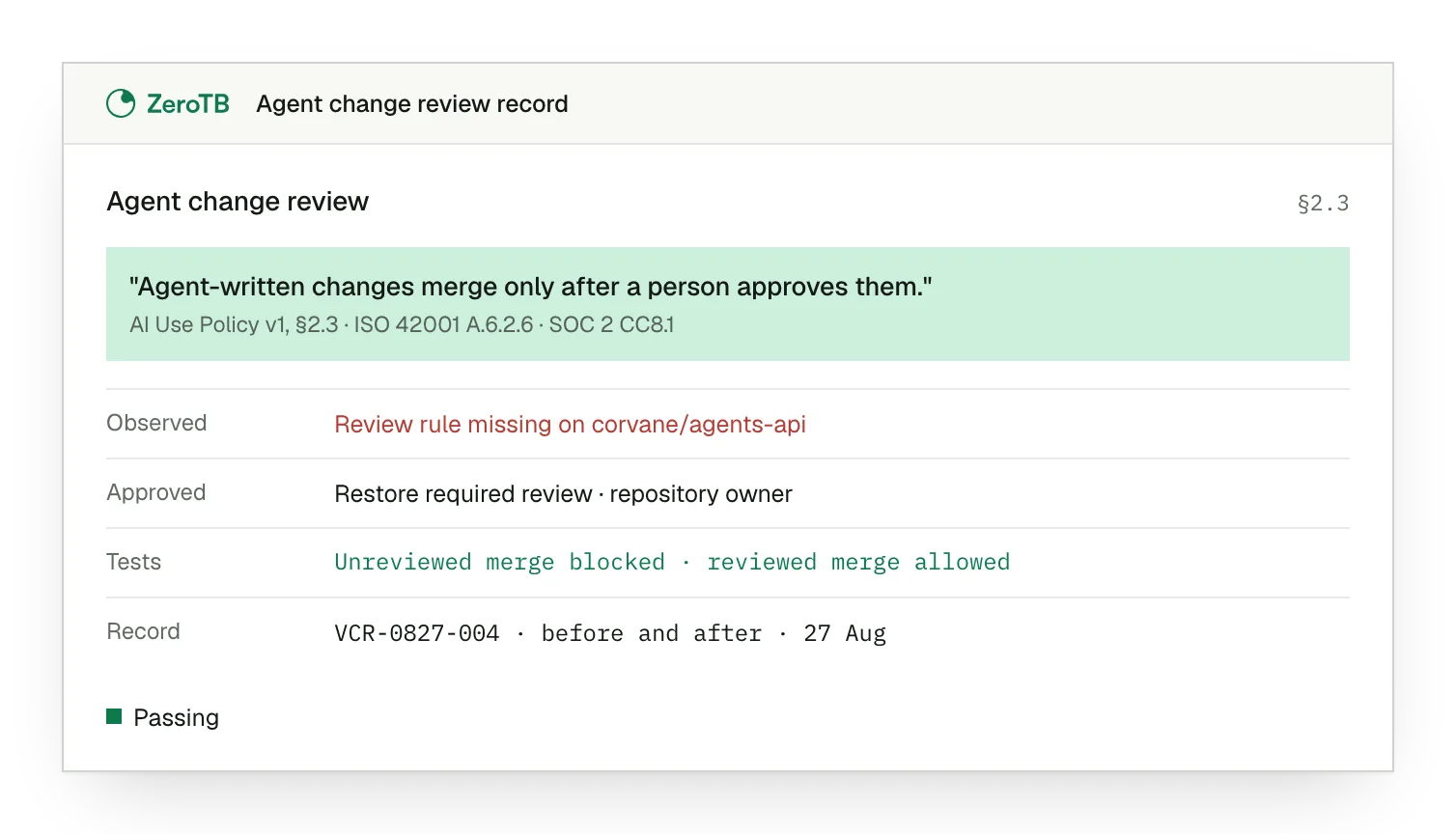
Missing review rule. The policy requires human approval, but the observed setting allows the agent's changes through without it.
Approved rule repair. A proposed correction restores the requirement after the repository owner reviews and approves the change.
Verified merge behavior. An unreviewed change is blocked in testing, and a change with the required approval proceeds.
Retained control evidence. The Verified Control Record holds the original gap, approved correction and results beside the commitment.
AI governance review checklist
Compare approved AI uses with observed accounts, credentials and activity, including the repositories and data each agent can reach.
Identify applicable obligations and select the framework outcomes that address the risks and assurance needed for the use.
Check each mapping for a defined control, owner, pass condition and current observation from the system it covers.
Establish who investigates a failed check, who approves a correction and which tests will demonstrate that it worked.
Confirm that new permissions, changed uses and approved exceptions enter the review process with evidence of the resulting decisions.
Sources
- NIST, AI Risk Management Framework, 2023, current overview accessed November 4, 2026.
- NIST, AI RMF Core, AI RMF 1.0, 2023.
- ISO, ISO/IEC 42001:2023, 2023.
- AIUC-1, About AIUC-1, accessed November 4, 2026.
- European Commission, AI Act overview, accessed November 4, 2026.
Related pages
AI governance
See how approved AI requirements connect to control checks, responsible owners and verified repairs across company systems.
Coding-agent compliance
Explore the access and change controls affected when coding agents modify repositories, workflows and infrastructure.
Control evidence
Examine the record that connects a restored control to the approved action and verification results.
Start with the Pilot
Talk with our team about the controls affected by AI use. The eight-week Pilot maps up to 25 commitments and takes two real control gaps through verified restoration, with records of the approved changes and their results.