Home / Organizational controls
What does ISO 27001 A.5.13 require for labelling information?
ISO 27001 A.5.13 concerns labelling information so its classification is clear to those handling it. The organization's classification scheme determines what the labels mean and where they belong. A review should follow information through copies and exports, because a label visible to the author may be missing from the recipient's file.
Opening the exported file is often the useful starting point. Does it still carry the classification shown in the original application? If that marking has disappeared, inspect the operation that produced the file before choosing a correction. The next export needs to carry it too.
Classification decisions
A useful label expresses a classification decision that the information owner can explain. The organization's scheme gives that label its meaning and connects it to handling rules. Applying a label therefore starts with knowing which classification belongs to the information.
An unclear classification needs an owner decision before anyone changes the marking. Otherwise, a technically successful repair can spread the wrong instruction across copies. The agreed classification gives the person correcting the document or system a clear result to work toward.
Labels across formats
The same classification may need different labels in different formats. People reading a document need to see its marking; a system may store the classification in a field. Once the document is printed, its meaning must still be clear on the paper.
A labelling procedure explains how to apply those labels and where each should appear. Staff can refer to it when they create or handle information. During a review, the procedure also gives the reviewer something specific to compare with documents, records and printed copies.
Label visibility across applications and formats
A label succeeds when the intended recipient can recognize its meaning. The view in the author's application does not establish what a recipient sees elsewhere. The review needs to include the application, account and format through which that recipient reaches the information.
For example, Microsoft's Office guidance explains that sensitivity-label display depends on tenant membership; guests do not see those labels in their apps. A visible document marking and stored label metadata serve different purposes. Test the form of communication the recipient will use.
Export failures
An export can preserve every figure in a report and still lose its classification. The source system shows the marking, so the omission may escape the person producing the report. It becomes apparent when someone opens the downloaded file on its own.
Adding the marking to that file corrects one copy. The next export will need the same treatment unless the template or process is repaired. Checking related copies helps establish how far the failure extends and whether different formats need separate changes.
Labels and protection
A label can communicate a handling rule without enforcing it. The reader may see that a document is sensitive and still be able to copy or share it. Restrictions depend on the settings that apply to the information and the operation being attempted.
Microsoft's sensitivity-label documentation describes both markings and encryption settings. When reviewing a repair, check the marking to establish what the recipient sees. If the approved handling rule also calls for restricted access or sharing, a separate test must establish that the restriction works.
Practical exceptions
The labelling procedure needs to account for formats that cannot carry the chosen label. An alternative is acceptable only if the intended user can still understand the classification. Record the limitation and the method used to communicate how that information should be handled.
An instruction accompanying a file may work for its first recipient. It becomes less useful when someone copies the file without that instruction. Inspect this next step with the information owner: the decision is whether the alternative still communicates enough, or the route must change.
Repair responsibilities
The information owner decides the classification; the system owner repairs how it is applied. These decisions may involve different people. Keeping them distinct helps the team resolve the actual gap, whether it comes from an incorrect decision, a missing marking or a changed template.
A proposed correction should identify the affected information, the cause and the expected result. The appropriate owner can then approve the change with its consequences in view. If the change affects protection settings, that decision also needs to account for legitimate access and sharing.
Verification after repair
The repaired process needs to produce an output that passes the original check. After a template change, generate a fresh export and open it as the recipient would. The result should show the classification in the place and form the procedure specifies.
Keep the date and result of that test with the change record. An unavailable output leaves the result unknown; a missing marking leaves the repair unfinished. Where the change also affects a handling restriction, record its test result before closing that part of the work.
Continuing checks
Include the label check when a template, application or export route changes. A repair can work today and disappear with the next revision. Whoever owns the route needs a way to learn that the check failed and to see the output that failed it.
A missing result also needs attention, since it leaves the current state unknown. In ZeroTB's approach to control restoration, observations remain linked to the commitment and any approved correction. That connection gives the reviewer a record of the work still awaiting a verified result.
Repair evidence
The evidence should let a reviewer follow the repair without reopening the investigation. Start with the rule and the output that failed it, then retain the approval and retest. Use protection or redaction where the files contain information the reviewer does not need to see.
A redacted copy should still show the classification marking and enough context to identify the tested output. Keep the format and test result clear, so the reviewer can understand what passed without seeing sensitive content unrelated to the labelling check.
Evidence for a labelling review
A labelling review follows the classification decision through to a tested output, using records such as these.
| Requirement | What an auditor asks for | Where it comes from |
|---|---|---|
| Agreed classification | The owner's classification decision and the label used to express it | The approved scheme and the record of the owner's decision |
| Consistent labelling | Samples showing where the agreed marking appears in each relevant format | The procedure, document templates and files produced from them |
| Defined exceptions | An explanation of the limitation and how the recipient learns the classification | The exception record and a sample showing the alternative in use |
| Approved repair | The missing or incorrect label and the change approved to correct it | The failed output and the change record, including its approval |
| Verified result | The new output and the result of inspecting it as the recipient | The dated retest linked to the Verified Control Record |
Related framework controls
| Framework | Control | What it covers |
|---|---|---|
| ISO 27001 | A.5.13 | The labelling procedure and how information carries its classification to users |
| SOC 2 | CC6.1 | Logical access to information and systems, with permissions assessed separately from the label |
| HIPAA | 164.308(a)(4) | A regulated entity's policies and procedures for authorizing access to electronic protected health information |
Example of restoring an export label
The recipient's copy is the test of this repair. Here, a report has a sensitivity marking in its source application, but the exported PDF has none. After the owner approves a template change, another export shows whether the marking reaches the PDF.
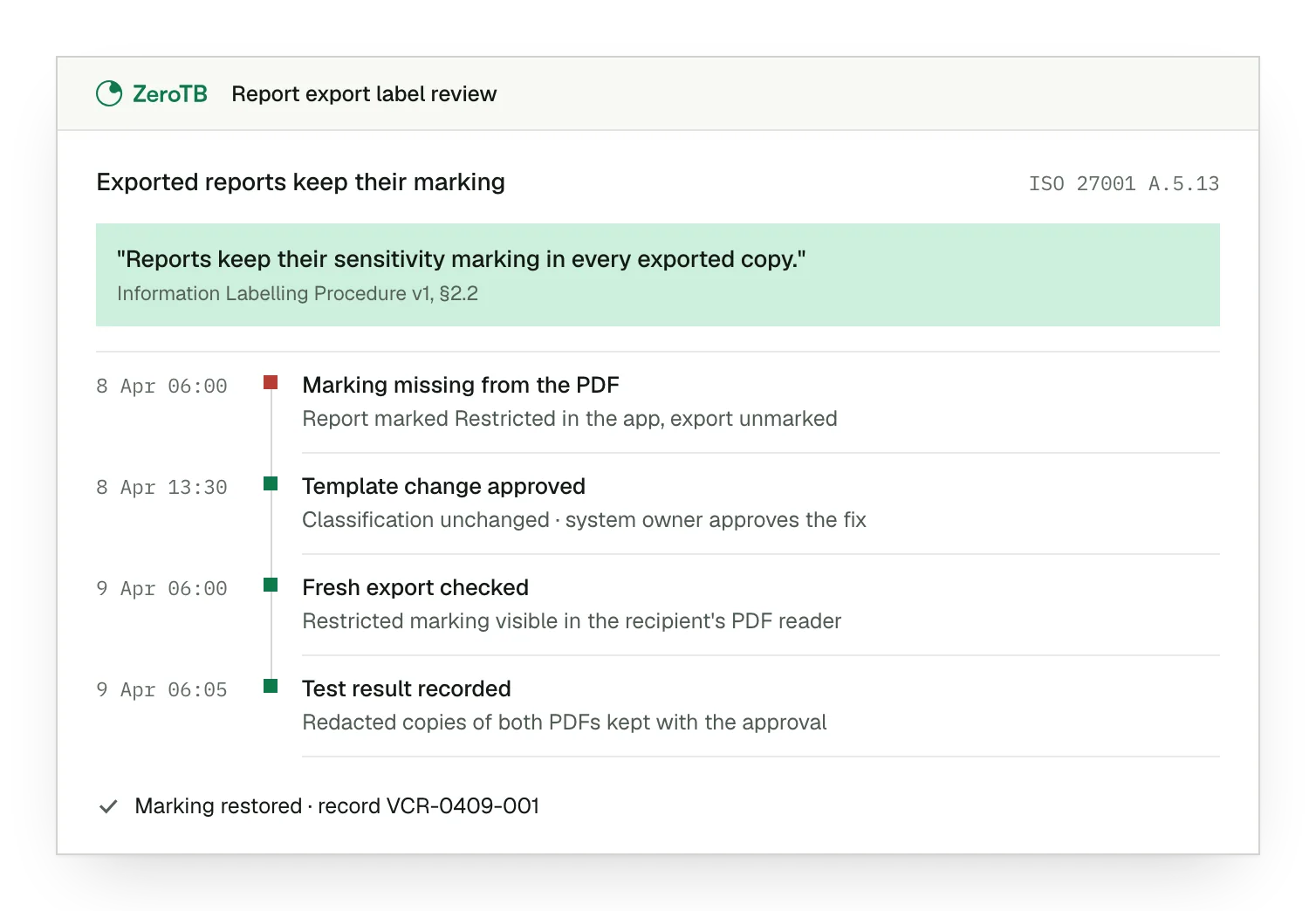
Missing report marking. The report has a sensitivity marking in the application, which is missing from the PDF.
Approved template change. The classification decision remains unchanged, and the system owner approves a correction to the export template.
Fresh output checked. The next export contains the marking, visible when the PDF is opened in the recipient's reading application.
Recorded test result. Redacted copies of both outputs sit with the change approval and the dated result of the retest.
Labelling review checklist
Establish the information owner's classification decision and the handling instructions that its label communicates to recipients.
Follow a representative copy or export and check what its recipient can see in the destination application.
Identify the template, process or instruction responsible for the gap, including affected copies and any approved exception.
Repeat the failed operation after approval and correction, then inspect the fresh output against the expected result.
Retain the rule, observations, approval and test result, with an owner responsible for checks when the route changes.
Sources
- ISO, ISO/IEC 27002:2022 control guidance, 2022.
- Microsoft Learn, Manage sensitivity labels in Office apps, accessed November 4, 2026.
- Microsoft Learn, Learn about sensitivity labels, accessed November 4, 2026.
- AICPA & CIMA, Trust Services Criteria, revised points of focus, 2022.
- Electronic Code of Federal Regulations, 45 CFR 164.308: Administrative safeguards, current text accessed November 4, 2026.
Related pages
Organizational controls
Explore the organizational responsibilities that support information handling, access decisions and the operation of security controls.
ISO 27001
Place the labelling control within the wider information security management system and its approach to risk.
Compliance frameworks
Browse the control libraries for related requirements across the frameworks that apply to the information being handled.
Start with the Pilot
Talk with our team about keeping information handling controls working. The eight-week Pilot maps up to 25 commitments and takes two real control gaps through verified restoration, with records of the approved changes and their results.