Home / Organizational controls
How does ISO 27001 A.5.31 address legal, regulatory and contract duties?
ISO 27001 A.5.31 covers the security duties a company has under applicable laws, regulations and contracts, and its approach to meeting them. For each duty, establish where it comes from, who owns it and how the company implements it. Revisit those decisions when the business or its agreements change.
Signing an agreement does not automatically update the procedure used by the team delivering the service. Someone has to identify the changed duty and connect it to that work. This is a practical concern under A.5.31: a company needs to know what it has accepted and how it meets those obligations.
Applicable duties
A.5.31 starts with the information security obligations that apply to the organization's actual work. Its activities, locations, information and agreements shape that scope. A useful review identifies the affected service and explains why the requirement applies to it.
A list of laws alone gives the operator little direction. Connect each source requirement to the work it governs. Record that relationship with the people responsible for interpreting the duty, including any conditions that limit its application to particular services or information.
The obligations register
An operator should be able to use the obligations register to find the source of a requirement. The entry needs enough detail to identify the relevant clause, the service it applies to and the person responsible for its implementation.
Keep the source version and the date of the last review beside the decision. At renewal, those details help a reviewer establish what changed. The register can live in a controlled document or an existing compliance system; its value depends on whether people can follow the connections.
Interpretation and ownership
The person interpreting a duty and the person operating its control need to agree on what implementation means. A legal, regulatory or contract specialist may resolve the wording. The service owner then needs to identify the procedure or system that will meet that requirement.
Before technical work begins, resolve questions that would change the proposed action. An engineer can test whether a setting meets a specified condition, but that test says nothing about an unsettled interpretation. Record the question and who can decide it, alongside the affected work.
Business and agreement changes
Review security duties when an agreement changes, even if the service remains the same. A renewal may alter a requirement that the operating team has followed for years. Unless the amendment reaches that team, the existing procedure can continue without anyone questioning it.
Changes in location, business activity or service scope can create similar gaps. Identify the affected controls during the review and connect the decision to the people responsible for them. The register preserves what was decided; the control owner needs to know which operating work follows from that decision.
Duties in daily operations
To check a duty, the operator needs an agreed description of what should happen in practice. An incident communication requirement, for instance, has a trigger, a recipient and a route for sending the notice. Those details belong with the procedure used by the incident owner.
A reviewer can inspect the procedure and use a controlled exercise to see whether the handoff works. This produces evidence about the agreed requirement in operation. Other duties may call for system observations or a human review; choose evidence that answers the question the particular duty raises.
Conflicting requirements
When two requirements appear to conflict, the operator needs a decision before changing the control. Give the responsible specialist both source references and the circumstances in which they apply. The question is what action meets the applicable duties in that situation.
Keep the decision and any remaining work with the issue. An internal exception records the organization's response; it cannot by itself change an external obligation. If interpretation remains unresolved, describe which implementation decision depends on it so completed technical work does not obscure the open question.
Approved corrections
An agreed requirement gives the team a basis for correcting the control. Compare the actual operation with that requirement and propose a change for the responsible person to approve. After the authorized action, verify the result against the requirement and retain the evidence before closing the gap.
This is the operating work ZeroTB supports: checks against systems, a drafted fix and verification of the authorized change. Its Verified Control Record keeps the commitment, before-and-after state, action, approval and verification together. That work follows the approved interpretation of the duty.
Evidence after a correction
Keep the reason for a correction with the evidence of its result. A later reviewer needs to know which duty the team was addressing and why the owner accepted the change. The source reference and approved interpretation provide that context for the operating evidence.
The verification record also needs to say what was tested. An exercise may establish that an incident notice reached the intended contact under specified conditions. Someone reviewing another duty can then judge whether that result is relevant, and what further evidence the separate assessment needs.
Ongoing review
The review schedule should follow changes in obligations and the systems that implement them. Agree a regular review with the responsible owners, and include checks after relevant contract, service or system changes. A calendar review alone can miss a duty that changes between scheduled meetings.
Review the quality of observations too. A disconnected system or an outdated procedure may leave the operator unable to establish the current state. Ask the responsible owner to investigate the missing evidence. Retain the last supported result with its date so the reviewer can see what remains unknown.
Audit evidence
Use these records to follow an applicable duty from its source through implementation and review.
| Requirement | What an auditor asks for | Where it comes from |
|---|---|---|
| Applicable duties | Sources and decisions identifying which information security obligations apply to the organization | The obligations register, relevant agreements and legal or regulatory references |
| Assigned responsibility | The owner of each duty and the control or procedure that implements it | Approved responsibilities linked to the register and operating procedures |
| Current requirements | Reviews showing how changed agreements or activities affected the requirements in force | Contract amendments, change reviews and dated register revisions |
| Implemented controls | Evidence that the affected systems or procedures meet the approved requirement | System observations, procedure reviews or controlled exercises appropriate to the duty |
| Verified corrections | The gap, authorized action and results supporting the decision to close it | Change approvals and dated verification linked to the source obligation |
Framework relationships
| Framework | Control | What it covers |
|---|---|---|
| ISO 27001 | A.5.31 | Which security duties apply, where they come from and how the organization meets them |
| SOC 2 | CC3.2 | Identifying and analyzing risks to objectives; a missed obligation may be relevant to that analysis |
| HIPAA | 164.308(a)(1) | The security management process, including analysis and management of risks to electronic protected health information |
Example of restoring an incident escalation
The agreement in this example names a new contact for incident notices. The procedure still points to the previous recipient. Correcting that mismatch requires the owner to confirm the amended duty, approve the new route and test the procedure before accepting it as working.
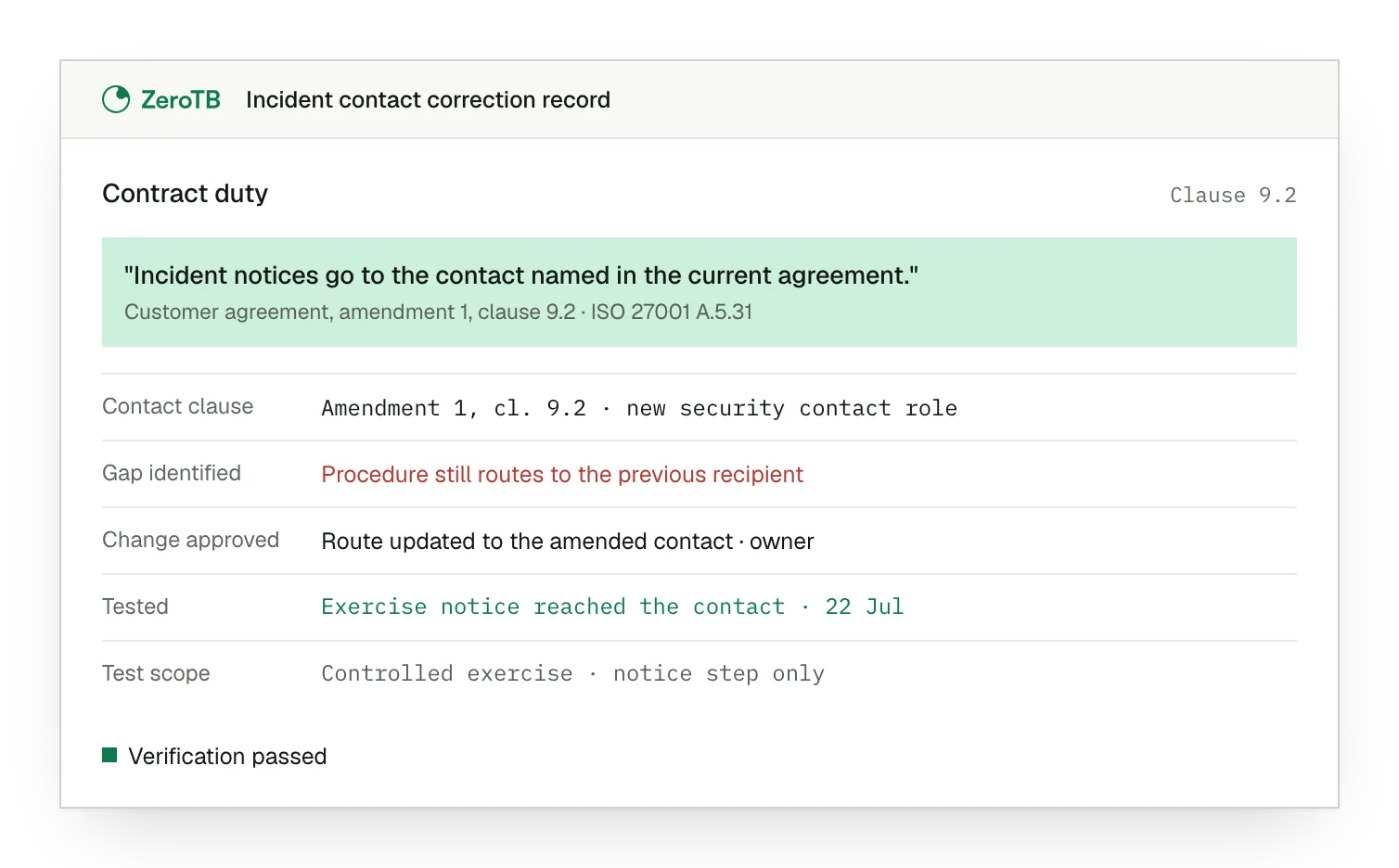
Changed contact. The contact clause in the amended agreement identifies who should receive incident notices.
Outdated route. The procedure used by the incident owner still points to the previous recipient.
Approved correction. The owner confirms the amended duty applies, then approves the change to the route.
Tested delivery. The controlled exercise follows the revised procedure and confirms that the notice reaches the intended recipient.
Obligations review checklist
Find the authoritative source and clause, then identify the service or information to which the duty applies.
Confirm the operational requirement with the responsible specialist and identify any unanswered question that affects implementation.
Compare the approved requirement with the affected procedure or system, using evidence that shows its current state.
Identify the action and approving owner, including how the result will be tested after the change.
Retain the source, decision, approval and verification together, with responsibility for reviewing future changes to the duty.
Sources
- ISO, ISO/IEC 27001:2022, 2022: information security management system requirements.
- ISO, ISO/IEC 27002:2022, 2022: information security control guidance.
- AICPA & CIMA, Trust Services Criteria with revised points of focus, 2022 revision.
- HHS, Guidance on risk analysis, 2010.
Related pages
Organizational controls
Explore the organizational controls that connect security responsibilities with the way the business operates.
ISO 27001
Read how individual controls support the wider information security management system and its ongoing operation.
Compliance frameworks
Find guidance for the other frameworks that shape your organization's security commitments and controls.
Start with the Pilot
Talk with our team about the duties behind your controls. The eight-week Pilot maps up to 25 commitments and takes two real control gaps through approved correction and verified restoration, with a record of each completed fix.