Home / Organizational controls
How does ISO 27001 A.5.27 support learning from incidents?
ISO 27001 A.5.27 uses learning from information security incidents to improve controls. A review needs to examine what caused the incident and how detection and response worked. For each material finding, decide what needs to change, who will change it and how to test the result.
The incident is over, but several actions from the review remain open. Some describe a precise correction; others say little about what completion would mean. A.5.27, one of the organizational controls, addresses how the organization uses that experience to improve security.
Incident learning
A.5.27 connects the review of an information security incident to improvements in the controls that protect the organization. The review examines why the incident occurred, how the team detected it and how the response worked. Each dimension can reveal a different improvement.
That improvement may affect a system setting, an operating procedure, a responsibility or training. A new policy is useful when the existing rule needs to change. Where the rule already describes the intended practice, the work may instead involve making that practice operate consistently.
Review timing
Useful lessons can reach the responsible teams while incident response is still underway. The team may already know about a gap that needs attention. NIST's incident response guidance recommends sharing lessons as they are identified, with a review as recovery draws to a close.
At that review, participants can examine the response and any corrections already made. Arrange it while they can still explain their decisions and find the records behind them. Give unanswered questions to someone who can investigate, and agree when the team will consider the findings.
Causes and response gaps
The review should explain both how the incident happened and how well the response limited its effects. Start with the event sequence and the information available at each decision. This helps distinguish a weakness in a control from a delay in recognizing or escalating the incident.
Examine which protections worked as well as which failed. A successful response step may belong in another team's procedure. Where the evidence cannot establish a cause, retain the uncertainty and the next investigation action. An assumed cause can send corrective work toward the wrong condition.
Specific improvements
Each material finding needs an action that changes the condition behind it. Consider the instruction "improve offboarding": the person receiving it still has to establish what went wrong. The review should identify the missing step and the change needed to include it in future departures.
Some findings call for a setting to change; others call for a procedure or responsibility to change. Training can help where people need knowledge to perform the task. Check whether the proposed action covers the whole finding, especially when both the system and the process contributed to it.
Priorities and ownership
Address the greatest remaining risks first and give each action an owner who can carry it through. An exposed access route may need immediate attention, while a wider procedure revision takes longer. Record how the team will manage the risk while that revision remains unfinished.
The action owner needs a clear decision from whoever controls the affected system or process. Where work depends on another team, record the dependency and expected date. Deferred actions need a reason and a review condition so they remain visible after the incident response ends.
Verification criteria
Define the expected result before approving an improvement. With a procedure change, this means deciding which cases the new step covers and what must happen in each case. Agree which record will let a reviewer see that the step occurred.
The owner also needs to consider what must keep working. A correction that removes an unwanted access route must preserve authorized access. Specify how to test both conditions, including any exceptions. The person accepting the work can then compare the result with the decision made before the change.
Tests of effectiveness
A completed change needs a test that addresses the finding it was meant to resolve. For a technical correction, the reviewer can inspect the resulting state. For a procedure, use a representative case and record what happens when the revised steps are followed.
Keep the date, the scope of the test and its result with the action. The reviewer needs all three to judge whether the improvement worked. When the result fails the agreed criteria, leave the action open. An unavailable result also leaves a question to resolve before acceptance.
Continuing control checks
An improvement can stop working when systems, responsibilities or procedures change. Keep an owner for the operating control after the corrective task closes. Choose checks that reflect how often the relevant condition changes, and decide where a failed check goes for attention.
If a similar incident occurs, compare its cause with the earlier review and its test results. The action may have missed part of the original problem, or a later change may have undone it. This distinction also helps explain recurring control findings and directs the next correction.
Shared lessons
A finding in one system can reveal a weakness in a process used elsewhere. Check those other uses before extending the correction. Two applications may use the same departure procedure but require different steps to remove access. Each step needs to suit the application concerned.
Explain the change to the people who will use the revised procedure. They need to understand what to do differently and may need training to do it. Share enough incident detail to explain the reason, and retain the full review for those investigating or assessing the outcome.
Evidence for closure
A reviewer should be able to trace an incident finding through the decision, the change and the result. Keep references between those records so the reviewer can understand why the action was selected. Record outstanding work separately from actions whose results have been verified.
For a control correction, ZeroTB's Verified Control Record connects the commitment, before-and-after state, action, approval and verification. Link that record to the incident finding it addresses. The incident review can then show which improvements have reached an accepted result and which still need attention.
Evidence of incident learning
These records help an auditor see what the team learned and what it did with each finding.
| Requirement | What an auditor asks for | Where it comes from |
|---|---|---|
| Reviewed incident | The cause, response and lessons the review identified | Incident records and the team's review of them |
| Defined improvements | The change chosen for each finding, its owner and intended result | Tasks linked to the incident review |
| Approved changes | The decision to proceed, including reasons for deferring any work | Approvals from the system or process owner |
| Tested results | The test performed and the result the reviewer accepted | Dated system observations or records from testing the procedure |
| Continuing responsibility | Who checks the control now and how failures receive attention | Control ownership, scheduled checks and subsequent failure records |
Related framework requirements
| Framework | Control | What it covers |
|---|---|---|
| ISO 27001 | A.5.27 | Using incident learning to improve security controls and their operation |
| SOC 2 | CC7.5 | Recovery from security incidents, including improvements informed by the response |
| HIPAA | 164.308(a)(6) | Incident response, mitigation and documented outcomes for organizations subject to the Security Rule |
Example of correcting an offboarding gap
A missed application account can expose a gap in the whole departure process. In this example, an incident review finds that the procedure omitted an application. The improvement adds that application to the process and tests account removal during a controlled departure exercise.
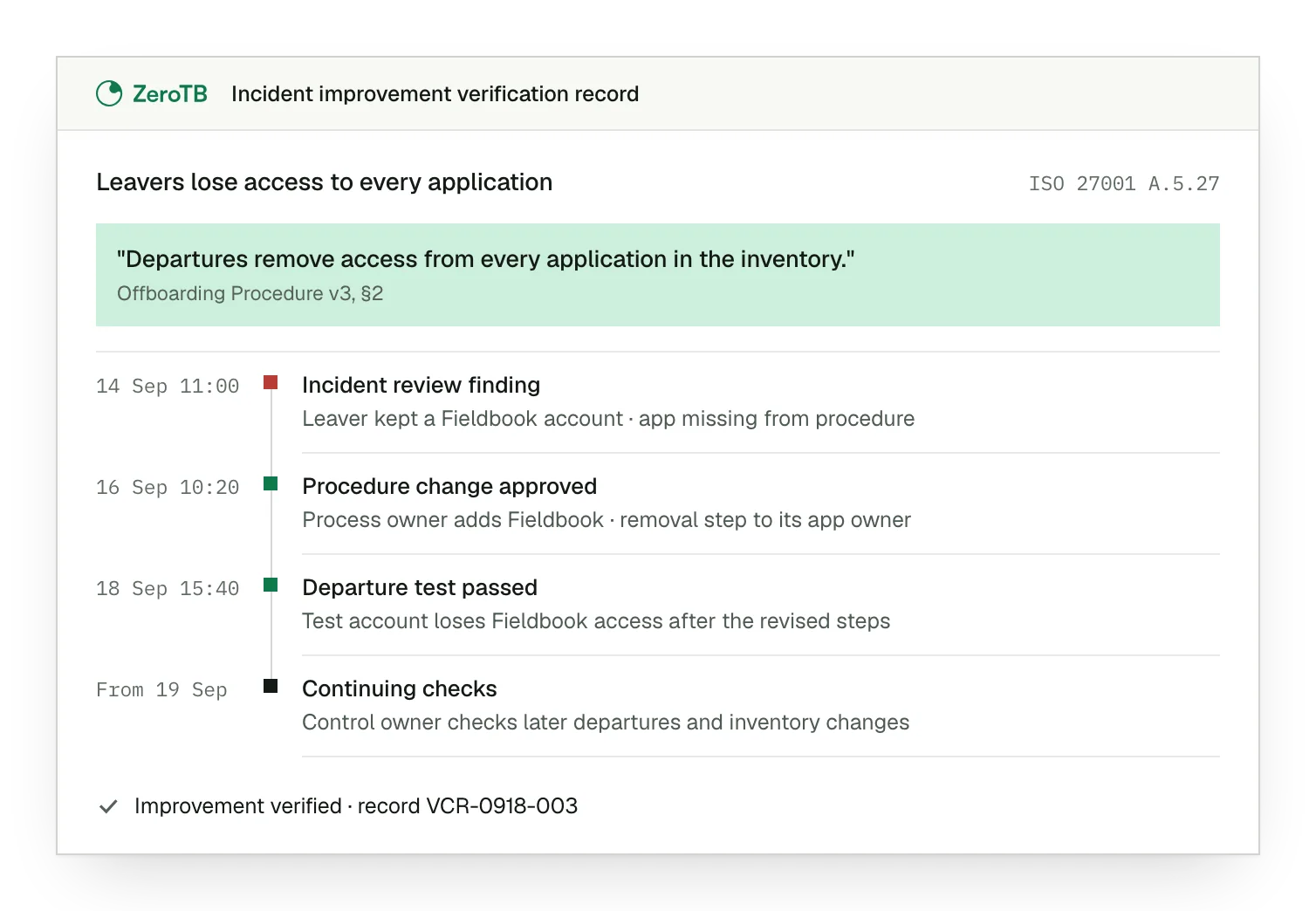
Missed application. The incident review links the retained account to an application absent from the departure procedure.
Approved procedure change. The process owner approves adding the application and assigning its removal step to the application owner.
Tested departure. A test account loses access after the revised procedure runs, with the result dated and retained.
Continuing checks. The control owner checks later departures and reviews the procedure when the application inventory changes.
Incident learning checklist
Select a material review finding and identify the control or process condition that allowed the problem to occur.
Describe what must change and how a reviewer can check that the improvement addresses the finding.
Identify the action owner, approval and dependencies, including how the team will handle risk until completion.
Examine the test result and retain the evidence, with ownership for checks after the corrective task closes.
Sources
- ISO, ISO/IEC 27002:2022 control guidance, 2022.
- NIST, SP 800-61r3 incident response recommendations, 2025, review timing and lessons learned.
- AICPA & CIMA, Trust Services Criteria, 2022 revision, related SOC 2 criteria.
- HHS, HIPAA audit protocol, 2018 update, security incident procedures.
Related pages
ISO 27001
Read how the individual controls fit within an organization's information security management system.
Compliance frameworks
Browse guidance for the other frameworks and follow the links between related control requirements.
Recurring findings
Read why a corrected gap can appear again and what to examine when it does.
Start with the Pilot
Talk with our team about keeping incident improvements working. The Pilot covers eight weeks: we map up to 25 commitments and take two real control gaps through approved correction and verified restoration. You receive records of that work and its results.