Home / Organizational controls
What does ISO 27001 A.5.14 require for information transfer?
ISO 27001 A.5.14 concerns how an organization protects information it transfers internally or to others. Rules and agreements define what may be sent, who may receive it and how it will be protected. Keep those arrangements effective by reviewing changes to recipients, delivery methods and access.
A recipient may confirm that a report arrived without knowing who else could open its link. Reviewing the exchange means checking both the delivery and the access it allowed. The transfer agreement supplies the conditions against which to judge those observations.
Transfer scope
A transfer rule needs to identify the information, its approved recipients and the route used to reach them. Include exchanges between internal teams as well as those with outside organizations. The information's sensitivity helps determine which protections belong in that rule.
For a recurring exchange, record the purpose and the information that may be sent. This gives the reviewer a specific agreement to compare with actual deliveries. A later change in the report's contents can then receive the same attention as a change in destination.
Protection for the exchange
The transfer method should protect the information for the whole exchange. Consider who can access it while it moves and when it reaches its destination. The approved arrangement should make the required protection clear enough for the people operating that method to check.
A protected connection can still deliver information to the wrong person. Recipient checks and protection of the route address different risks. Review them together before accepting a delivery method, including whether the intended recipient can receive and use the information through that method.
Transfer responsibilities
A transfer arrangement needs an owner for errors as well as approval. Someone has to investigate when a report arrives late, goes to the wrong address or cannot be opened. The arrangement should identify who can authorize the exchange and confirm receipt when required.
When another organization handles the information, a written agreement can make each party's responsibilities clear. It should also give the people operating the transfer somewhere to refer a problem. A change to those responsibilities needs review by the people responsible for the agreement.
Recipient authorization
A new recipient needs review against the agreement that permits the transfer. The original approval might cover a particular organization or receiving group. Sending the same report through the same service does not establish that a different recipient falls within that approval.
For shared locations, the receiving group can grow while the destination stays unchanged. Look at who can retrieve the information there, including any members added since approval. The owner can use that comparison to decide whether the group still matches the recipients covered by the agreement.
Changes after approval
An unchanged report can acquire a different risk when someone changes how it is sent. Replacing an approved delivery service with a broadly accessible link is one example. The content and recipient may stay the same while the new method permits wider access.
Treat the changed method as a decision to review. Compare its permissions and protection with the agreed arrangement, then establish what must change before further use. Record the owner's decision and the test results so future reviewers can see why the replacement was accepted.
Evidence of current operation
The evidence for a transfer needs to describe its current route. Earlier setup records remain useful for understanding the decision, but they may describe permissions that have since changed. Check the settings and delivery records that apply to the exchange under review.
If a setting is unavailable or a test cannot run, explain what that prevents the reviewer from establishing. It might leave recipient access unresolved, for example. Give the unresolved question an owner and retain it until an observation supports a decision about the transfer.
Exposure and incident response
Information may already have reached an unintended recipient by the time a transfer gap is found. Establish what moved and who could receive it, then refer possible exposure through the incident process. The responsible team can assess those exchanges while the route is corrected.
Keep the earlier delivery records and observations available to that team. Restricting access now can prevent further exposure, but a successful test of the repaired route cannot explain past use. Record the incident assessment separately so the repair's completion does not obscure an unfinished investigation.
Approved corrections
Approval of a correction depends on knowing how it will affect the intended delivery. Set out the recipient and method that should remain available, followed by the permissions or workflow that need changing. The owner can then assess the proposed action against the transfer agreement.
The person who owns that agreement may need a system owner to make the change. ZeroTB's control restoration process connects the commitment and observed state with a proposed fix. People authorize material actions; a check of the resulting state determines whether the gap can close.
Verification before closure
Verification needs to show that approved delivery works and unintended access has been addressed. Test the corrected route using suitable information, with the expected results agreed beforehand. Confirm that the intended recipient can use the information and that the unwanted access path is closed.
If either result is missing, keep the gap open for further work. A changed setting is useful evidence, but the test explains what that change achieved. Record the result and its date with the approval so the reviewer can judge whether the correction met its purpose.
Records for future reviews
The next reviewer needs enough history to understand why a transfer was accepted. Keep the rule or agreement with its authorization, relevant delivery details and evidence of protection. The record should answer what was allowed and how the exchange met the conditions attached to it.
Avoid collecting another sensitive report merely to demonstrate that it was sent. For corrections, a Verified Control Record connects the gap, action, approval and verification result. That history helps a later reviewer distinguish evidence about the current route from decisions made before it changed.
Transfer evidence
These records help a reviewer compare the exchange that was authorized with the one that took place.
| Requirement | What an auditor asks for | Where it comes from |
|---|---|---|
| Defined exchange | The permitted information, recipients and method for the transfer | The approved rule, together with any agreement governing the exchange |
| Recipient authorization | Approval for the people who can receive or retrieve the information | Recipient decisions and the delivery location's current access records |
| Applied protection | The protection applied to the information on its actual route | The method's settings, permissions and records of relevant deliveries |
| Assigned responsibilities | Responsibility for authorizing transfers, confirming receipt and handling errors | The procedures and agreements used by the sending and receiving parties |
| Verified correction | Evidence that the approved repair preserved delivery and removed unwanted access | The original observation, change approval and results of testing the repaired route |
Related framework requirements
| Framework | Control | What it covers |
|---|---|---|
| ISO 27001 | A.5.14 | Transfer arrangements and protection of information exchanged inside or outside the organization |
| SOC 2 | CC6.7 | Protection and restriction of information as it crosses the boundaries of a system |
| HIPAA | 164.312(e)(1) | Safeguards against unauthorized access to electronic protected health information while it is transmitted |
Example of restoring a restricted transfer
A permission change can restore the agreed audience for a recurring report. Here, the report has moved to a shared link with broader access than its transfer agreement permits. The owner approves restricting that link, and testing confirms that the intended recipients retain access.
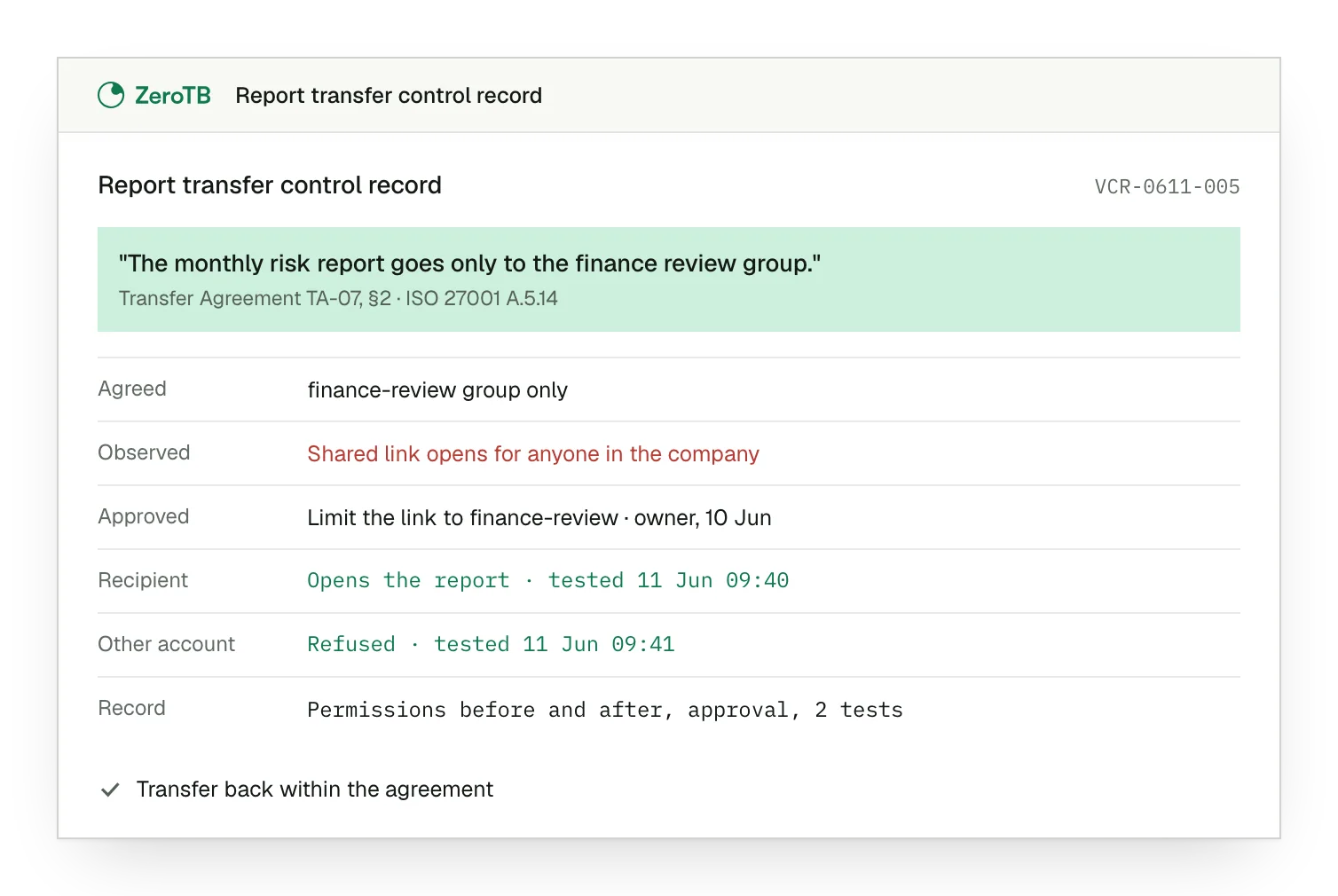
Broader access. The agreement permits one receiving group, but the observed link allows other people to open the report.
Approved restriction. The owner approves limiting the link to the receiving group specified in the agreement.
Delivery tested. The test confirms that the recipient can open the report and an unapproved account cannot.
Closure recorded. Before-and-after permissions, the approval and both test results explain why the gap was closed.
Transfer review checklist
Establish which information, recipients and delivery method the agreement covers, including the responsibilities attached to the exchange.
Examine the route in use and compare the people who can retrieve its contents with the agreed recipients.
Route possible exposure through the incident process and obtain approval for a change that preserves required delivery.
Test delivery to an intended recipient and confirm that the unwanted access path has been closed.
Save the approval with the observations and results, avoiding additional sensitive copies kept only to demonstrate delivery.
Sources
- ISO, ISO/IEC 27001:2022, 2022, information security management system requirements.
- ISO, ISO/IEC 27002:2022, 2022, guidance on information security controls, including information transfer.
- AICPA & CIMA, Trust Services Criteria with revised points of focus, 2022 revision, including CC6.7.
- HHS, Transmission of electronic protected health information, reviewed July 2013, transmission security guidance.
Related pages
Organizational controls
Browse the controls that assign responsibilities and set rules for how an organization handles information.
ISO 27001
Read about the management system within which transfer rules are selected, maintained and reviewed.
Compliance frameworks
Use the framework library to find other requirements relevant to the information and systems in scope.
Start with the Pilot
Talk with our team about the transfers that concern you. The eight-week Pilot maps up to 25 commitments and takes two real control gaps through approved correction and verified restoration, with a record of each completed fix.