AI governance solutions control and record AI use
AI governance solutions include AI governance tools and services that find uses, enforce policy and keep evidence. ZeroTB maintains SOC 2 controls in the systems coding agents change.
Serve audited companies. We support US software, AI, fintech and healthtech companies with 25 to 250 people
Maintain framework commitments. Our work covers SOC 2, ISO 27001 and HIPAA after the first audit
Check connected systems. We read GitHub, AWS, Google Workspace, identity providers and endpoints
An approved coding agent works under the repository permissions and release settings each team connects it to.
AI governance challenges start once agents are approved
AI governance challenges continue after approval: a repository loses required review, another starts without protection, or an account gains permissions the approval never covered.
Compliance interprets the requirement, engineering controls the repository and security reviews access. The gap can pass between them.
AI governance software checks systems against AI policy
AI governance software tests the conditions an AI use policy describes, such as required repository review. The policy sets permitted work and exception owners.
The NIST AI RMF treats risk management as work throughout an AI system's life. AI governance frameworks covers that wider program.
AI governance tools differ by what they control
AI governance tools cover distinct jobs. AI governance platforms may bundle several, from finding shadow AI to restricting an agent's next action.
| Task | AI inventory and shadow AI discovery | Policy and risk workflows | Runtime guardrails | Data classification and DLP | ZeroTB |
|---|---|---|---|---|---|
| What it controls | AI tools in use and their owners | Assessments and approvals of AI uses | Actions agents can take at run time | Sensitive data reaching AI tools | SOC 2 controls in repositories, cloud and accounts |
| When it acts | When a new AI tool appears | Before a use is approved | On each request or action | When data moves | Daily checks and repair of each gap |
| What a reviewer reads | An inventory of uses and owners | Risk assessments and decisions | Logs of allowed and blocked actions | Data policy events | A signed Verified Control Record per repair |
| Fits when | AI use is unknown | Uses need sign-off | Agents need limits on actions | Sensitive data reaches AI tools | SOC 2 controls drift as agents change systems |
Start with inventory and owners when AI use is unknown. Once uses are recorded, establish who repairs failed controls.
Agentic AI governance limits permissions and approves changes
Agentic AI governance starts with what connected tools permit. Reading a repository requires different authority from merging code or changing access.
OWASP excessive agency guidance calls for limits and human approval of the system, action and expected result. Owners decide exceptions.
AI agent governance records link actions to approvals
AI agent governance needs an audit trail linking actions to approvals and resulting states. Test claims to record every change.
Check repository actions, identities, resources, local commands and connected services. New repositories can escape scope. Unknown, stale and disconnected checks remain visible.
ZeroTB repairs the controls that agents break
ZeroTB restores SOC 2 controls through daily checks, repairs, human approval and verification. Checks examine systems without connecting to coding agents.
Runbooks, pull requests, API actions or guardrails address recurring gaps. The signed Verified Control Record keeps commitments, before-and-after states, actions, approvals and verification together.
Example of restoring required review
This example follows a repository used by coding agents after required review disappears. The record shows the approved correction and the check that follows.
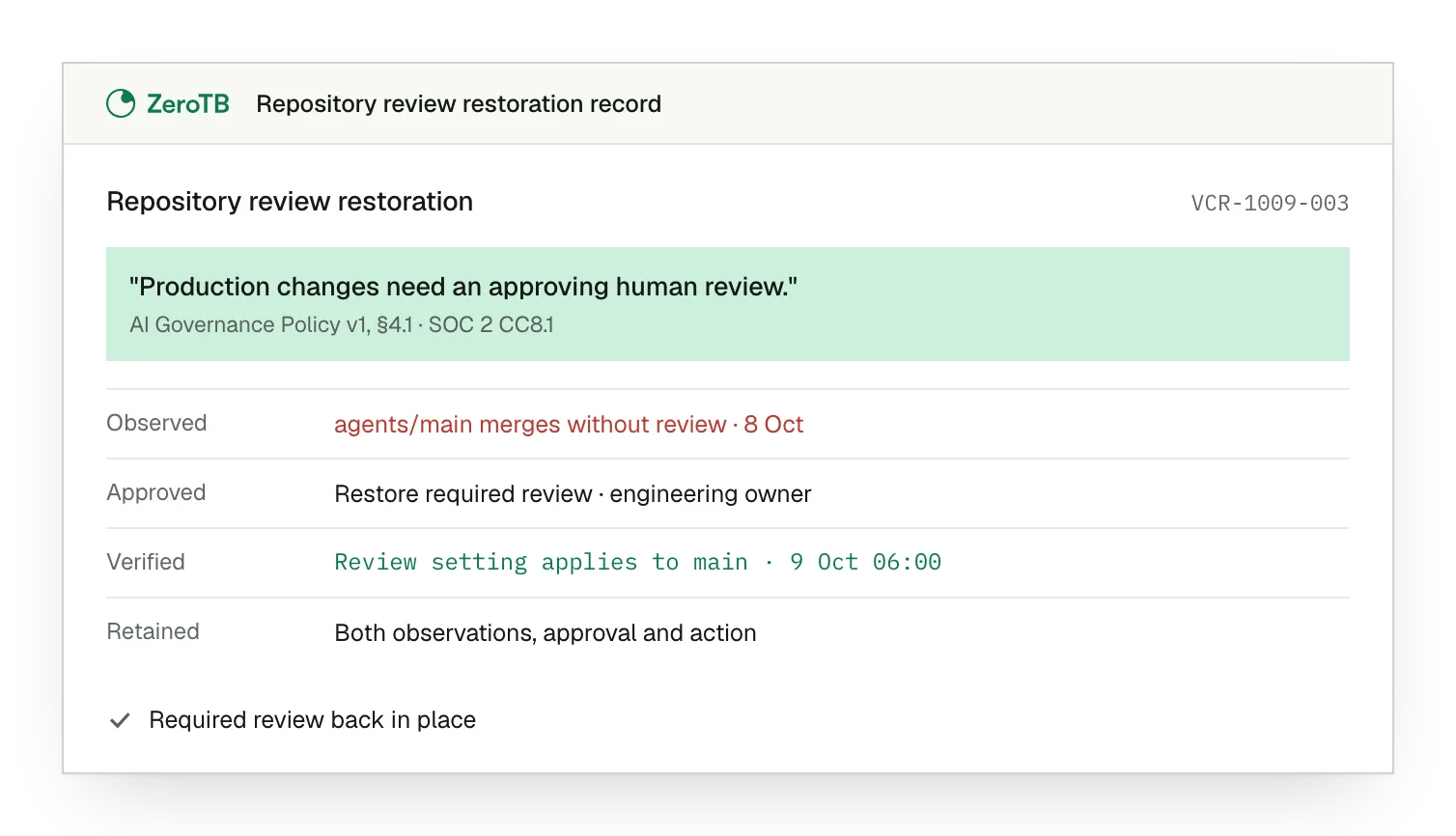
Observed review gap. Changes can pass without the review required for production changes.
Approved correction. The engineering owner approves restoring required review on the branch.
Verified review setting. A later check confirms that the setting applies to the branch.
Retained repair evidence. The record keeps both observations, the approval and the completed action.
Test each vendor on one SOC 2 commitment
Follow a SOC 2 commitment already held, such as reviewing production changes.
Ask the vendor to test the repositories coding agents use.
Establish who investigates, drafts the repair and checks the result.
Confirm that approval covers the specific action about to happen.
Read the requirement, observations, approved action and later check together.
Sources
- NIST, AI Risk Management Framework Core, 2023.
- OWASP, LLM06:2025 Excessive Agency, 2025.
- ZeroTB, Control operations and verified restoration, 2026.
FAQ
What is the difference between AI governance tools and an AI governance platform?
AI governance tools cover individual jobs such as inventory, risk decisions, runtime limits or data protection. An AI governance platform bundles several of those capabilities.
What does AI governance compliance mean for a SOC 2 company?
AI governance compliance means SOC 2 commitments still hold as coding agents change repositories, cloud settings and access. AI governance frameworks explains the wider program, including NIST AI RMF.
Is ZeroTB an AI governance platform?
ZeroTB combines software and a team to maintain SOC 2, ISO 27001 and HIPAA controls after audits. Inventory and runtime guardrail tools cover other AI governance jobs.
Does ZeroTB connect to our coding agents?
ZeroTB connects to no coding agent. ZeroTB checks the systems agents change: GitHub, AWS, Google Workspace, identity providers and endpoints.
What access does ZeroTB need to our repositories and cloud accounts?
ZeroTB starts read-only. Write access is scoped by action class and revocable. Your team reviews material changes as pull requests. Direct API actions are opt-in and reversible.
Start with the Pilot
The eight-week Pilot maps up to 25 commitments and restores two real control gaps, with verified results and signed records.