GRC stands for governance, risk and compliance. It connects the decisions a company makes, the risks it faces and the obligations it must meet. In a software company, a useful GRC program connects those decisions to operating controls, with clear responsibility for correcting failures and checking the result.
An access-removal ticket says "done," but the account still works. Compliance has a record of completion while the application still permits access. That gap matters to both teams. Their GRC program needs a way to detect it and carry the correction through.
The three parts of GRC
Governance establishes who decides, risk management examines what could affect the company's objectives, and compliance addresses its obligations. The three activities inform one another. OCEG's definition of GRC brings them together as capabilities that help an organization achieve its objectives responsibly.
Changing access to customer data involves all three. Someone has authority to approve the change, someone considers the exposure, and someone identifies the requirements. With those decisions recorded together, the system owner can understand why access should be retained, restricted or removed.
GRC frameworks
A GRC framework organizes the relationships between objectives, risks, requirements and controls. OCEG's Capability Model uses four activities: Learn, Align, Perform and Review. They cover understanding the organization, connecting decisions to its objectives, taking action and reviewing whether the approach works.
A practical test is whether a new owner can follow a control back to its requirement and forward to its evidence. The record should explain who is responsible and what the control protects. Otherwise, the new owner must reconstruct that context from earlier discussions.
Information security governance
Information security governance establishes authority over security priorities, resources and accepted risks. A security team uses those decisions to define requirements, while engineering and IT apply them. The arrangement needs to identify who can authorize a change when an operational need conflicts with a rule.
An exception records that decision: the reason, affected scope, approver, safeguards and conditions for review. The next owner should be able to understand why it was allowed. A temporary need can then be reconsidered when the circumstances that justified it change.
Shared controls across frameworks
One GRC program can hold the company's SOC 2, ISO 27001 and HIPAA requirements. Where their scope overlaps, a shared control may support several of them. An access review can therefore produce evidence relevant to more than one part of the program.
Keep the mappings in a common control library, with links to the evidence for each requirement. Reviewers can then see what the shared control covers. They still need to check whether its observations establish the required result or whether another check is necessary.
Control descriptions for system checks
A useful control description tells its owner what must be true in the system. If company data requires an approved work account, the check needs to cover the applications and login routes that expose it. An unchecked local login could leave that requirement unenforced.
The requirement comes from the company's policies, reports or contracts, and its owner approves the interpretation. Observations then show whether systems meet it. If a connection fails or the evidence becomes stale, the status needs to show what is still unknown.
Risk and compliance management
Risk and compliance management can generate more tickets than a team can resolve when findings arrive without a clear response path. Examine the queue for repeated reports of the same gap. Linking those reports can let an engineer investigate one correction while retaining each finding.
The engineer needs the observed failure, expected result and approval route. The requirement, exposure and consequences of delay help establish priority. If a ticket repeatedly waits for a decision, the program needs to address that waiting time as part of resolving the gap.
Verified closure
An approved change needs a result check before the finding closes. If the correction removes an account, testing must establish that the account can no longer gain access. It must also check that the access needed by other users still works.
Keep the requirement and before-and-after observations with the action, approval and verification result. Another reviewer can use them to assess the closure decision without asking the engineer to reconstruct the work. A failed or unavailable check leaves the finding open with its status recorded.
Ownership between audits
Control ownership continues after a finding closes. New applications, repositories and permissions can change which systems a control reaches. An owner needs responsibility for those changes as well as the original repair, so checks continue to cover the systems as they change.
The checking schedule should reflect how often the underlying condition can change and the consequences of a missed failure. Continuous control monitoring supports that continuing work. Repeated failures also provide a reason to examine whether new systems receive the required settings when they are created.
When to use GRC software
A spreadsheet may be enough while a program has clear owners and a manageable set of records. The case for software grows when people cannot reliably find the current evidence or decision. Separate copies and missing review history are useful signs of that difficulty.
GRC software can link requirements, controls and evidence, assign reviews and retain decisions. Evaluate those functions against a finding from the existing program. Where a platform already manages the records well, the remaining need may be help with the actual system changes.
GRC providers
The GRC industry includes platforms, advisers and services that operate controls. A platform may manage records and reviews, while an adviser assesses requirements or helps design the program. Engineering-led companies also need to establish who will investigate a failure and perform the repair.
ZeroTB combines its product with service to carry that repair through human approval and verification, keeping evidence of the result. ZeroTB keeps the commitments, checks and repair evidence together. Your team approves the commitments and decides which material changes can proceed.
Program review
Leadership needs to understand the exposure that remains after the program's work. A task count leaves out which systems are affected, what has been accepted and where evidence is missing. A useful review brings those details together before asking for a decision or resources.
Recurring failures deserve their own examination. Review them alongside changes in coverage and delays in approvals, while keeping unknown states visible. The findings can show leadership where a policy, an approval route or the way systems are set up needs to change.
Example of resolving an access finding
An access finding needs a decision about the account and evidence that the decision took effect. In this example, a contractor has left but can still sign in. The application owner approves removal, and the resulting access check supplies the evidence for closure.
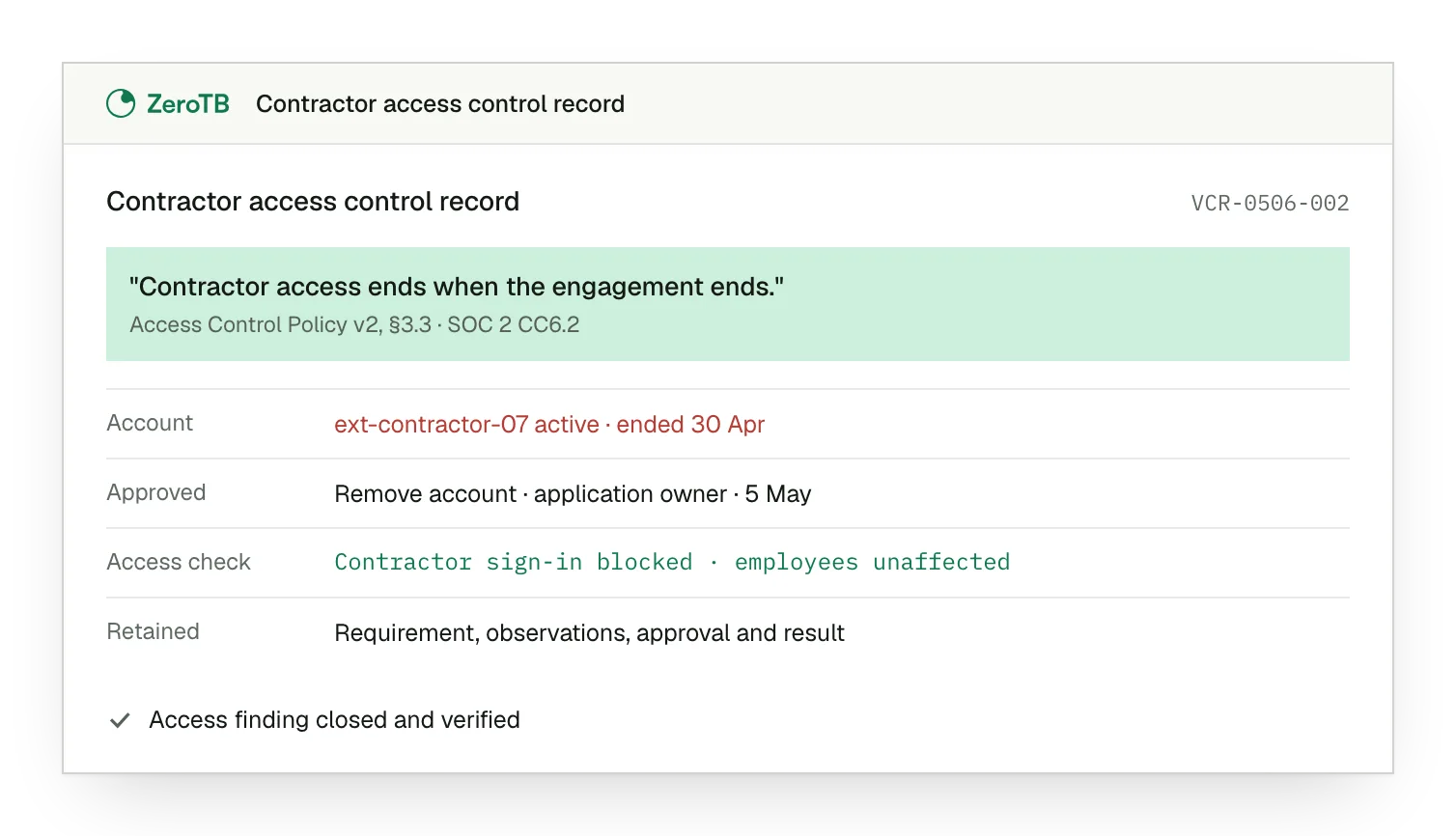
Active contractor account. The observed account remains active even though the contractor's engagement has already ended.
Approved access removal. The application owner confirms that the account has no remaining purpose and approves its removal.
Access check results. Testing shows that contractor sign-in is blocked and employees retain the access they need.
Retained control evidence. The Verified Control Record connects the approved removal with its requirement, observations and test results.
GRC program checklist
Read one requirement alongside its control description and current evidence, checking that they cover the same systems.
Check the recorded owners for the requirement, any exceptions and the decision to change the affected system.
Choose an unresolved finding and identify the work or decision that must happen before its owner can act.
Look for the approved change and the observations that show whether its result justified closing the finding.
Identify who checks the control after closure and how that person learns about new systems within its scope.
Sources
- OCEG, What is GRC?, accessed November 2026.
- ZeroTB, Control operations and verified evidence, 2026.
- ZeroTB, Recurring SOC 2 findings, 2026.
Related pages
GRC software
Consider which records and reviews need software support as the compliance program grows.
Coding-agent compliance
Read how teams maintain controls as coding agents change code, configurations and access.
Healthtech compliance
Explore the control work shared by SOC 2 and HIPAA programs in healthtech companies.
Start with the Pilot
In the eight-week Pilot, we map up to 25 commitments from your report and take two real control gaps through approved repair and verified restoration. Talk with our team about the controls that need attention in your program.