Home / Organizational controls
What does ISO 27001 A.5.24 require for incident planning?
ISO 27001 A.5.24 addresses incident planning through agreed roles, procedures and communication. Before an incident, the organization needs to establish how people will report a problem, reach decision-makers and coordinate the response. Exercises help test those arrangements; follow-up checks establish whether repairs to identified weaknesses have worked.
The plan names a response coordinator, lists contacts and explains how to escalate a problem. Those details can change after approval. Reviewing A.5.24 means looking beyond the document to the people and services it depends on, then checking whether the arrangements still work together.
Preparation scope
A.5.24 prepares an organization to manage information security incidents through agreed responsibilities, procedures and communication. The plan connects the initial report with the people who assess the situation, coordinate technical work and make business decisions. The people involved need to understand those connections before an incident occurs.
Preparation supports the later work of assessing events, responding to incidents and learning from them. These related controls address different parts of incident management. For A.5.24, focus the review on whether the organization has usable arrangements for carrying out that work.
Response authority
Responders need to know who can make each decision before an incident begins. The response coordinator brings the work together, while system owners judge technical actions and business owners decide matters within their authority. A contact list becomes useful when it explains those responsibilities.
The plan should also explain who acts when the usual decision-maker is unavailable. A deputy needs both the authority and information required for the decision. During an exercise, an unanswered call can reveal whether that handover exists or whether work stops with the first contact.
Reporting and escalation
Reporting instructions should get a suspected incident to someone able to assess it. Staff need to know where to report a problem and what information to include. The receiving team then uses agreed criteria to decide who else needs to become involved.
An escalation should carry enough context for that next person to decide what to do. The procedure also needs to say who receives updates as the situation changes. Without those arrangements, technical staff can repeat work while business or communication teams wait for information.
Communication during outages
Responders need a way to communicate and read the plan when their usual services fail. If the plan and messaging service share an unavailable sign-in system, both may become inaccessible at once. A document review can easily miss that shared dependency.
Test whether the designated people can retrieve instructions and reach their contacts under the selected failure conditions. An alternative route needs suitable access protection and someone responsible for maintaining it. Its value depends on responders being able to use it when the usual route fails.
Response resources
Response roles depend on working access to tools and information. A procedure may require system records or technical instructions that its assigned responder can no longer reach. Check the resources each role needs against the work described in the current plan.
Outside help needs the same attention. Decide when it is needed, how it is contacted and which tasks it covers. NIST SP 800-61r3 includes relevant suppliers in incident planning and exercises. Their involvement lets the organization test the handover between its staff and external support.
Changes after the audit
Staff changes and new systems can leave an approved incident plan out of date. A contact may still appear in the plan after leaving the responsible role. A procedure may describe a system the company has replaced, leaving the current owner without usable instructions.
Review the arrangements affected by each material change, as well as the plan on its agreed schedule. A revised contact can be checked directly. A new communication or access dependency may need an exercise that reproduces the conditions under which responders would rely on it.
Exercise design
An exercise needs a defined question and an observable result. It might test whether a recent change has left a response dependency unusable. Agree what participants should be able to do before the exercise starts, and give the observer that same expectation.
Record where the actual sequence differs from the plan: a delayed decision, missing information or an inaccessible resource. Those observations give an action owner something specific to correct. NIST SP 800-61r3 recommends using exercises to identify improvements and prepare staff and relevant third parties for response work.
What discussion exercises cannot prove
A tabletop exercise lets participants work through response decisions without making changes to production. It can reveal that two people expect each other to authorize an action, or that nobody knows the backup contact. Record those findings against the procedures examined in the discussion.
Discussion alone cannot demonstrate that a technical action will succeed. Someone may explain how to retrieve the plan but still be unable to access it during an outage. A separate, safe test can establish whether that route works and supply evidence for the exercise finding.
Verified improvements
A repair needs a follow-up test before an exercise finding can close. The finding records what failed; the proposed correction explains what will change. After the responsible person approves the correction, repeat the relevant test. An unsuccessful result leaves the finding open.
The ongoing work includes assigning owners, arranging checks and following overdue actions. ZeroTB's control operation model applies that approach to incident exercises, with schedules drawn from the commitment and verified completion. The reviewer receives evidence to support the decision about whether the preparation gap is resolved.
Readiness records
Readiness evidence needs to connect the plan with what happened when people tried to use it. Keep the approved version, scenario, participating roles and observations together. These records explain what the exercise covered and which assumptions remained untested when it ended.
For each resolved weakness, retain the approved correction and dated follow-up result. A reviewer can then trace the change from the original obstacle to the working arrangement. Attendance records establish participation; the observations and retest explain what the organization learned and improved.
Evidence for incident preparation
Useful evidence shows who could act, which arrangements were tested and how the team resolved the weaknesses it found.
| Requirement | What an auditor asks for | Where it comes from |
|---|---|---|
| Defined arrangements | Approved procedures identifying response roles, decision authority and escalation routes | The incident plan and its approval history |
| Available resources | Evidence that contacts, instructions and required resources were accessible under the tested conditions | Contact checks, access tests and exercise observations |
| Practised responsibilities | The scenario, participating roles and decisions showing how the team used the plan | Exercise records linked to the plan version tested |
| Resolved weaknesses | Each material finding, its owner, approved correction and follow-up result | Action records and dated retest evidence |
| Current preparation | Reviews addressing changes to staffing, systems and response dependencies | Plan revisions linked to changes and completed reviews |
Related framework controls
| Framework | Control | What it covers |
|---|---|---|
| ISO 27001 | A.5.24 | Preparing the organization to manage incidents through defined responsibilities, procedures and communication |
| SOC 2 | CC7.4 | Using an incident response program to understand an event, contain its effects and address it |
| HIPAA | 164.308(a)(6) | Addressing security incidents through procedures for response, mitigation and records of incidents and outcomes |
Example of restoring incident communication
Contact instructions are useful only if responders can retrieve them when needed. This example follows an exercise where a messaging outage also blocks access to those instructions. The finding closes after an approved alternative lets the team reach its contacts under the same conditions.
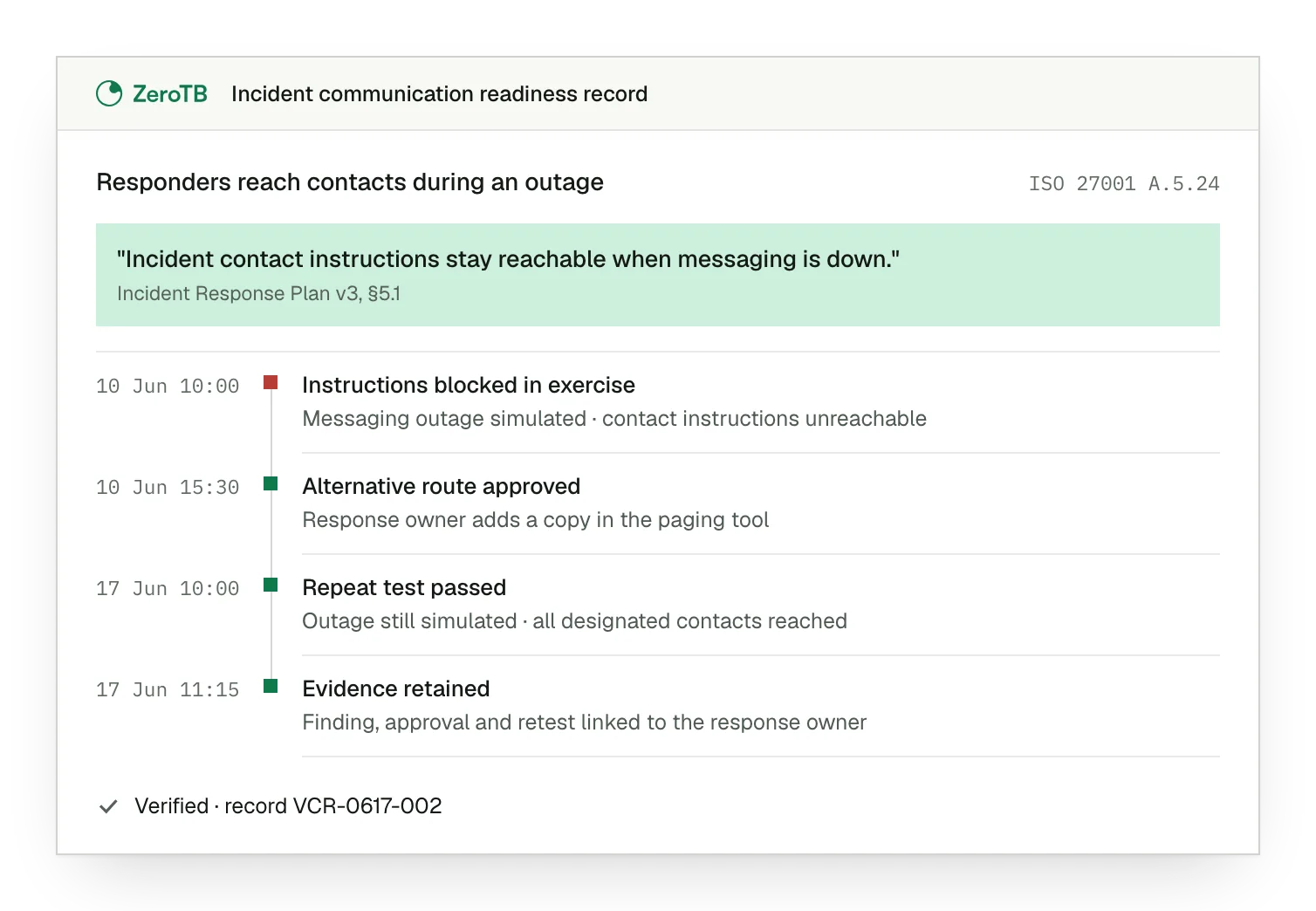
Blocked contact instructions. The messaging outage leaves the response team unable to open its approved contact instructions.
Approved alternative route. The response owner authorizes another route to the instructions that remains available during the outage.
Successful repeat test. The team retrieves the instructions and reaches the designated contacts with the simulated outage still active.
Retained test evidence. The completed record shows the obstacle, the authorized change and the result of repeating the test.
Incident preparation checklist
Identify the approved preparation commitment and the failure that would prevent the response team from using it.
Check who coordinates the response, who authorizes material decisions and who acts when a primary contact is unavailable.
Exercise the contact, communication or resource dependency under the selected conditions, recording what worked and what failed.
Give the finding an owner and agree a change that addresses the observed weakness while preserving necessary protections.
Repeat the relevant test and retain the dated result with the finding and approval before closing the gap.
Sources
- ISO, ISO/IEC 27002:2022 control guidance, 2022.
- NIST, SP 800-61r3: Incident response recommendations and considerations for cybersecurity risk management, 2025.
- AICPA & CIMA, Trust Services Criteria with revised points of focus, 2022 revision.
- HHS, HIPAA audit protocol, 2018 update.
Related pages
Organizational controls
Place incident preparation alongside the other organizational responsibilities in the ISO 27001 control library.
ISO 27001
Connect incident preparation with the wider information security management system and its control requirements.
Compliance frameworks
Explore related guidance for the different frameworks that apply to the controls your organization operates.
Start with the Pilot
Our eight-week Pilot maps up to 25 commitments and takes two real control gaps through approved correction and verified restoration. Talk with our team about incident readiness and where that work could help your organization.