Home / Organizational controls
What does ISO 27001 A.5.33 require for protecting records?
ISO 27001 A.5.33 calls for protection of records against loss, damage, disclosure and unauthorized changes. The safeguards depend on the records and the obligations for keeping them. Review access and retention by category, and check those protections again when the records move or their storage settings change.
A file transfer says little about the safeguards at its destination. The records may arrive intact but inherit broader permissions or an earlier deletion date. Reviewing those changes requires the record owner and storage team to compare the new arrangements with the requirements that still apply.
Record categories and obligations
The reason for keeping a record determines the protection it needs. A contract preserves agreed terms; an incident history preserves information about an event and the response. Their owners need to identify the obligations for each and the people who will need access.
Follow each category to the places where it is stored. Copies and exports may be part of that process, with separate permissions or retention settings. Including them in the review gives the owner a way to account for the records beyond their original location.
Retention rules
A.5.33 sets no single retention period for all records. The period depends on the obligations for the category concerned. Put the approved period and its basis in the retention schedule, where the storage team can use them to assess the cleanup rule.
Some records may need an exception to that schedule. Keep the decision and its owner with the affected category so a later cleanup does not remove those records too soon. Reviewers should be able to explain why the exception remains in place and who can change it.
Access to retained records
An archive needs access controls for the records it holds. Reading, editing and deleting are different rights, and a person may need only one of them. Review administrative access too: an account that can change the storage safeguards can affect the records they protect.
Before accepting a shared folder as the new location, inspect its permissions. The destination may give access to people who could not reach the source. Compare those rights with approved uses of the records, then preserve legitimate retrieval when removing access that has no approved purpose.
Record integrity
Record integrity concerns whether the information remains reliable for its intended use. The ability to open a file settles only part of that question. An approval history, for instance, needs to preserve enough information for a reviewer to establish the decision originally made.
Examine the information available about changes to the record. Version history and recorded activity can help identify an alteration and the events around it. Where an amendment was authorized, keep its reason with the approval. This lets a reviewer distinguish a legitimate change from an unexplained one.
Storage migrations
A migration review needs to cover the protections at both storage locations. Copying the files leaves open questions about destination permissions and cleanup defaults. Compare these with the requirements for the transferred records before deciding that the new location provides the protection they need.
The source also needs a decision. If copies stay there, someone must remain responsible for their access and retention. The same applies to exports kept after the move. Account for each location used in the recordkeeping process so the review does not end at the destination.
Retrieval over time
Retained records need to remain retrievable for their intended use. A storage inventory establishes that an item exists; a retrieval check establishes whether an authorized person can obtain and read it. Test the route staff would use when they need the record.
Record which category and version the test covered, along with the result and any limits. If the record cannot be retrieved, investigate the failed route and any recovery options. A successful test on another category does not explain what happened to the inaccessible material.
Limits of storage locks
A storage lock applies to particular material under particular settings. With Amazon S3 Object Lock, the protection belongs to the specified object version. It permits creation of new versions. The review therefore needs to identify the version under protection and the retention setting applied to it.
Check that this is the version the organization needs to retain. Then test the route staff use to retrieve the record, which may return a different version. Protection against deletion or replacement can serve one requirement while access and retrieval require separate evidence.
Corrections and approval
Before changing a safeguard, establish what protection the affected records need. The record owner decides the intended access and retention; the storage team can then assess the proposed correction. Keep the category, observed gap and required result with that approval so both teams share the same scope.
ZeroTB checks commitments against systems, drafts a fix and obtains approval before verifying the changed state. The Verified Control Record keeps the evidence from that sequence. Applied to record protection, the work follows the affected category through the change and checks whether the agreed safeguards hold.
Verification after a repair
A correction is ready for closure when the relevant checks establish that protection has been restored. For a cleanup rule, check the records it covers and when it permits deletion. Add retrieval and permission tests where needed to establish that the intended use remains possible.
Deal separately with any damage that preceded the correction. A changed setting cannot recover deleted material. Identify the affected records and the recovery or investigation still required, so a completed configuration change does not conceal unfinished work. Obtain current observations wherever missing or stale results prevent a conclusion.
Evidence without unnecessary copies
An auditor needs to understand how the records are protected. That rarely calls for copying the entire collection into the evidence package. Keep the category, requirement, observed gap, approval and dated result together, with references that let the reviewer inspect the supporting material.
Apply the records' handling rules to any extracts the evidence includes. Where a reviewer can inspect a restricted source directly, a reference may serve the purpose. This avoids creating additional copies whose access and retention would also need to be managed through subsequent changes.
Continuing ownership
After closure, the storage owner needs responsibility for further checks and a route for reporting failures. Some failures will require a decision from the record owner before anyone can correct them. Keep that responsibility clear so an observed gap reaches someone who can act.
Use the current requirement for the category at the next review. A retention exception or a change in business needs may affect the rule that should apply. Checking against that requirement helps the team assess later migrations and cleanup changes without losing the reason for the original repair.
Record protection evidence
A reviewer can use this evidence to follow the requirement from the record category to the result of a check.
| Requirement | What an auditor asks for | Where it comes from |
|---|---|---|
| Defined record scope | The categories covered, the reasons for keeping them and the responsible owners | Record inventories showing the locations and obligations for each category |
| Appropriate retention | The approved retention period and how the storage configuration implements it | Retention schedules, exception approvals and the corresponding cleanup rules |
| Restricted access | The people and accounts with access, their rights and the approvals behind them | Account and permission listings, with the decisions that authorize access |
| Reliable and usable records | The scope and results of checks on integrity and retrieval | Version history, relevant system activity and records of retrieval tests |
| Verified correction | The observed failure, authorized repair and results supporting its closure | The repair record, approval and verification results, including outstanding recovery work |
Related framework requirements
| Framework | Control | What it covers |
|---|---|---|
| ISO 27001 | A.5.33 | Record protection reflecting the purpose of the records and the obligations for keeping them |
| SOC 2 | CC6.1 | Logical access to systems and information, relevant to who can reach stored records |
| HIPAA | 164.312(c)(1) | Safeguards against improper alteration or destruction of electronic protected health information |
Example of correcting premature deletion
In this example, a storage team finds a deletion rule that is too short for the records in a migrated archive. Nothing in the checked scope has disappeared. The owner approves a correction, and the team checks both the changed rule and the retained records.
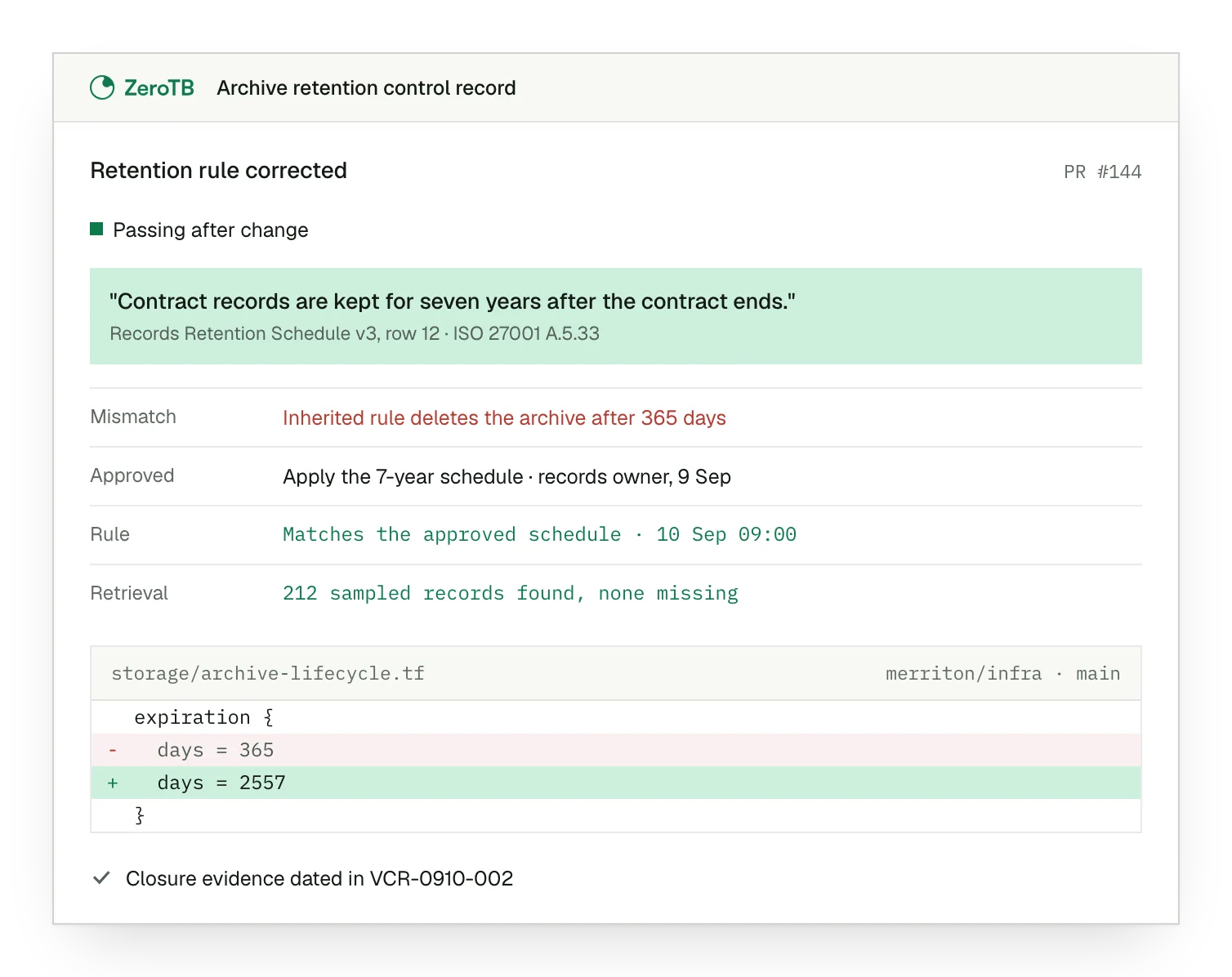
Retention mismatch. The destination inherited a cleanup rule that would remove the archive's records too early.
Approved correction. The owner approves the schedule that applies to these records before the team changes it.
Records checked. The changed rule matches the approved schedule, and retrieval checks find no missing records within scope.
Closure evidence. The dated results identify what was checked and sit beside the approval for the correction.
Record protection checklist
Identify the record category, its purpose and the approved access and retention requirements that apply across its locations.
Compare destination permissions, cleanup settings and retained copies with the requirements that applied before the storage change.
Confirm the intended protection with the record owner, including exceptions and the access that must remain available.
Verify the corrected setting and relevant retrieval or integrity checks, then assess any earlier loss or alteration separately.
Retain the decision and dated results with their scope, and assign responsibility for subsequent checks and unresolved work.
Sources
- ISO, ISO/IEC 27001:2022, 2022, information security management system requirements.
- ISO, ISO/IEC 27002:2022, 2022, information security control guidance.
- AWS, Locking objects with Object Lock, accessed November 4, 2026.
- AICPA & CIMA, Trust Services Criteria with revised points of focus, 2022 revision.
- HHS, HIPAA audit protocol, 2018 update, integrity provisions.
Related pages
Start with the Pilot
Our team can discuss how record protection fits into the controls you need to keep operating. The eight-week Pilot maps up to 25 commitments and takes two real control gaps through approved correction and verified restoration, keeping evidence of the work.