Home / Organizational controls
What does ISO 27001 A.5.19 require for security in supplier relationships?
ISO 27001 A.5.19 addresses security in supplier relationships: how a supplier could put information or services at risk, and how the company manages that risk. Start with the service in use. Revisit the assessment when its scope changes, and keep evidence of the decisions and corrections that follow.
A supplier approved for one job may later receive production data or administrator access. The original review tells you little about that expanded role. A.5.19, one of the ISO 27001 organizational controls, makes the current relationship the subject of the security decision.
Current supplier use
A supplier assessment is useful only when it describes the service your company actually uses. Identify the information the supplier handles, the systems it can reach and the operations that depend on it. These details establish what the security decision needs to cover.
One supplier may provide several services with different access and data needs. Record the relevant service alongside its business owner and approved purpose. A decision about one product then has a clear boundary when another team proposes using a different product from the same supplier.
Risk-based assessment
The possible consequences of a supplier failure determine how closely to examine the relationship. Consider the sensitivity of the information involved, the power of the supplier's access and the services that depend on it. Each can affect the depth of review.
A supplier with no sensitive data or system access may need only a limited assessment. Record the reason for that choice. If its work later changes, the reviewer can compare the new use with the assumptions that justified the earlier decision.
Supplier evidence
Supplier evidence needs to cover the service, period and protections relevant to the decision. An assurance report for a different product can leave the service in use unexamined. Read its scope alongside the current engagement before relying on its conclusions.
Where the evidence leaves a material question unanswered, request information about that specific gap. The response should help the owner decide whether the proposed use is acceptable. NIST's due diligence guidance treats supplier research as support for decisions about both new acquisitions and existing systems.
Responsibilities on both sides
Resolving supplier risks often requires decisions from people who control different parts of the relationship. The business owner knows why the service is needed. Security examines the risks, and the system owner can change the permissions granted by the company.
A supplier contact is needed when the correction concerns the supplier's own work. The review record should make these responsibilities visible, including who can accept a remaining risk. This is part of security governance: someone must have authority to decide what happens next.
Changes after approval
A supplier's permissions or service role can expand while its security assessment remains unchanged. The company may begin sharing production data, grant administrator access or depend on the service for more important work. None of these changes has to coincide with contract renewal.
Compare that use with the scope the owner approved. Access records show permissions; the business owner can explain what work those permissions support. Read both together to identify the change in risk and decide whether the safeguards from the earlier review still apply.
Decisions on expanded use
The owner needs to decide whether expanded supplier use is acceptable and under what conditions. That may mean approving additional safeguards, reducing access or postponing the new work. The decision should state which use it permits and which risks remain unresolved.
Where the supplier already supports a necessary service, immediate removal of access may cause an interruption. The owner can agree a temporary arrangement while the team resolves the gap. Record why it is needed, what it permits and when the decision must be reconsidered.
Corrective work
A useful correction identifies what must change and who can change it. The work may involve narrowing internal permissions, asking the supplier to improve a safeguard or revising the agreed service. Each action needs a result that the reviewer can check.
For approved commitments within connected systems, ZeroTB checks the observed state, drafts a correction, obtains human approval and verifies the result. Its Verified Control Record keeps that evidence together. Supplier-provided evidence remains part of the wider assessment when the action concerns systems the supplier operates.
Verification and closure
Close a supplier gap when the evidence demonstrates that its agreed correction worked. For an access change, check the resulting permissions and whether the supplier can still perform its approved work. A completed request alone leaves those two questions unanswered.
Keep dated observations with the decision and action they verify. If the supplier still owes evidence for a separate safeguard, that item remains open. The review can then show a completed internal correction without implying that every issue in the relationship has been resolved.
Ongoing review
A scheduled review provides a regular opportunity to examine the supplier relationship, but material changes need attention between those dates. Choose the schedule using the relationship's risks and the company's commitments. Agree which changes should cause the owner to reopen the assessment.
A missed review needs someone to follow it through. Assign that responsibility and an escalation path for unanswered requests. If evidence has expired or a supplier has not responded, record the outstanding question so the owner can decide whether continued use remains acceptable.
Ended relationships
Ending a purchase does not itself remove the access created to deliver it. When a supplier engagement ends, examine the accounts and permissions associated with that service. Confirm whether any still have an approved purpose before arranging their removal with the system owner.
Information held by the supplier requires separate attention. Use the agreed arrangements to determine what should be returned, retained or deleted and how completion will be confirmed. Any obligations that continue after the engagement ends should remain visible in the relationship record.
Supplier security evidence
A reviewer should be able to follow the supplier decision from its approved scope to the evidence of completed work.
| Requirement | What an auditor asks for | Where it comes from |
|---|---|---|
| Defined relationship | Which service was reviewed, what it handles and how the business uses it | The supplier inventory, agreed service description and access records |
| Assessed risk | Why the review was sufficient and who approved continued use | The assessment and the owner's decision, including any conditions |
| Relevant assurance | Whether the evidence addresses the service and safeguards under review | Supplier reports and responses, with notes on their scope and period |
| Assigned corrections | What remains to be done, by whom and under which conditions | Supplier correspondence, change requests and approved temporary arrangements |
| Verified correction | What changed and how the reviewer established that the correction worked | Dated observations and supplier evidence attached to the verification record |
Related framework controls
| Framework | Control | What it covers |
|---|---|---|
| ISO 27001 | A.5.19 | Information security risks arising from the supplier relationships within the organization's scope |
| SOC 2 | CC9.2 | Risks associated with vendors and business partners that affect the organization's objectives |
| HIPAA | 164.308(b)(1) | Assurances that business associates appropriately safeguard electronic protected health information handled on a covered entity's behalf |
Example of restoring approved supplier access
In this example, the supplier's approved support work is limited to a test environment, but its account also permits production access. The service owner confirms that the extra permission has no purpose. Removing it restores the agreed scope without interrupting support.
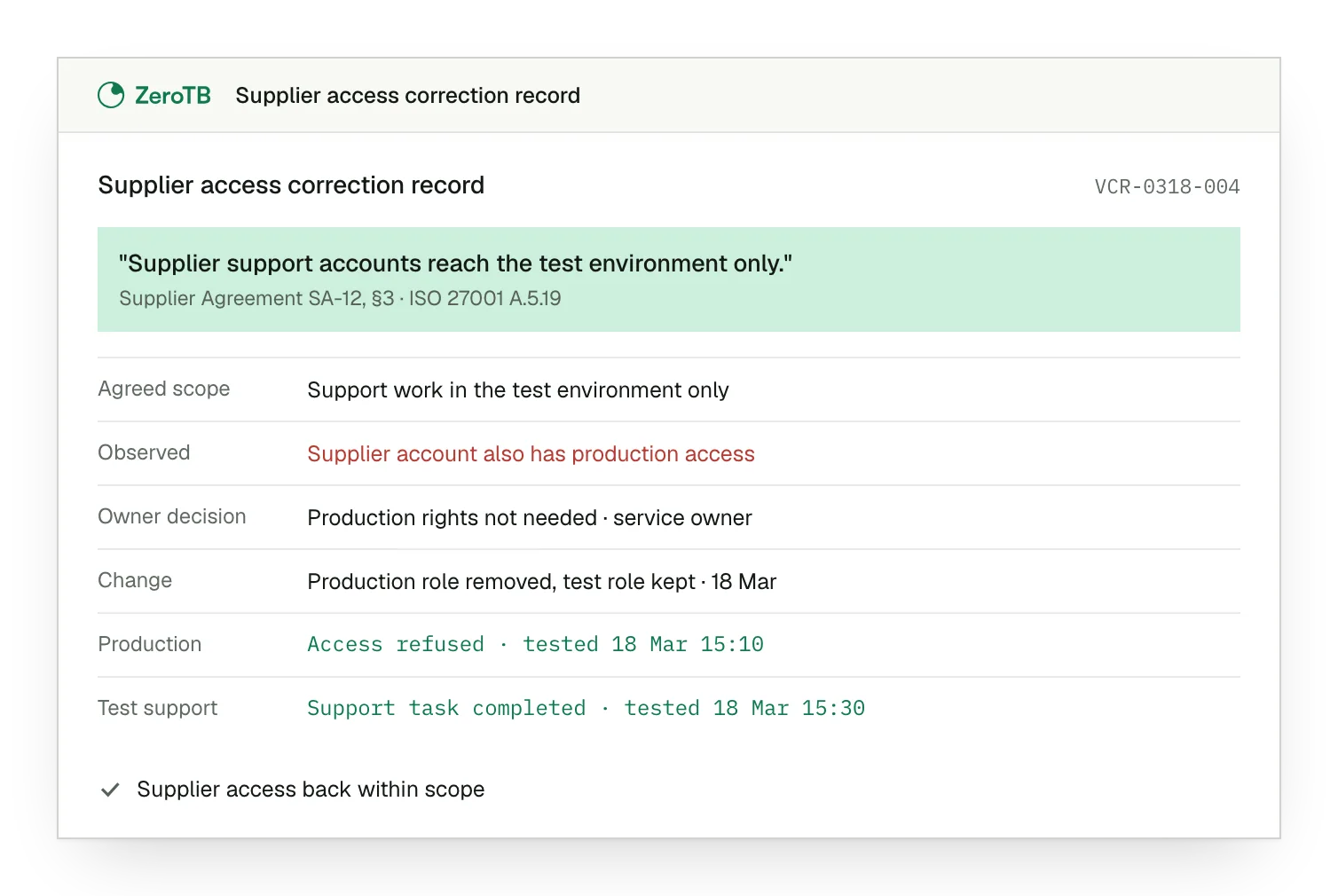
Scope difference. The review compares the test-only support agreement with the account's current production access.
Owner decision. The service owner confirms that the extra permission is unnecessary for the agreed support work.
Permission removed. The approved correction changes the account's production rights and leaves its test permissions in place.
Result checked. After the change, production access fails and the supplier can still complete its support task.
Supplier review checklist
Compare the approved engagement with the information, permissions and operational responsibilities the supplier currently holds.
Confirm that the review reflects the consequences of losing information, granting excessive access or interrupting the service.
Check that supplier reports and responses cover the service, period and safeguards on which the decision relies.
Identify who can approve changed use, who can correct internal access and who owns outstanding supplier actions.
Agree what observations will demonstrate a completed correction and which unresolved items need continued review.
Sources
- ISO, ISO/IEC 27001:2022 and ISO/IEC 27002:2022, 2022.
- NIST, Cybersecurity supply chain risk management: Due diligence assessment quick-start guide, July 2026.
- AICPA & CIMA, 2017 Trust Services Criteria with revised points of focus, 2022 revision.
- HHS, Summary of the HIPAA Security Rule, accessed November 4, 2026.
- ZeroTB, Compliance control operations, source captured October 23, 2026.
Related pages
Organizational controls
Explore the related responsibilities that support supplier security within an information security management system.
ISO 27001
Read how individual controls fit into the wider approach to managing information security risks.
Compliance frameworks
Find control guidance across the frameworks that apply to the systems and services your organization uses.
Start with the Pilot
Talk with our team about keeping supplier controls current. The eight-week Pilot maps up to 25 commitments and takes two real control gaps through approved correction and verified restoration, with evidence of the work completed.