Choose GRC software by following a control from the risk decision to the evidence that it works. Compliance and engineering should be able to use that same history. Test your current platform by tracing a finding through repair to evidence that the control works.
A dashboard can show every outstanding finding while the compliance team still spends its days asking engineers for updates. Buying software changes this workload only when it changes how the work gets done. The evaluation needs to follow a finding beyond the screen where it first appears.
GRC software and risk decisions
GRC software connects governance, risk management and compliance so a decision can be followed through to its controls and evidence. Governance establishes who can decide. Risk management records the problem and chosen response. Compliance links the resulting obligations to the work and evidence that support them.
These links let a reviewer follow a risk decision to the relevant control, its owner and current evidence. The reviewer can then assess whether the agreed response still holds. The GRC overview explains those program responsibilities; this guide focuses on the software and operating support behind them.
The right scope for SaaS
A mid-size SaaS company may need a control library, a risk register and a reliable history of exceptions more than a broad suite. Test those needs first. Include the next planned framework or business unit in the evaluation, so the purchase can support that addition.
Integrated risk management software serves a wider purpose when risk decisions cross business functions and depend on several owners. A lighter GRC tool can suit a narrower program. Spreadsheets can also work while someone can maintain the links, review dates and changes without losing track of them.
Existing compliance platforms
If you already have a compliance platform, test whether it carries a finding through repair to verified evidence. Inspect the approval, the change and the check that confirms the control works. ZeroTB keeps commitments, checks, repairs and audit evidence together in one place. Your team can follow that record without maintaining the links between two systems.
An unresolved finding may be waiting for an engineer to investigate and repair the control. That work matters when buying compliance software: establish which program tasks it handles and which operating tasks remain. A team with adequate records may need help investigating and repairing failures between reviews.
Shared work with engineering
Engineers need enough detail to act on a finding without asking compliance to reconstruct it. The affected system, observed condition and intended change belong with the commitment that explains the issue. Compliance can then assess the risk while engineering works from the same account of the failure.
Follow that account into the team's ticketing system. Check that the ticket retains its control and evidence links as work progresses. Agree how a changed setting reaches the control owner, so compliance can assess its effect before the next scheduled review.
Repository and cloud evidence
An integration is useful only if its observations answer the control's actual question. For code repositories, inspect which review rules and changes it reads. For cloud accounts, inspect the resources and configurations it covers. A connection to one account leaves the coverage of other accounts unresolved.
Ask the provider to demonstrate refresh timing, required permissions and the behavior after a connection fails. The last passing check must show when it ran, even after the connection stops working. Visible stale, unknown and disconnected states help a reviewer identify where further investigation is needed before accepting the evidence.
Cybersecurity risk management
A fintech security team has to understand both the technical finding and the business decision it calls for. Cybersecurity risk management software helps assess threats and weaknesses in systems. GRC software connects those findings to control owners, compliance commitments and decisions about accepting or treating the risk.
NIST's continuous monitoring guidance describes how observations about control effectiveness support timely risk decisions. Use a failed control in one service to evaluate that connection. The owner's response and the evidence after a change should explain whether the intended protection now works.
Cloud risk in healthtech
A healthtech buyer needs to distinguish software hosted in the cloud from software that checks the cloud environment. A risk register can hold assessments without inspecting any configuration. Establish whether the proposed tool supplies those observations or records decisions based on evidence collected elsewhere.
HHS cloud guidance calls for regulated organizations to understand their cloud environment when assessing risks to electronic protected health information. Trace where that information is stored and who has access. The evaluation should also show which protections each party manages, with evidence connected to the relevant risk decision.
Shared controls across frameworks
Shared controls can reduce repeated work across SOC 2 and HIPAA when the evidence supports both programs. The mapping needs to explain that relationship. A reviewer should see which requirement each observation addresses and why the same result is useful in both places.
Inspect system coverage and review periods before accepting that reuse. Evidence from one application may say nothing about another application added to the program. Keeping that boundary in the record lets reviewers use the evidence within its scope and see where another check is needed.
Policy as code
A policy-as-code check needs a rule that expresses the intended condition and names the systems it covers. With those details, its result can enter the GRC program as evidence of a defined requirement. Retain the rule version so a reviewer can understand the test later.
A failed test and a missing observation need distinct records. The workflow should also retain the observation time when a requirement changes. Together with the rule version, that date helps the control owner judge which results remain relevant and whether a new test is needed.
Control restoration between audits
A failed check needs an operating owner who can carry the issue through to a working control. During selection, establish who investigates failures, prepares corrections and verifies the result. This responsibility determines how much coordination the compliance team must continue to do after the software is installed.
ZeroTB carries that work through and keeps the commitments, checks and repair evidence together, with people authorizing material actions. Its Verified Control Record preserves the commitment, before-and-after state, action, approval and verification. That gives compliance and engineering a shared account of the completed repair when they review the control later.
The cost of operating the program
Compare GRC tools by the work left after the dashboard updates. Ask how much investigation, reassignment and evidence gathering each finding requires. More visible findings can still mean more work if nobody has responsibility for resolving them. The evaluation should show who completes that work before purchase.
Include administration in the comparison: maintaining integrations, revising checks and reviewing exceptions all require ongoing attention. A narrow program with manageable manual records may reasonably keep them. A program struggling with recurring failures needs a credible way to complete repairs, alongside the records that explain them.
Example of restoring a review requirement
A useful evaluation follows one broken control through to a verified result. In this example, a repository's required review count changes from one to zero. The record connects that gap to an approved correction and a fresh check before the issue closes.
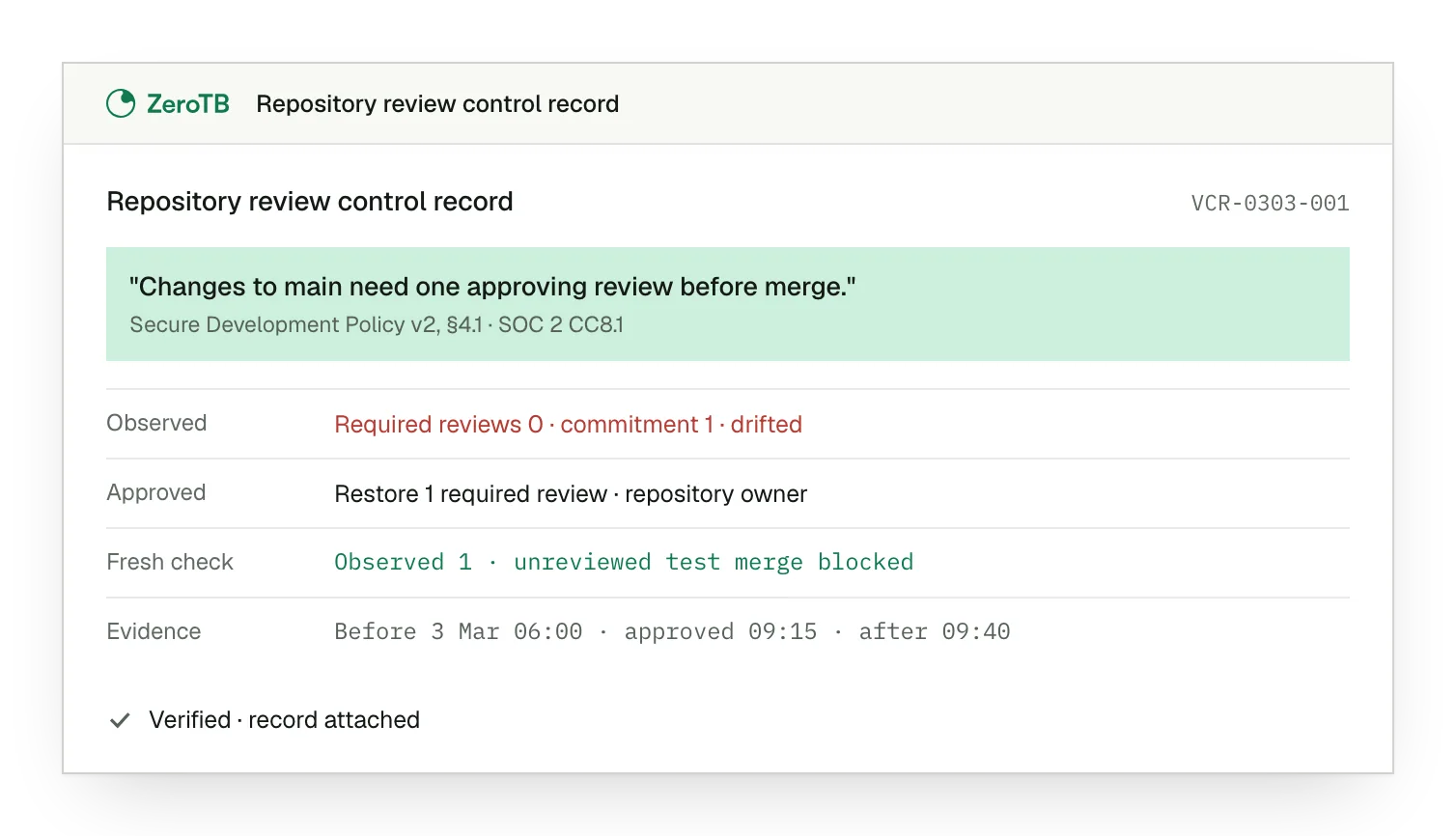
Observed review gap. The check finds zero required reviews where the approved commitment requires one before merging.
Approved rule change. The repository owner approves restoring the required review count after checking the proposed change.
Verified merge protection. A fresh check confirms the rule, and a test confirms unreviewed changes cannot merge.
Retained repair evidence. The record keeps the earlier setting, approval and dated verification together for later review.
GRC software evaluation checklist
Use an approved requirement in the demonstration and follow its connections to the owner, systems and available evidence.
Disconnect a test connection during the demonstration and inspect the stale observation and notification that the owner receives.
Check the proposed scope for investigation, correction and approval work, with a responsible party for each task.
Read the record of a completed repair, including its approval, before-and-after state and evidence of the working protection.
Estimate the investigation, maintenance and coordination left with the team under each option, using the same program scope.
Sources
- NIST, Information Security Continuous Monitoring, SP 800-137, 2011.
- HHS, Guidance on HIPAA & Cloud Computing, accessed November 2026.
- ZeroTB, Control operations and verified evidence, 2026.
Related pages
Coding-agent compliance
Explore control changes caused by coding agents and the work needed to keep protections operating.
Fintech
See how ongoing control work supports fintech teams between audits as their systems change.
Healthtech
Explore the operating work behind controls that support healthtech teams across SOC 2 and HIPAA.
Start with the Pilot
Our team maps up to 25 commitments and takes two real control gaps through verified restoration during the eight-week Pilot. Talk with us about the recurring control work in your GRC program and where support would help.