Home / Organizational controls
What does ISO 27001 A.5.1 require for information security policies?
Under ISO 27001 A.5.1, the information security policy and its supporting policies need management approval, publication, communication and acknowledgment. They also need review at planned intervals and after significant change. Use the review to decide whether the approved instructions still fit the work, and correct any gaps that it reveals.
The next policy review is months away, but a team has already moved its files into a new service. The policy still applies. What needs attention is whether its instructions cover the new arrangement and whether the service allows only the access those instructions permit.
Policy scope
The policy's scope tells a service owner whether a rule applies to the work they are planning. It needs to identify the information and business activities covered, together with the responsibilities involved. A broad promise to protect information leaves those decisions open.
A template can help organize the document, but the organization still has to decide what the policy means for its work. Consider a service handling company files: its owner should be able to tell which accounts and working practices the policy permits.
Supporting policies
Supporting policies give staff the detail they need to act on the main policy. An access policy might explain who can use a service; an information-handling policy might explain what can be stored there. Both need to follow the direction management approved.
Read related instructions together when one of them changes. A rule requiring approved work accounts should have the same meaning in the main policy and the documents that apply it. Staff need a consistent answer even when their work crosses several policy subjects.
Policy ownership
The policy owner organizes the review and brings proposed decisions to management for approval. Service owners explain what the rules mean in practice. Their input can reveal a restriction that would interrupt necessary work, or an instruction that the current system cannot enforce.
Management can then approve a rule with an understanding of the work required to implement it. The application owner may need to approve the specific access change separately. Keep both approvals available to the people making the change, since they answer different questions about authority.
Approved versions
People need one clearly identified, approved version of each policy that applies to their work. Connect the version to its approval, effective date and owner. Readers can then distinguish the rule in force from a draft still awaiting a decision.
Retain earlier versions where they explain past decisions, and make their status clear. Links in onboarding material and operating procedures should lead to the current instructions. A policy repository loses practical value when staff must compare several copies to decide which one has authority.
Communication and acknowledgment
People need to know what a policy change means for their own work. Send the applicable instructions to affected staff and relevant outside parties, with an explanation of what has changed. An announcement that a new version exists leaves them to discover its consequences.
Link acknowledgments to the version people received. That makes it possible to establish who acknowledged which instructions, including after a later revision. To establish whether a service follows those instructions, examine the service itself: the acknowledgment records describe a different part of the work.
Review timing
Review the policy at planned intervals and when significant changes affect its meaning or use. A new service, an incident or a changed obligation can justify a review before the scheduled date. The policy owner needs to hear about those changes to judge their effect.
The review schedule should reflect the organization's circumstances and commitments. If the organization chooses an annual review, that date remains one trigger among others. A service introduced soon after approval still needs a decision about how the existing rules apply to it.
Policy and practice gaps
A difference between a policy and actual work needs a decision about which one must change. The policy may describe an obsolete working arrangement. Alternatively, the rule may remain appropriate while a system setting or an everyday practice allows people to bypass it.
Assess the intended protection before changing the text. A newly permitted activity needs an approved rule that addresses its risks and obligations. Where the existing rule still applies, correction should restore that protection. Changing the policy simply to match observed behavior can leave the original concern unresolved.
Review decisions
A useful review record explains the conclusion, including a decision to leave the policy unchanged. Record the version examined, the changes considered and the reason for the outcome. This gives a later reviewer a basis for understanding why the policy remained appropriate.
When a revision is needed, connect the new approval to the affected instructions and communication records. Track the resulting system changes until the service owner completes them. Approval of the revised document can happen before the service owner finishes implementing the rule in the affected system.
Operating evidence
Testing a policy rule requires a concrete expected result. If company information must be reached through approved work accounts, examine which accounts can open it in each affected service. Compare that access with the rule and retain the observation that supports the conclusion.
For this work, ZeroTB checks the policy commitment against the system, drafts a fix and obtains approval before correction. It then tests the result and retains the evidence. The policy's scope, approval and communication each have their own records alongside this evidence of operation.
Policy evidence
A reviewer should be able to follow the adopted policy through the decisions and work that kept it current.
| Requirement | What an auditor asks for | Where it comes from |
|---|---|---|
| Defined policy set | Which policies apply to the work within scope | Policy register, main policy and supporting documents |
| Approved current version | Which version management approved and when it took effect | Document history and management approval for the adopted text |
| Communication and acknowledgment | Who received the rules and acknowledged them | Distribution and acknowledgment records identifying the policy version |
| Policy review | What prompted review and why the owner retained or changed the text | Dated review notes and decisions about affected policies |
| Operating follow-through | Whether the correction restored the rule in the affected service | Change approval and before-and-after observations in the Verified Control Record |
Related framework requirements
| Framework | Control | What it covers |
|---|---|---|
| ISO 27001 | A.5.1 | The organization's approved security policy set, its communication and its continuing review |
| SOC 2 | CC5.3 | Policies that establish expectations and procedures that carry those expectations into daily work |
| HIPAA | 164.308(a)(1) | A security management process addressing risks to electronic protected health information through policies and procedures |
Example of restoring an approved sharing rule
This example keeps the existing policy and corrects access in a new service. The rule allows approved work accounts to open company files. During review, a personal account is found with access. Its removal needs approval and a check that permitted work can continue.
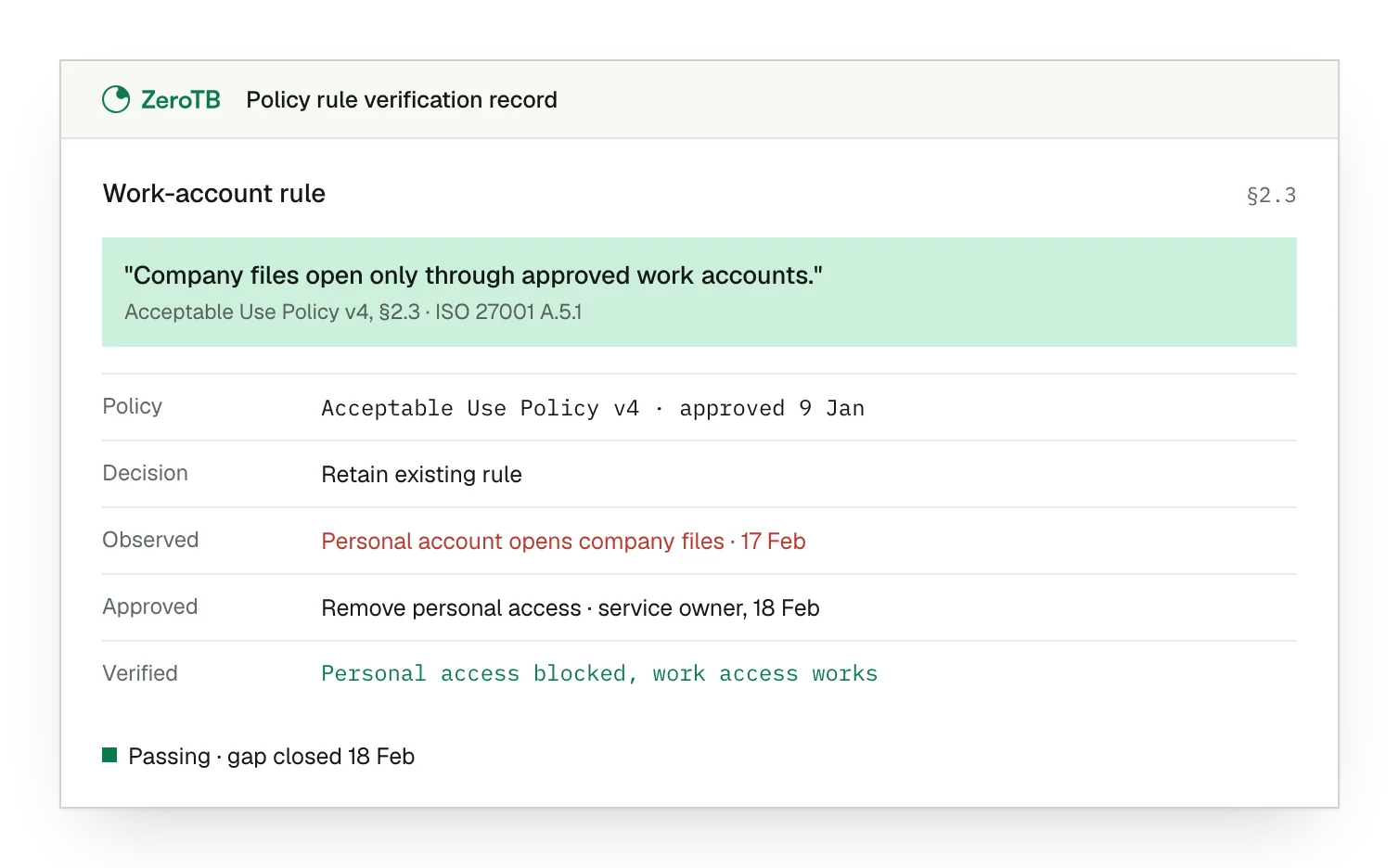
Existing policy rule. The record identifies the policy version requiring an approved work account to open company files.
Observed access gap. An access check finds a personal account still able to open the files.
Approved access change. The owner approves removing personal access after confirming that approved accounts can support the work.
Verified access result. A second check shows blocked personal access and working access through an approved account.
Policy review checklist
Identify the information and activities governed by the rule, including new services introduced since the last review.
Confirm which text management approved and whether affected readers can find and acknowledge the version in force.
Determine whether scheduled review, changed work, an incident or a new obligation calls for a policy decision.
Establish whether the rule needs revision, the operating practice needs correction, or both need an approved change.
Connect the review decision with communication records and any system tests needed to verify the resulting correction.
Sources
- ISO, ISO/IEC 27002:2022, information security controls, 2022. Control identity and guidance framework.
- AICPA & CIMA, Trust Services Criteria with revised points of focus, 2022 revision. Related SOC 2 criterion CC5.3.
- HHS, HIPAA audit protocol, updated 2018. Security management and policy documentation.
- ZeroTB, Control operations, 2026. Approved corrections, verification and retained control evidence.
Related pages
Organizational controls
Explore the organizational responsibilities that support the wider information security management system and its policies.
ISO 27001
See how individual controls fit within the information security management system and its wider requirements.
Control design
Connect an approved policy commitment to the systems, checks and decisions needed to keep it operating.
Start with the Pilot
Talk with our team about keeping policy commitments working as systems change. The eight-week Pilot maps up to 25 commitments and takes two real control gaps through approved correction and verified restoration, with a record of the completed work.