Codex AI coding agent edits and runs code
OpenAI's Codex reads files, edits code and runs commands on laptops or in cloud environments. ZeroTB's software and team keep SOC 2 controls working after audits for US software, AI, fintech and healthtech companies.
Limit commands. The sandbox and approval policy decide what a task may run
Review connections. Apps, browser activity, web search and connected tools extend beyond local command limits
Review code. Codex Security examines application code for vulnerabilities that need investigation and repair
Codex security starts with sandbox and approval settings
The sandbox limits command access. OpenAI's Agent approvals and security explains the separate approval policy that governs requests for more permission.
Check permitted reach. Review which files and network connections the sandbox allows commands to access.
Review the patch. Permission to run a task leaves its resulting patch subject to company review.
Record the environment. Laptop and cloud permissions can differ. Record the environment and credentials Codex uses.
Connected services widen what Codex can reach
Connected services have access outside local command limits. OpenAI's Codex security cookbook covers apps, browser activity, web search and connected tools separately.
Check account permissions. The connected account determines which records and actions Codex can reach.
Review new connections. A new connection can expand access while the sandbox configuration stays unchanged.
Inspect active accounts. Check the account each connection uses, including the permissions granted to it.
Your data rules limit what Codex can read
The approved Codex task determines which company information it needs. Company data rules govern whether that information can be supplied.
Include useful context. Repository context may help Codex understand the source file it needs to change.
Justify sensitive access. Customer records and production credentials need a separate reason for inclusion.
Assess both sides. Vendor assessment covers data handling, while internal review determines what Codex may receive.
Codex Security finds vulnerabilities in the code itself
Codex Security examines application code for vulnerabilities. Its findings give the team issues to investigate and repair in that code.
Assign each finding. A finding gives its owner a specific issue to investigate in the code.
Understand accepted changes. The person accepting a patch needs to understand its changes and tests.
Keep change records. Record who reviewed the patch, which tests ran and how the release was approved.
Approved pull requests can hide missing branch rules
For SOC 2 change management, branch protection enforces required reviews or passing checks. Its coverage includes the receiving branch and bypass routes.
Test required review. An approved pull request can enter a branch that also accepts unreviewed changes.
Check new repositories. Agent pull requests can reach a new repository before its protections are set.
Recheck restored rules. A restored review rule can disappear again while the repair ticket still looks complete.
Release workflows decide which Codex changes reach production
A reviewed Codex change still needs an approved release route. Workflow permissions determine which people and service accounts can change production.
Follow approved routes. A reviewed change still needs to reach production through the agreed workflow.
Limit service accounts. Their permissions determine which production changes they can make.
Recheck workflow edits. Changes to workflows or service accounts can alter the route into production.
ZeroTB restores review rules after Codex changes
ZeroTB starts read-only, checks GitHub against SOC 2 commitments daily and prepares repairs. It checks systems Codex changes without connecting to coding agents.
Approve scoped repairs. Your team reviews and merges repairs. Write access is scoped by action and revocable.
Verify before closure. Fresh passing checks close gaps, while unknown, stale and disconnected results stay visible.
Decide acceptable exceptions. Your control owner decides whether a departure from the commitment is acceptable.
ZeroTB covers the gaps Codex safeguards leave
The sandbox governs tasks, Codex Security examines code, and branch rules govern merges. ZeroTB takes responsibility for investigating and repairing control gaps.
| Task | Sandbox and approvals | Codex Security | Branch rules | ZeroTB |
|---|---|---|---|---|
| What it covers | What tasks run and reach | Vulnerabilities in application code | Branch protection for accepted merges | SOC 2 commitments checked daily |
| What it leaves open | Access through connected services | Whether required review is enforced | Bypass routes and new repositories | Code vulnerabilities remain Codex Security's job |
| Who acts on gaps | Whoever configures the environment | The team investigating each finding | The repository owner | ZeroTB prepares repairs, your team approves |
| What auditors see | Your record of task scope | Findings to investigate | The current branch rule | A signed Verified Control Record |
Example of blocking unreviewed merges again
Here, tests confirm that a restored branch rule blocks unreviewed merges. The Verified Control Record keeps the requirement, condition, change, approval and result.
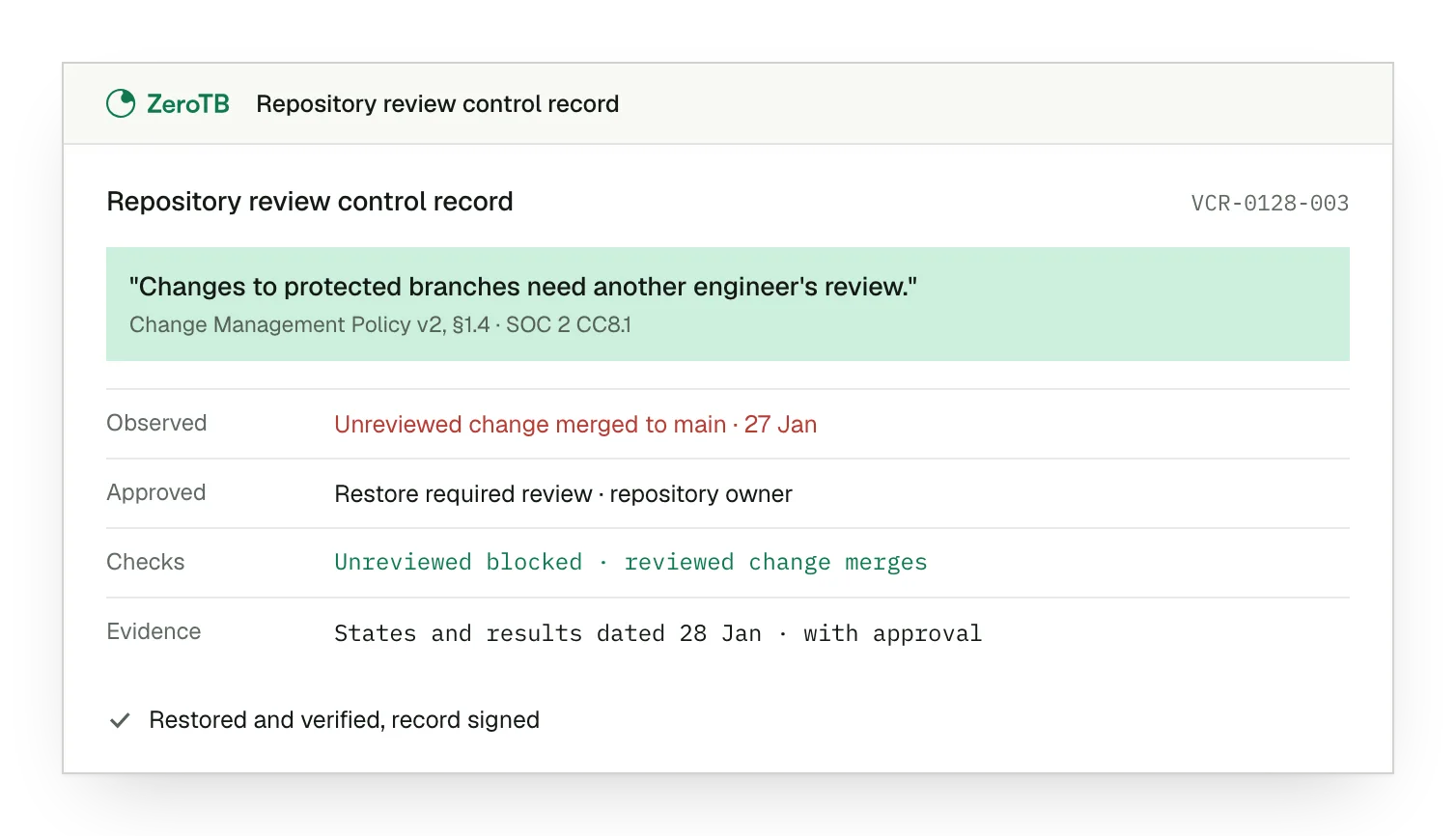
Missing review rule. The repository accepts an unreviewed change despite a policy requiring another reviewer.
Approved rule change. The owner approves restoring required review on the branch receiving changes.
Verified merge conditions. An unreviewed change is blocked, while a change with the required review proceeds.
Retained closure evidence. Observed states and verification results remain beside the approved correction.
Check five things before Codex reaches production
Establish where Codex runs, its permitted tasks and the data it can reach.
Check files, services and the accounts behind each connection.
Inspect repository and release rules for required reviews and tests.
Obtain the owner's approval, then test the corrected condition.
Keep the repair's decision and verification together, with an owner for further checks.
Sources
- OpenAI, Agent approvals and security, accessed November 4, 2026.
- OpenAI, Codex Security, accessed November 4, 2026.
- OpenAI, Codex security cookbook, accessed November 4, 2026.
Start with the Pilot
Discuss Codex controls. Over eight weeks, the Pilot maps up to 25 commitments and takes two real gaps through verified restoration.