Home / Organizational controls
What does ISO 27001 A.5.7 require for threat intelligence?
ISO 27001 A.5.7 asks organizations to gather threat information and assess what it means for their security. Connect each relevant report to the systems it could affect and an owner who can decide what to do. Retain that decision and the evidence of any correction.
Receiving an advisory is only the beginning of the work. Someone has to establish whether the affected technology is in use, decide how to respond and follow the action to completion. The gap often appears between those jobs, especially when different teams own them.
Relevant threat information
Threat intelligence should help someone decide how to protect a system, a service or information. A report might describe an exploited weakness, an attack method or a threat to a supplier. Its value depends on whether the organization can use it to make a security decision.
The decision can concern immediate protection or a wider change in risk. An attack method may prompt a detection check; a change in supplier exposure may prompt a risk review. ISO's overview connects the collection and analysis of threat information with security decisions and subsequent reassessment.
Sources and coverage
Choose sources that cover the technologies and business relationships the organization depends on. Supplier advisories, security communities and internal incident findings can answer different questions. A source list should make those differences clear, so a reviewer can identify which risks receive attention and where information is missing.
Check whether reports arrive with enough context to judge their relevance and credibility. Preserve the source, date and any limits on distribution when passing information to another team. NIST SP 800-150 provides guidance on selecting sources and setting rules for sharing threat information.
System exposure
A threat report becomes useful when its conditions are compared with the systems actually in use. The product name in an advisory may differ from the name in an asset register. Establish which deployment, version, feature or connection the report could affect before dismissing it.
The assessment should explain how the reported threat could reach the affected information or service. Current settings and deployment records help test that explanation. If the available inventory cannot establish whether a component is present, record the unresolved question and assign the investigation to someone who can answer it.
Decision ownership
An owner needs to carry each relevant report through to a decision about the response. That person may need help from another team: security can assess an advisory, but the application owner may be the person authorized to change the affected service.
For the handoff to work, the application owner needs to understand the affected scope, the proposed response and its priority. Record acceptance of the work and the route for unresolved decisions. An absent reviewer or a change in team responsibilities should leave a visible decision to resolve.
Response priority
The response should reflect the organization's exposure and the consequences of a successful attack. A severe advisory may affect an unused feature, while a less prominent report may concern an exposed service holding sensitive information. The assessment needs to explain that local difference.
Use the available evidence about exploitation, reachable systems and existing protections to support the decision. Record what remains unknown and whether it could change the priority. The owner can then evaluate the reason for a deadline, and new information can prompt a deliberate change in the response.
Decisions without a change
Some assessments will reasonably conclude that no immediate change is needed. The affected product may be absent, or an existing protection may already address the reported condition. Retain the observation behind that conclusion, the scope it covers and the owner's acceptance of the decision.
A decision to monitor needs similar care. Specify who will review new information and what would reopen the assessment. If a reviewer cannot find a component in an incomplete inventory, its presence remains an open question. The record needs to preserve that uncertainty until someone investigates.
Approved responses
A response can involve a system change, a detection check or an investigation. State the intended effect before selecting the action. A change that limits exposure, for example, needs a check showing that the affected route is restricted while necessary service remains available.
For a technical correction, the proposal should identify the affected system, the intended state and the approval needed to proceed. Other responses may update an operating procedure or the risk assessment. In each case, the owner needs to know what result will establish that the response is complete.
Missed handoffs
The control can fail after a report is read if nobody accepts responsibility for the next action. A forwarded message or an unassigned ticket can leave the assessment unfinished. Review the handoff itself when a relevant warning has no decision or an agreed response has stalled.
To restore the control, establish the current scope, assign responsibility and resolve the missing decision. A later deployment may have changed the original exposure. Recheck that context before reviving an old task, and correct the routing or inventory problem that allowed the warning to be overlooked.
Verification after action
A completed change needs a check against the exposure that prompted it. An installation record may show that an update ran; a current observation establishes which version the affected deployment now uses. The evidence should answer the original security question and identify the systems actually checked.
Keep failed or unavailable checks visible until the owner can resolve them. ZeroTB's Verified Control Record connects the commitment, before-and-after state, action, approval and verification. That connection lets a reviewer follow the correction and understand the basis for closing the gap without reconstructing it from separate messages.
Continuing assessment
An earlier assessment may need reopening when a deployment or an advisory changes. A component that was absent can enter production later; a supplier can expand the scope of a warning. Set clear review conditions for the earlier decision so its owner can recognize when the reasoning needs updating.
When a warning was missed, review how it passed through the process. The correction may involve a source, an asset name or the team receiving the work. AI security covers the related concern of permissions and connections changing as agents enter the environment.
Audit evidence
A reviewer should be able to select a report and follow what the organization did with it.
| Requirement | What an auditor asks for | Where it comes from |
|---|---|---|
| Relevant information | Which report reached the team, when it arrived and what it concerned | The original advisory, security report or internal finding linked to the assessment |
| Assessed exposure | Which systems could be affected and how the team established that scope | The inventory match, deployment details and settings used to assess the report |
| Explained decision | Why the owner chose a response and how its priority was decided | The assessment and owner decision, including the reason for retaining a monitoring response |
| Assigned response | Who accepted the work and what they agreed would count as completion | The assigned work, recorded acceptance and approval for any change that followed |
| Verified outcome | What the team checked after acting and whether the exposure was addressed | The dated results and approvals retained in the evidence record |
Related framework requirements
| Framework | Control | What it covers |
|---|---|---|
| ISO 27001 | A.5.7 | Collection and analysis of threat information for decisions about protection |
| SOC 2 | CC3.2 | Identification and analysis of risks to objectives; the assessment may draw on threat information |
| HIPAA | 164.308(a)(1) | Analysis and management of risks to electronic protected health information |
Example of resolving an overlooked advisory
Matching an advisory to a deployment can reveal work the team missed. Here, the inventory uses an internal name for the affected service. Once the reviewer identifies it, the service owner approves a correction and receives the results of the agreed checks.
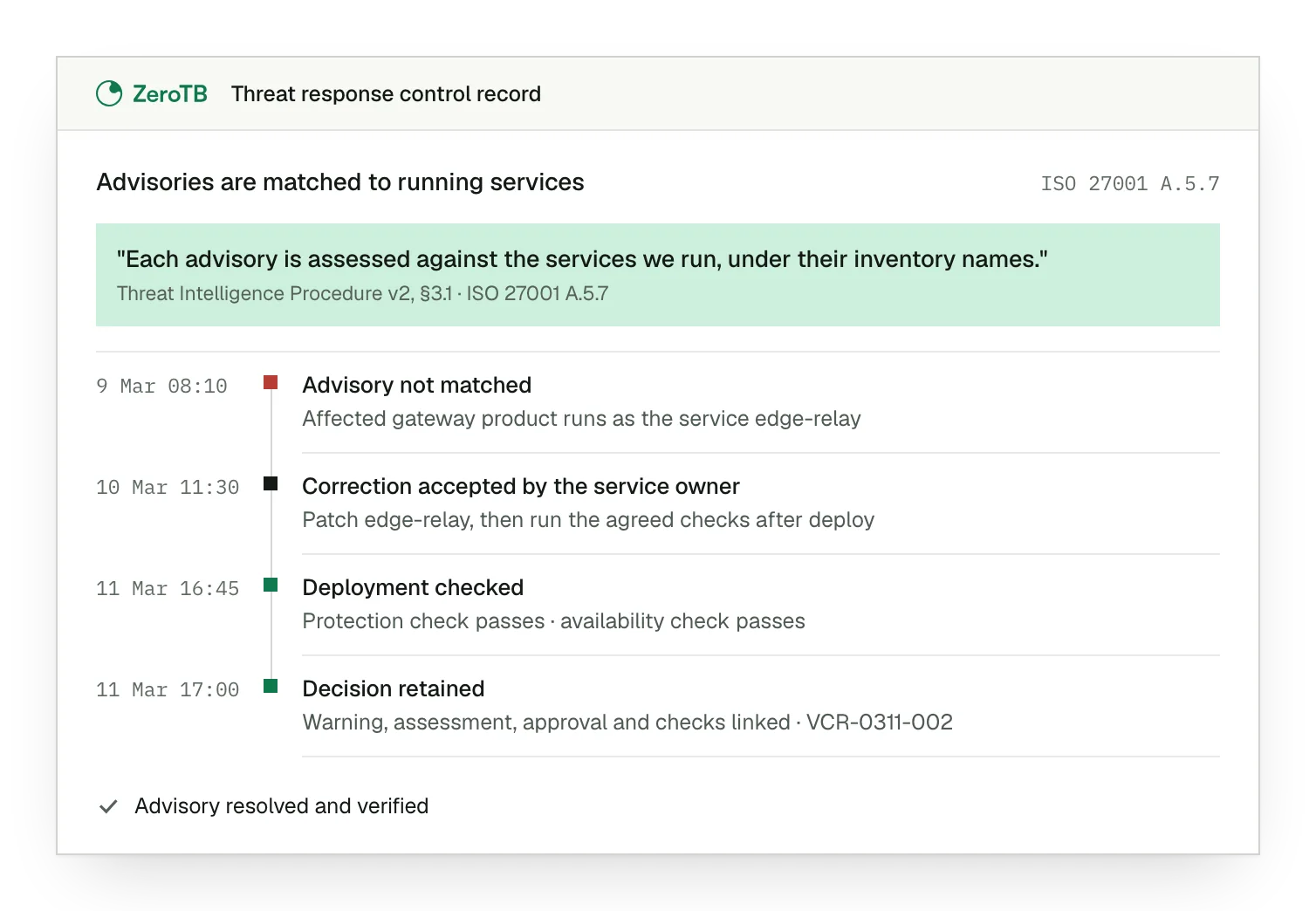
Missed asset match. The product named in the advisory matches a service listed under a different internal name.
Accepted response. The owner accepts the proposed correction for that deployment and the conditions for checking it.
Checked deployment. The updated service passes the agreed protection check, and the availability check also succeeds.
Retained decision. Another reviewer can read the original warning beside the assessment, approval and completed checks.
Threat intelligence review checklist
Select a recent advisory and follow it into the assessment, including the systems considered and the reason for that scope.
Read why the owner chose the response and what would reopen it, especially where the decision was to monitor.
Look for acceptance by the team doing the work and an agreed result against which it can be checked.
Read the checks against the original exposure, looking for failed results and affected systems left outside the completed review.
Sources
- ISO, ISO/IEC 27002:2022, 2022, control guidance reference.
- ISO, Threat intelligence and why it matters for cybersecurity, accessed November 4, 2026.
- NIST, SP 800-150: Guide to cyber threat information sharing, 2016.
- AICPA & CIMA, Trust Services Criteria, 2022 revision.
- HHS, Summary of the HIPAA Security Rule, accessed November 4, 2026.
Related pages
Organizational controls
Find the organizational responsibilities that support threat assessment, ownership and the handling of security information.
ISO 27001
See how individual controls fit within the wider information security management system and its approved scope.
Compliance frameworks
Explore related guidance across the frameworks that shape a company's security commitments and control evidence.
Start with the Pilot
Talk with our team about the gaps that recur between audits. The eight-week Pilot maps up to 25 commitments and takes two real control gaps through approved correction and verified restoration, with evidence of the resulting state.