Security at ZeroTB
You decide which material changes ZeroTB can make to your systems. We begin with observation, then work within the permissions you grant for repairs. This page explains those boundaries and how we handle customer data. Our independent audit report is available under NDA for your security review.
Access without clear limits
A security review needs a clear account of what an integration can read and change. Permission to inspect a system leaves a separate question: who can authorize a repair? That boundary needs to hold when the tool moves from identifying a problem to acting on it.
A tool connects
Change permissions remain unclear
Approval boundaries become uncertain
Approved control changes
ZeroTB carries each commitment through to a checked result, with people deciding what it means and which material changes can proceed.
Read and check
AI reads commitments for your approval, and ZeroTB checks the relevant systems against the agreed requirements.
Draft the fix
ZeroTB proposes a response to the gap, including a runbook, pull request or approved API action.
Authorize the change
People authorize material actions. ZeroTB executes the approved logic within the permissions granted for that work.
Verify and record
ZeroTB checks the resulting state before closure and preserves the approval and result in a Verified Control Record.
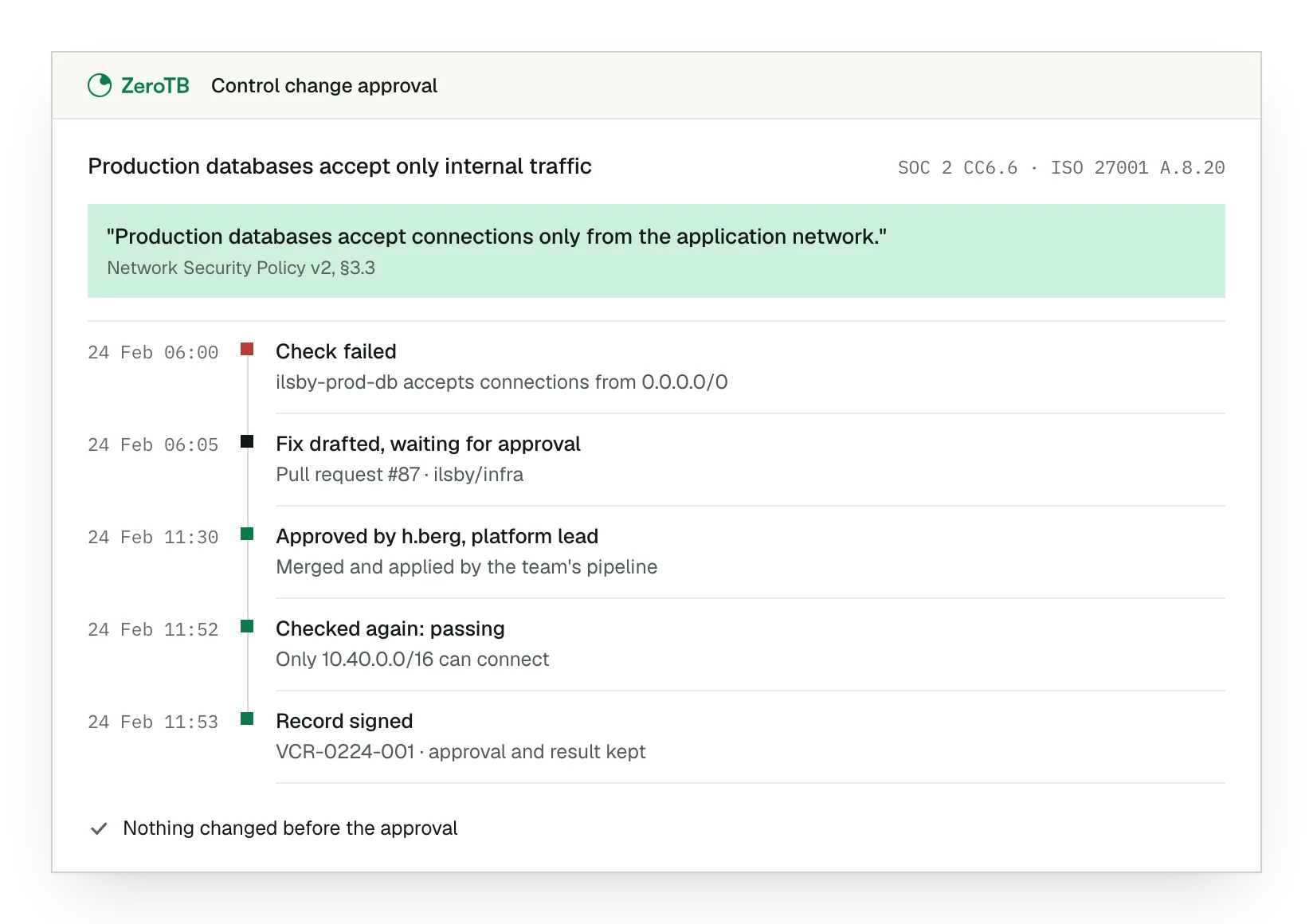
Limits on automated actions
The permission to connect a system does not authorize every repair. ZeroTB separates observation, approved changes and verification of the result.
ZeroTB observes first. Any write access needs a scoped grant for the relevant action class, which you can revoke.
Pull requests are the default for material changes, so your team reviews and merges the proposed repair.
Direct API actions require an opt-in. They are reversible, and policy restricts the systems and resources they can affect.
Unknown, stale and disconnected checks stay visible as such. AI cannot mark a control healthy or close it independently.
Customer data protection
The DPA describes how ZeroTB protects customer information, including the safeguards below. It also sets confidentiality obligations for personnel who access that data.
Data travels and is stored in encrypted form. ZeroTB keeps each customer's data logically separate from other customers' data.
Access follows least-privilege rules, with multi-factor authentication for all administrative access. Customers control access for their users and guests.
The service keeps tamper-resistant audit records. ZeroTB also uses infrastructure logging, threat detection and regular security testing.
ZeroTB uses cloud infrastructure in the United States; the published sub-processor list identifies US processing locations for every provider.
Independent audit and review
ZeroTB is independently audited. We use the same control lifecycle in our own compliance program, and the report is available under NDA. We also provide security documentation and responses to security questionnaires for customer reviews.
Independent audit report available under NDA
Published processing terms and security measures
Listed sub-processors with purposes and locations
Talk to our team
Talk with our team about access permissions, approval requirements and the security information you need to evaluate ZeroTB.
FAQ
Is ZeroTB itself independently audited for SOC 2?
Yes. ZeroTB is SOC 2 audited, and its report is available under NDA. We use the same control lifecycle in our own compliance program. The Data Processing Addendum describes access to the most recent independent audit report under confidentiality.
Are inputs to AI providers used to train models?
No. Inputs to third-party AI model providers are not used to train models. The Sub-processors page identifies the providers that process customer data, their purposes and processing locations. The DPA sets out the terms for ZeroTB's use of those providers.
What does ZeroTB's device software collect?
If installed, the software collects device and security information, including identifiers, software versions, patch status, vulnerabilities, malware detections and diagnostic logs. It does not collect file contents, keystrokes, screenshots or browsing history. The DPA's Annex I describes the full scope.
What happens to our data when the agreement ends?
Customers can export data before the agreement ends. ZeroTB deletes customer personal data within 30 days afterwards, with exceptions for records under storage locks, backups and legally required retention. Locked records remain until the lock expires; backups expire on a rolling 30-day schedule. The DPA continues to protect retained data.
When does ZeroTB notify customers about a security incident?
ZeroTB notifies the customer without undue delay, and within 72 hours after confirming a security incident. The notice describes the known impact and response measures, with further information provided as it becomes available. Section 8 of the DPA defines the notification commitment.
Will we hear about new sub-processors before they receive data?
Yes. Administrators receive an email at least 30 days before a new sub-processor begins processing customer data, and we update the published list. You can object on reasonable data-protection grounds during the notice period. Section 6 of the DPA explains the process for resolving an objection.
How can we obtain a countersigned DPA?
Email compliance@zerotb.ai to request a countersigned copy. You can read the published DPA before contacting us. It forms part of the service agreement and describes the customer personal data we process, the purposes of that processing and the security measures we maintain.
Start with the Pilot
The eight-week Pilot maps up to 25 commitments from your report and takes two real control gaps through verified restoration. You receive working controls and portable evidence records, with material changes subject to human approval.