Home / Organizational controls
What does ISO 27001 A.5.37 require for written operating procedures?
ISO 27001 A.5.37 concerns written operating procedures and their availability to the people who need them. Document the steps, prerequisites and checks that let an intended operator complete the task. When systems change, test the affected instructions and retain evidence that the approved procedure remains usable.
A procedure can pass a document review and still fail during use. The operator may lack a required permission or encounter a console that the instructions no longer describe. The useful question is whether the current instructions let that person complete the work safely.
Scope of the procedure
A.5.37 concerns the operating instructions people need to handle information and run the systems that process it. Start with the work covered by the approved control. Define the task, the systems it affects and the people expected to perform it.
The amount of detail should fit the task's risk, complexity and intended users. A familiar, routine operation may need brief instructions. Work performed rarely may need more explanation because the operator cannot rely on recent experience. Document length alone says little about usability.
Instructions for the operator
A usable procedure explains what must be ready, what to do and how to recognize the expected result. Put prerequisites before the steps that depend on them. These can include permissions, required tools and the conditions under which the work can begin.
Describe the checks that confirm completion and the response when a step fails. An operator needs to know when to stop and who can resolve the problem. Missing instructions at that point can turn a documented task into an improvised change.
Access to current instructions
Operators need access to the approved version at the time they perform the task. Check where they find the instructions and whether their accounts can open them. A document that only its author can read will be of little help to a colleague covering the work.
Copies can cause confusion after a revision. Someone may still follow a downloaded file or a printed checklist because it is close at hand. Mark the current version and replace old working copies. Recovery instructions also need a location that remains reachable during the relevant failure.
Ownership and approval
The procedure owner decides whether a proposed method is suitable for the work and approves changes to the instructions. This needs knowledge of the operation itself. Someone responsible only for filing the document may miss a change to the systems it describes.
Version history should explain the owner's decision as well as the edit. If an operator suggests a workaround, record why the owner accepted or rejected it. Other operators can then follow the approved method, and a later reviewer can understand how it was chosen.
Changes that affect procedures
A recent review date does not tell an operator whether the instructions still match the system. A console, permission or service may have changed since that review. Include affected procedures in the work needed to complete those changes, as well as scheduled reviews.
Ask where operators have needed extra steps. Private notes and repeated explanations can reveal work that the approved procedure leaves out. Compare the workaround with the intended method before adding it to the document; the workaround itself may need correction or the owner's approval.
Tests with another operator
A test with an intended operator reveals missing knowledge that the procedure's author may supply from memory. Choose someone with the expected role and skills. Their attempt should establish whether the written instructions provide enough information to complete the task in the agreed setting.
Record where the operator pauses, asks for help or departs from the steps. Assistance can make an operation succeed while concealing a gap in the procedure. Keep that distinction visible in the test record so the review addresses the instruction that failed.
Safe test conditions
The test needs to exercise the instructions without creating an unacceptable risk to the service or its data. Agree the environment, permissions and stopping conditions before execution. A recovery exercise, for example, needs a suitable target and a clear boundary around production data.
A walkthrough can expose missing information when a full execution is unsuitable. Record which steps were discussed and which were performed. If a permission or recovery step remains untested, preserve that limit in the result and decide how to check it safely.
Correction and retesting
A repeat test is the basis for closing a procedure gap. Use the failed step to identify what differs from the approved method, then draft a correction for the owner. After approval, replace the instructions and obsolete copies before an operator tries the affected work again.
Save the result with the original failure and the approval. This is how ZeroTB approaches control operations: a commitment leads to a check, an approved correction and verification of the outcome. The record needs to show that someone could use the revised instructions successfully.
Automation and human judgment
A procedure with defined inputs and a testable result gives automation a useful job. Software can collect observations and save the outcome of a check. The reviewer can use those records to see whether the operation met the conditions agreed for it.
A completed script may still leave a question unanswered about the result. Decide what each check establishes and where a person must judge the outcome. Keep failed checks and missing observations visible. Decisions about permitted actions and approval of material changes remain with people.
Evidence of usable procedures
Keep the procedure version beside the record of its test. The reviewer needs its approval, the execution date and the system or environment where it ran. Include the operator's role and any departures from the instructions, especially help that made completion possible.
That context matters when the instructions have changed since an earlier test. A Verified Control Record connects the commitment, before-and-after state, action, approval and verification after a correction. From those details, the reviewer can follow what failed, what changed and how the revised method performed.
Procedure evidence
Use these records to explain which instructions apply, who can use them and what happened when they were tested.
| Requirement | What an auditor asks for | Where it comes from |
|---|---|---|
| Defined task | The operation covered, intended users and conditions for performing it | The approved procedure and the control or policy that defines its purpose |
| Available instructions | How intended operators find and access the current version | The controlled document location, access settings and checks from the operator's role |
| Assigned ownership | Who reviews the method and approves changes to it | Procedure ownership, version history and the decision recorded for the current revision |
| Usable steps | What happened when an intended operator followed the instructions | A dated execution or test record identifying the version, environment and deviations |
| Completed correction | How the team resolved a failed step and confirmed the result | The observed gap, approved revision and repeat test linked in the control record |
Related controls
| Framework | Control | What it covers |
|---|---|---|
| ISO 27001 | A.5.37 | Written instructions for operating work, made available to the people who need to use them |
| SOC 2 | CC5.3 | Procedures that put policies into operation and support the performance of control activities |
| HIPAA | 164.308(a)(1) | Policies and procedures for addressing security violations within the scope of the Security Rule |
Example of restoring a recovery procedure
In this example, a safe recovery test exposes an obsolete console reference and a permission missing from the instructions. The owner approves a revision. A second operator tests it, leaving a result that the reviewer can connect to the corrected steps.
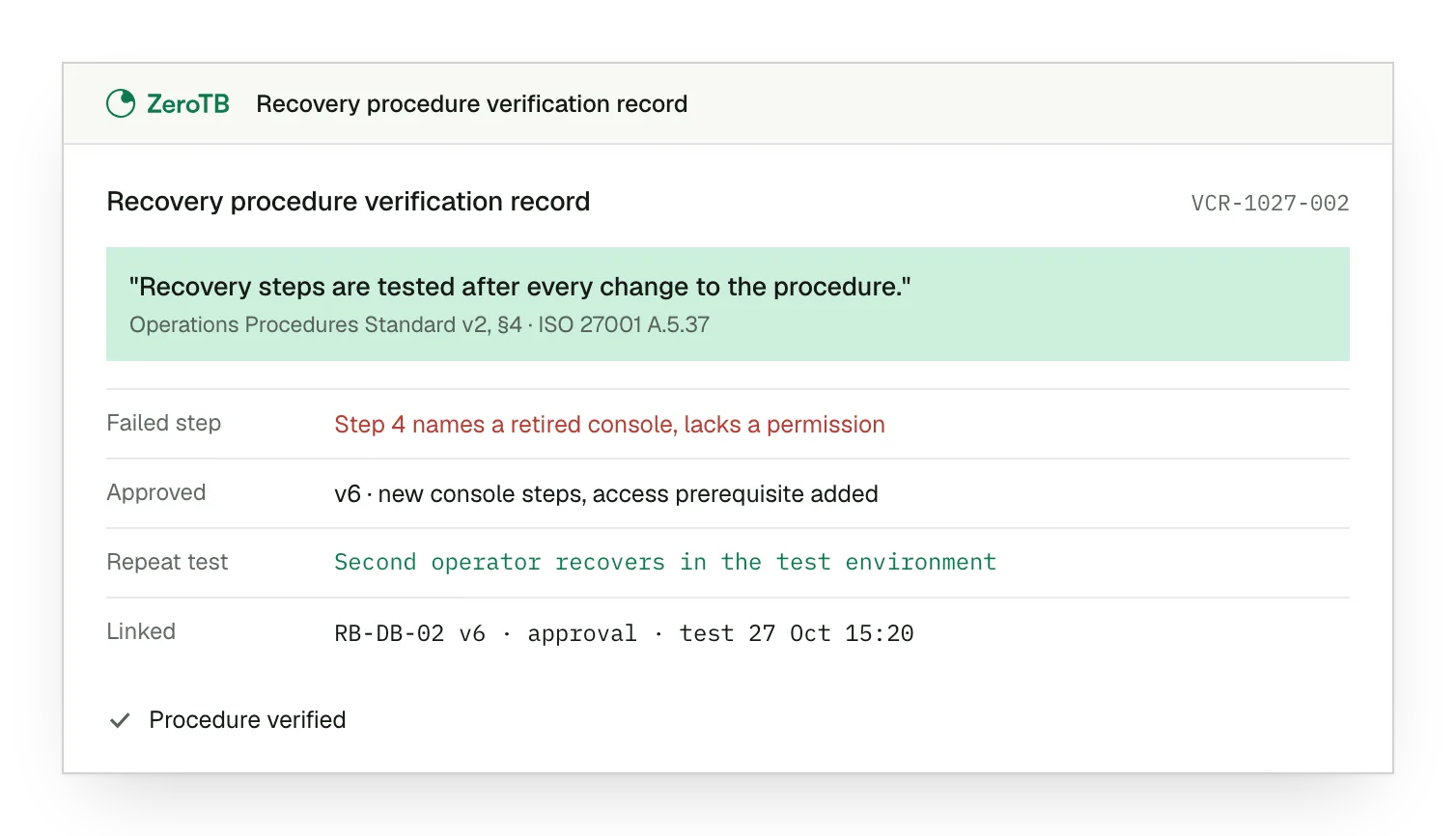
Failed instruction. The old console reference leads nowhere, and the instructions omit a permission needed for recovery.
Approved revision. The owner approves the replacement console steps and adds the access prerequisite to the procedure.
Successful repeat test. Another operator uses the approved revision in the test environment and obtains the expected recovery result.
Retained execution evidence. The dated test result links back to the failed instruction, approved change and procedure version.
Procedure review checklist
Identify a task covered by the approved control and the role expected to complete it.
Compare the instructions with current consoles, permissions and services, including workarounds that operators have needed.
Agree a safe setting, expected result and stopping conditions that let an intended operator test the instructions.
Check that the result identifies the procedure version, relevant environment and any unresolved deviations from the approved method.
Sources
- ISO, ISO/IEC 27001:2022, 2022. Information security management system requirements.
- ISO, ISO/IEC 27002:2022, 2022. Guidance on information security controls.
- AICPA & CIMA, Trust Services Criteria with revised points of focus, 2022 revision.
- HHS, HIPAA audit protocol, 2018 update. Security management process.
- ZeroTB, Control operation and verified restoration, 2026.
Related pages
Organizational controls
Read the other organizational controls that govern how information security work is assigned and performed.
ISO 27001
See where individual controls fit within the information security management system and its commitments.
Compliance frameworks
Browse the control libraries for the frameworks covered by the same company security program.
Start with the Pilot
Talk with our team about keeping procedures and controls working. During the eight-week Pilot, we map up to 25 commitments and take two real control gaps through approved correction and verified restoration, with evidence of the work and its result.