Home / Organizational controls
What does ISO 27001 A.5.35 require for independent review of the security program?
ISO 27001 A.5.35 concerns independent review of the security program: its approach and how it works in practice. Reviews take place at planned intervals and when significant changes warrant them. A competent reviewer needs sufficient independence from the work, and management needs to receive the findings and arrange appropriate follow-up.
A review is useful when management can act on its conclusions. That takes more than receiving the report. The organization needs a way to assign corrective work, examine the results and explain what happened to each finding before the next assessment begins.
Review scope
An independent review examines both the security approach and how the organization puts it into practice. The review needs to consider whether policies, responsibilities and controls remain suitable for the work they cover. Its scope should make those boundaries clear before assessment begins.
A policy review can establish what the organization intends. Interviews, records and system observations help establish how it operates. Together, they give the reviewer a basis for judging the approach. Record excluded activities so management can understand the limits of the resulting conclusions.
Reviewer independence
A reviewer needs enough separation from the work to question its design and operation. An internal reviewer may be suitable when they can assess the area objectively. An external reviewer also needs scrutiny if they helped design or operate the controls being examined.
Document the reviewer's responsibilities and relationship to the work. Where those responsibilities conflict with the assessment, assign that part to another suitable reviewer. In a small team, outside help can provide the separation that the organization cannot achieve with its own staff.
Reviewer competence
The reviewer must understand the security work well enough to evaluate the evidence and challenge the conclusions. Match their knowledge to the systems, processes and security requirements within scope. Independence alone cannot establish whether a reviewer can identify a weakness in those arrangements.
Specialists can explain unfamiliar systems or help interpret technical evidence. Keep their contribution distinct from the reviewer's assessment, particularly when they operate the system under review. The reviewer needs to understand the evidence well enough to reach and explain an objective conclusion.
Review timing
A.5.35 combines planned reviews with review prompted by significant changes. Set a schedule that reflects the organization's circumstances and security risks. Between scheduled reviews, assess whether changes have made earlier conclusions incomplete or introduced security work that needs independent examination.
A major service launch, a different operating model or a substantial change in responsibilities can justify another review. Record the reason for the timing decision and the areas it affects. This keeps review timing tied to changes in the organization and the risks they introduce.
Coverage after change
The date on a report says when the review happened; its scope says what received examination. A recently added service may fall outside that scope. Compare the activities the reviewer assessed with the current operation, especially where significant changes have introduced new security responsibilities.
Agree any extension with the reviewer, including the evidence needed to assess the affected activities. The extension may leave earlier conclusions intact while examining the new work. Record both the additional coverage and remaining exclusions, so management can read the assessment with its boundaries clear.
Evidence for assessment
Useful review evidence connects an approved security requirement with what people and systems do. Policies establish the expected practice; dated observations, approvals and activity records show its operation. The reviewer can then compare the two and investigate differences that affect the conclusion.
Evidence from another assessment can inform the review when its scope and period are relevant. For example, a SOC 2 report can identify commitments to examine. The reviewer still needs to account for excluded systems, later changes and evidence that is missing or stale.
Findings and management decisions
Management needs each finding to identify the gap, its significance and the decision required. A useful finding connects the review criteria with the observed condition. That connection shows management why the issue matters and who can address it. This also helps management prioritize corrective work across different teams.
Preserve the reviewer's conclusion alongside management's response, including the action owner and intended completion date. If management accepts a risk or disagrees with a finding, record its reason and decision. A later reader should be able to distinguish that decision from the independent assessment.
Corrective action
The finding determines what a correction must achieve. Unclear responsibilities may call for a revised procedure and an assigned owner. Where the procedure is sound but a system permits access outside its rules, corrective work must address that operating condition in the affected application.
Before approving a change, the owner needs to understand its expected effect and how that effect will be tested. An access correction must also preserve the access the business still needs. Keep those decisions with the finding as the basis for follow-up.
Verification and closure
Follow-up should establish whether the correction achieved its intended result. Inspect evidence from after the change and compare it with the agreed outcome. Where a system setting changed, test its effect as well as confirming that someone completed the assigned action.
Keep unresolved conditions visible when evidence is missing or the test fails. A successful technical correction supplies evidence for the reviewer's follow-up judgment. Preserve that judgment with the results so management can understand why the finding closed and which issues still require attention.
Continuing review
The next review needs the history of previous findings and the changes that followed. Recurring issues can reveal that a correction addressed only part of the problem. Those patterns help the reviewer decide where to examine the security approach and its operation more closely.
ZeroTB's Verified Control Record retains the commitment, before-and-after state, action, approval and verification for a restored control. These records support assessment of corrective work. The independent reviewer uses the relevant evidence to judge the broader security program and report conclusions to management.
Review evidence
The review file needs to explain what was assessed, who assessed it and what happened after management received the findings.
| Requirement | What an auditor asks for | Where it comes from |
|---|---|---|
| Defined scope | Activities examined, exclusions and the reason for the review's timing | The agreed review plan and decisions about changes to its scope |
| Independent, competent review | The reviewer's relevant knowledge and relationship to the work under assessment | Qualifications, responsibilities and the documented basis for assigning the reviewer |
| Findings supported by evidence | The observations behind the conclusions and the criteria used to assess them | Review report with supporting records, interviews and dated system observations |
| Management action | A response to each finding, with responsibility and a date for corrective work | Management decisions and actions assigned against the review's findings |
| Assessed corrections | Evidence of the result and the reason for closing or retaining each finding | Change approvals, verification results and the recorded follow-up conclusion |
Related framework requirements
| Framework | Control | What it covers |
|---|---|---|
| ISO 27001 | A.5.35 | Independent review of the security approach and its operation, with scope and follow-up recorded |
| SOC 2 | CC4.1 | Ongoing or separate evaluations of whether internal controls are present and functioning |
| HIPAA | 164.308(a)(8) | Technical and nontechnical evaluation of security policies and procedures against applicable Security Rule requirements |
Example of closing a review finding
A finding about review coverage needs evidence that the omitted work has been assessed. In this example, routine access reviews missed a new service. The record follows the owner's decision to include it through to the independent reviewer's assessment of the completed correction.
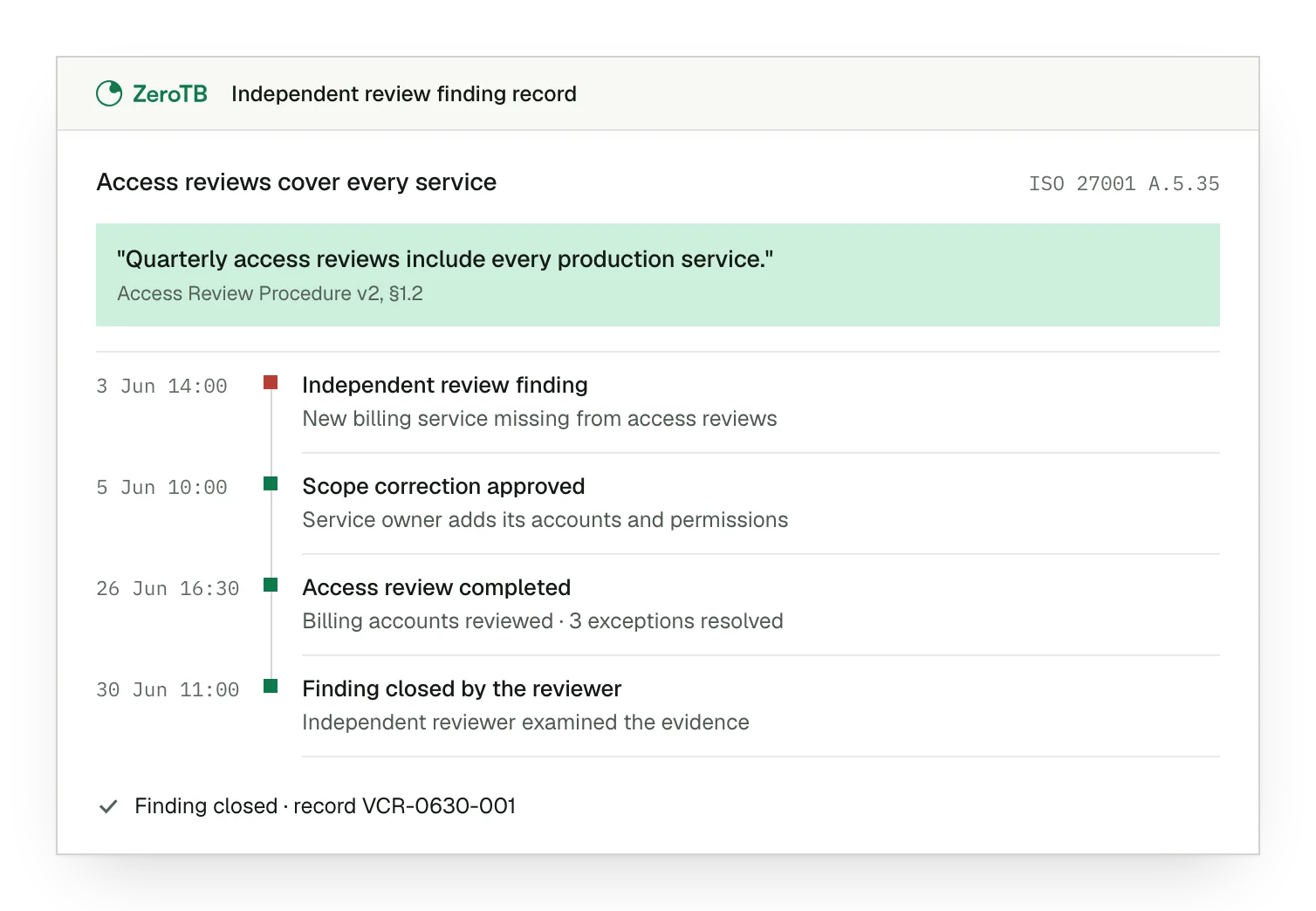
Review finding. The independent reviewer identifies the missing service and records the gap in access review coverage.
Approved correction. The owner agrees to include the service's accounts and permissions in the access review.
Completed work. The access review now includes the service, with decisions and resolved exceptions recorded against its accounts.
Closure decision. The independent reviewer examines that evidence and records whether the correction addresses the original finding.
Independent review checklist
Compare the planned assessment with the current security program, including significant changes and any activities excluded from earlier reviews.
Check the reviewer's relevant knowledge and relationship to the work, then resolve responsibilities that could compromise an objective assessment.
Connect each finding with management's response, an action owner and an agreed result that follow-up can assess.
Examine evidence after the correction and retain the follow-up conclusion, including any unresolved issue or condition that requires further review.
Sources
- ISO, ISO/IEC 27001:2022, 2022. Information security management system requirements.
- ISO, ISO/IEC 27002:2022, 2022. Information security control guidance.
- AICPA & CIMA, Trust Services Criteria with revised points of focus, 2022 revision. Related SOC 2 evaluation criterion.
- HHS, HIPAA audit protocol, 2018 update. Evidence for evaluation under 164.308(a)(8).
Related pages
Organizational controls
Explore the organizational controls that establish responsibilities for managing security across the business.
ISO 27001
Place independent review within the wider information security management system and its controls.
Compliance frameworks
Find related guidance for the frameworks that apply to the organization's security program.
Start with the Pilot
Talk with our team about keeping corrective work moving after a review. The eight-week Pilot maps up to 25 commitments and takes two real control gaps through approved correction and verified restoration, with evidence of the results.