Home / Organizational controls
What does ISO 27001 A.5.20 require for security terms in supplier contracts?
ISO 27001 A.5.20 addresses security terms in supplier contracts: the duties both parties agree to for the service, information and access involved. Those terms need to fit the relationship. When a service changes, review the agreement for missing responsibilities and verify any operating changes needed to carry out the revised terms.
A support team gains access to production, but the supplier still works under its original hosted-service agreement. The security review now has two things to establish: whether the terms cover that access, and whether the protections required by those terms actually operate.
Agreement scope
Supplier security terms need to describe the service as it operates today. The relevant scope includes the information the supplier handles, the systems it can access and the work it performs. This gives contract and security owners a shared basis for reviewing requirements.
A standard agreement provides a starting point for that review. Its terms still need to fit the relationship and applicable obligations. A supplier that receives information and a supplier that administers production systems can create different security responsibilities, even when both provide software services.
Security responsibilities
The agreement needs to establish which party owns each security responsibility. Both parties may have work to do when access changes, information needs protection or an incident occurs. The terms need enough detail for each party to understand what it has agreed to do.
Consider the end of a support arrangement. Someone must decide when access ends, and someone must remove it. The agreement can assign those responsibilities alongside duties for handling information when the service ends. The terms depend on the work and information involved.
Incident communication
A notification duty only helps if the message can reach someone responsible for responding. The agreement may require the supplier to report incidents, yet leave the recipient unclear. The contact details and escalation procedure need to make that route usable.
A test message to the agreed contact can reveal an address that no longer works or reaches the wrong team. Keep the result with the procedure it tests. It establishes whether that route works; decisions made during an actual incident require separate evidence.
Service changes
A supplier can gain new access while its signed agreement still describes the original service. Added production support is one example: the supplier now enters systems it previously only hosted. That access may introduce security duties that neither party considered in the original purchase.
The review should compare the agreement with a description of the changed work and current access records. Service owners can explain what support now involves. Security and contract owners can use that detail to identify missing responsibilities and decide whether the terms need amendment.
Contract decisions
Changes to agreed responsibilities require the parties authorized to interpret and amend the agreement. Contract owners need a clear description of the gap and the proposed responsibilities. Security and service owners contribute the operating detail needed to assess whether those terms fit the work.
The agreement and its implementation can involve different approvals. Accepting a revised access responsibility does not itself change a supplier account's permissions. The decision should identify any operating action required, the person who can authorize it and the result expected after that action.
Unresolved requirements
An unresolved security requirement needs an explicit decision about the remaining risk. If the parties cannot agree to a proposed term, the record should explain the unresolved responsibility. The authorized owner can then decide whether the service can continue under an approved arrangement.
An accepted risk needs an owner and review conditions, including when a change in the service would reopen the decision. Keep that decision distinct from a completed correction. A draft amendment or an ongoing negotiation cannot establish that both parties have accepted revised responsibilities.
Operational checks
Closure needs evidence that the agreed operating change took effect. An executed amendment establishes the responsibilities the parties accepted. For a change to supplier access, compare the permissions now available with those terms, including whether the supplier can still perform its approved work.
ZeroTB checks systems against approved commitments, proposes a correction, obtains approval and verifies the result before closing the gap. Its record gives security governance a traceable account of the work. The parties authorized to interpret or amend the contract retain those decisions.
Supplier evidence
Some supplier responsibilities depend on evidence held outside the organization's systems. A check of a local account can establish its permissions, but leaves the supplier's own information-handling practices untested. The review needs evidence that addresses the particular responsibility being assessed.
Distinguish an observed result from a supplier statement and from evidence that has been requested but remains unavailable. Record what each item establishes and which question remains open. Missing or outdated evidence leaves an unresolved assessment, even when the agreement contains an appropriate requirement.
Review records
The review record should connect the current agreement with the decision and evidence that support closure. Retain the executed terms, relevant amendments, service scope and review decisions together. A reviewer should be able to identify which version applies to the service being assessed.
For a correction, link the original gap to its approval, the action taken and the dated verification result. Keep any remaining exception visible with its owner. This record lets a later reviewer understand the closure decision when the supplier relationship changes again.
Evidence for supplier agreements
The evidence should let an auditor identify the applicable terms, understand any gap and examine the reason for closing it.
| Requirement | What an auditor asks for | Where it comes from |
|---|---|---|
| Current service scope | What the supplier does and which information and access the agreement covers | Executed terms, the service description and records of current access |
| Agreed responsibilities | Which party has accepted each relevant security duty | The agreement and any executed amendments that apply to the service |
| Incident communication | Who receives supplier incident reports and whether the route reaches them | Agreed notification terms, contact details, escalation procedure and route test results |
| Authorized decisions | Who accepted revised terms or approved a remaining risk | Approval and exception records identifying the owner and review conditions |
| Verified correction | Whether the approved operating change achieved the expected result | The original gap, change approval and dated observations linked to the agreement |
Related framework controls
| Framework | Control | What it covers |
|---|---|---|
| ISO 27001 | A.5.20 | Security duties agreed between the organization and the supplier for the service involved |
| SOC 2 | CC9.2 | Risks that the organization assesses and manages in its vendor and business partner relationships |
| HIPAA | 164.308(b)(1) | Assurances that electronic protected health information receives appropriate safeguards in applicable business associate relationships |
Example of restoring supplier access coverage
In this example, an agreement review catches a gap created by added production support. The parties agree to terms covering that work, and the system owner approves the access change. Closure follows checks of the supplier's permitted tasks and the access restrictions.
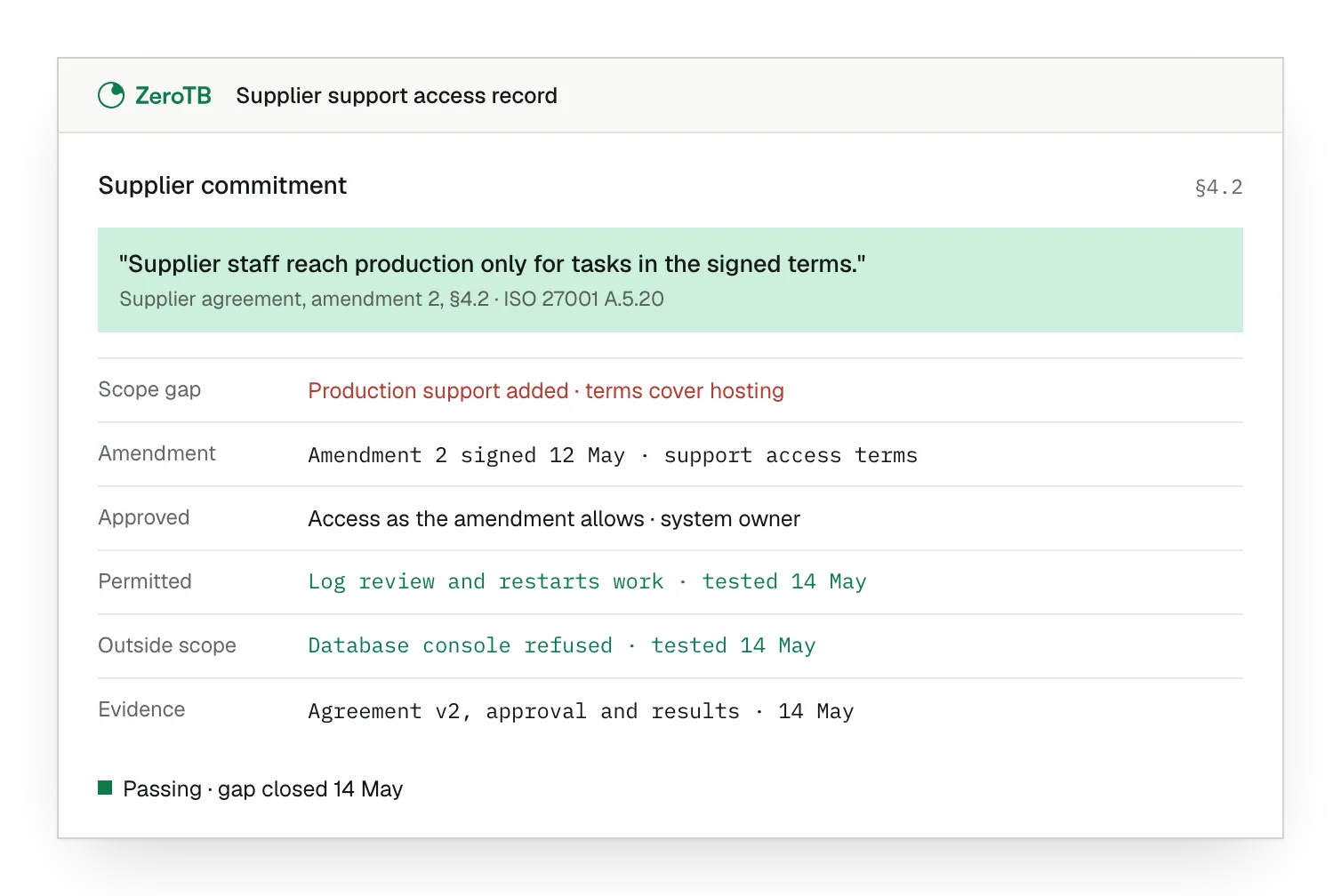
Expanded service scope. The supplier can now enter production, while the agreement still describes only the hosted service.
Agreed access terms. The signed amendment records which support access is permitted and which duties each party accepts.
Tested access limits. Access tests show that permitted support work succeeds and attempts outside the agreed scope fail.
Retained closure evidence. The executed terms sit beside the approval and test results used to close the gap.
Supplier agreement review checklist
Compare the executed agreement with the work now performed, including the information and systems the supplier uses.
Establish who owns each relevant duty, including incident notification and the removal of access when work ends.
Ask the authorized parties to decide on missing responsibilities and approve the required changes or remaining risk.
Check whether the approved action achieved its expected result; keep the gap open where evidence remains missing.
Retain the applicable terms, approved action and dated result together, including the owner and conditions for any exception.
Sources
- ISO, ISO/IEC 27001:2022, 2022. Information security management system requirements.
- ISO, ISO/IEC 27002:2022, 2022. Guidance on information security controls.
- AICPA & CIMA, Trust Services Criteria with revised points of focus, 2022 revision.
- HHS, Business Associate Contracts, 2013.
- ZeroTB, Control operation and verified restoration, 2026.
Related pages
Organizational controls
Explore the organizational responsibilities that surround supplier agreements within an information security management system.
ISO 27001
Read how individual controls support the wider information security management system and its risk decisions.
Compliance frameworks
Find the control libraries for other frameworks that apply to the systems and information under review.
Start with the Pilot
Talk with our team about supplier commitments and the controls behind them. The eight-week Pilot maps up to 25 commitments and takes two real control gaps through approved correction and verified restoration, with a record of the results.