Home / Organizational controls
What does ISO 27001 A.5.6 mean for security forums and peer groups?
ISO 27001 A.5.6 concerns relationships with specialist groups that help the organization improve its security knowledge and decisions. Choose security forums and peer groups relevant to the business, give each relationship an owner, and retain examples of how useful advice reaches an internal assessment or improvement.
A security-group subscription can remain active long after anyone stops reading it. A.5.6 belongs among the organizational controls because the relationship depends on people knowing why it exists, who maintains it and where useful information goes.
Relevant specialist contacts
A useful specialist contact gives the security team knowledge it can apply to the organization's risks. Professional associations, specialist forums and security communities can provide different kinds of advice. The useful choice depends on the systems, information and working practices the organization needs to protect.
A broad community may help with general security practice, while a specialist group may help staff understand a particular technology. Consider whether the people responsible for those subjects can use the information. An inactive membership gives the reviewer little evidence that the team keeps its knowledge current.
Purpose and ownership
The owner of a specialist relationship should be able to say what the company gets from it. Incident preparation is one possible purpose; advice about a new technology is another. A stated purpose gives the participant a reason to follow particular discussions.
A successor needs that explanation too. A short record of the group, its purpose and the internal destination for advice can make a handover easier. Membership receipts establish that a subscription exists, but they leave the next participant to work out what to do with it.
Participation and continuity
Participation needs a working route from the group to the person responsible for reviewing its information. A subscription, forum account or event registration gives the participant access to the group. Recent activity helps establish whether someone still uses that route for its intended purpose.
The review rhythm should fit the relationship and the information it supplies. An occasional specialist discussion and a frequently updated mailing list need different attention. The owner can explain how information is reviewed between formal control reviews and how someone else takes responsibility during an absence.
Advice and internal decisions
A participant needs to get relevant advice to someone who can judge its effect on the organization. That may be a policy owner, an engineer or the person responsible for incident preparation. Receiving the message starts the review; the responsible team decides what follows.
Sometimes the advice warrants a change. Sometimes the team needs to investigate, or finds that the issue does not apply to its systems. A dated explanation preserves the reason for that decision. The next reviewer can see both the advice and what the team did with it.
Safe information sharing
Questions to a specialist group need to stay within the company's rules for sharing information. The participant may need advice about a real incident or configuration. Before sending details, the participant needs to know which information can be disclosed and which details must be withheld.
The same care applies to evidence kept after the discussion. A review record needs enough context to explain the decision, with access suited to its contents. Copying an entire discussion into an evidence folder can add sensitive or unrelated material without helping anyone understand the control.
Relationships after staff changes
A staff departure can leave a useful security contact without anyone to maintain it. The membership continues and messages still arrive, but the recipient has left. In other cases, the person taking over knows about the group and cannot access it.
These failures need different responses. One calls for an owner; another calls for restored access. A group that has become irrelevant needs a decision about its purpose. Looking at recent participation and assessments helps the reviewer locate the problem before asking someone to correct it.
Approved corrections
The correction should address the reason the relationship stopped working. The responsible owner can approve a new participant, restore access or change where advice is reviewed. Where the group no longer serves its purpose, the decision may be to replace the relationship and explain why.
Keep the observed gap and the approved action beside the commitment they address. This follows the control restoration approach used by ZeroTB: a correction has an owner and a result to verify. For specialist relationships, that result includes a person assessing information and directing any necessary follow-up.
Verification of restored contact
Restored access is useful only when the intended person can receive and assess the group's information. After a handover, a current item can show whether advice reaches the new owner and whether the owner knows which internal team should review it.
Check the result against the gap that prompted the correction. If the inbox works but relevant advice still has no reviewer, part of the gap remains. Keep the unresolved part visible until evidence shows that the relationship meets the approved commitment.
Evidence of useful participation
Evidence should let a reviewer follow a relevant contribution through to an internal decision. A dated participation record, the advice assessed and the resulting decision can explain that sequence. If a change follows, its approval and verification belong with the record of the affected control.
A decision requiring no change can still show useful assessment when the reason is clear. The record should explain what was considered and why the team accepted the outcome. This gives the reviewer a specific basis for discussion without collecting every message the group has ever sent.
Audit evidence
These records help an auditor follow a relationship from its purpose through the work it informs.
| Requirement | What an auditor asks for | Where it comes from |
|---|---|---|
| Relevant relationships | What the team expects to learn from the groups it selected | The contact list, with a reason for each relationship and the work it is intended to inform |
| Current responsibility | Who receives the advice and who assesses it inside the company | The assigned owner, account or subscription details, and records of any handover to a replacement participant |
| Active participation | Recent use of the group for the purpose the team described | A dated discussion, attendance record or item of advice reviewed by the person responsible for the relationship |
| Internal assessment | What happened after the team received advice that applied to its work | Assessment notes that identify the advice, the decision and the reason for any change or lack of action |
| Restored operation | Whether the correction returned the relationship to its intended use | The gap and approval, followed by a dated check of receipt and assessment by the intended participant |
Related framework requirements
| Framework | Control | What it covers |
|---|---|---|
| ISO 27001 | A.5.6 | Contacts through which staff can obtain specialist advice and keep their security knowledge current |
| SOC 2 | CC2.1 | The information a team uses to make control decisions, which may include advice it has assessed |
| HIPAA | 164.308(a)(5) | Security awareness and training for staff; advice may inform the material, while training needs its own records |
Example of restoring a neglected contact
A new owner can restore a useful source of advice after a colleague leaves. Here, a specialist list still delivers to an unmonitored inbox. The approved handover gives a replacement participant access and responsibility, followed by a check that current advice receives an assessment.
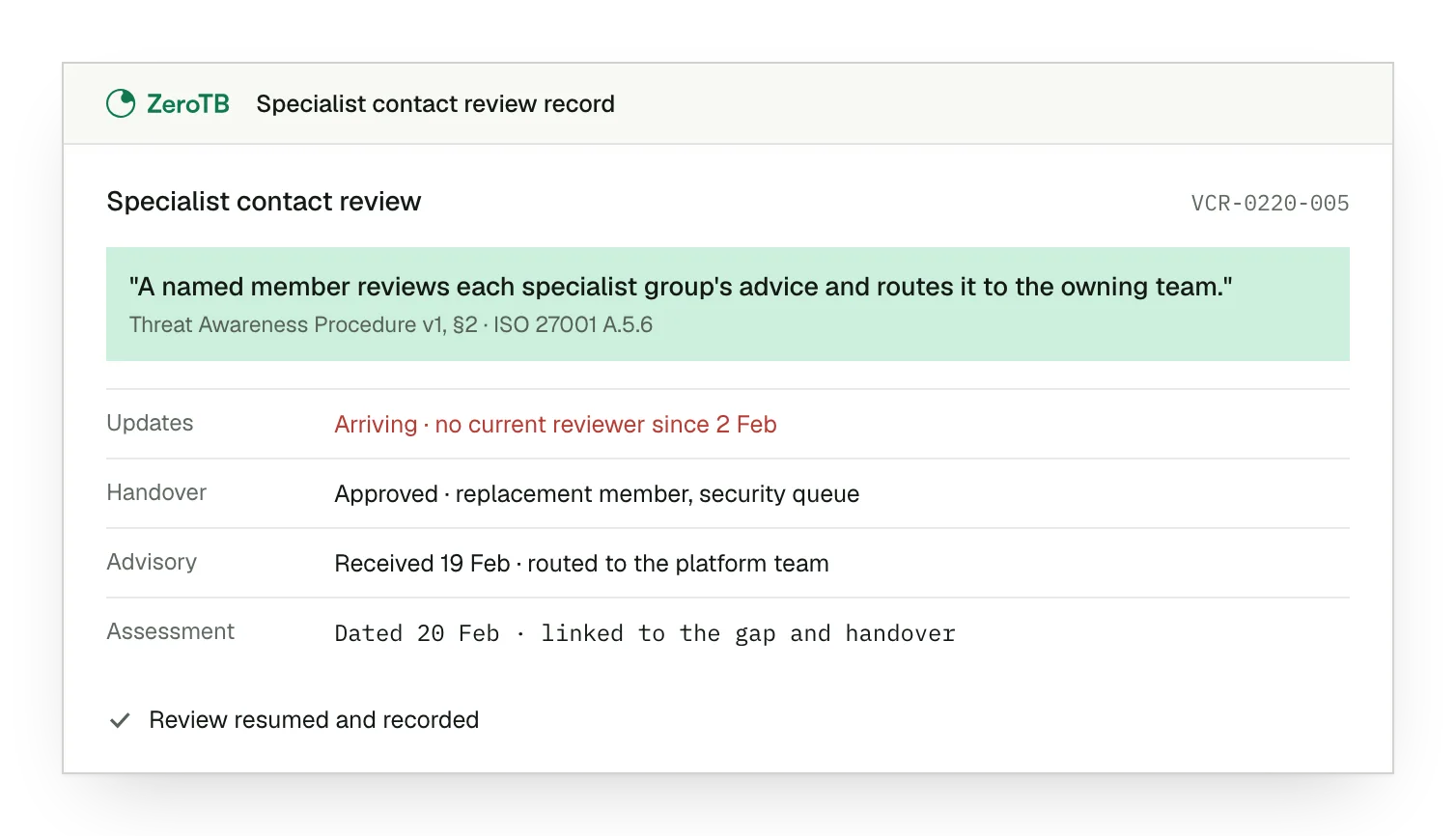
Missed advice. Messages from the group arrive, but the former participant has left without a replacement.
Approved handover. The security owner agrees who will take responsibility and where the advice will arrive.
Review resumed. A current advisory reaches the replacement participant, who sends it to the team concerned.
Recorded assessment. The window keeps the team's dated decision alongside the gap and the approved handover.
Specialist contact review checklist
Identify the security need each relationship serves and the person responsible for obtaining useful advice.
Check whether the intended participant has access and whether recent information has reached an internal reviewer.
Match the proposed action to the gap, with approval for changed ownership, access or the relationship itself.
Verify that a current item reaches the responsible person and receives an assessment against the organization's needs.
Retain the relevant advice, assessment and follow-up evidence so the next reviewer can understand the outcome.
Sources
- ISO, ISO/IEC 27002:2022 control guidance, 2022.
- AICPA & CIMA, Trust Services Criteria with revised points of focus, 2022 revision.
- HHS, Administrative safeguards: security awareness and training, Security Series, 2007 revision.
- HHS, October 2026 cybersecurity newsletter, 2026.
Related pages
Organizational controls
Explore the responsibilities that connect security policy with the people and processes that carry it out.
ISO 27001
Read how individual controls fit within an information security management system and its wider commitments.
Compliance frameworks
Find guidance for related requirements across the frameworks that shape the organization's security program.
Start with the Pilot
In the eight-week Pilot, our team maps up to 25 commitments and takes two real control gaps through verified restoration. Talk with us about keeping controls working and retaining evidence of the results.