Home / Organizational controls
What does ISO 27001 A.5.21 require for technology supply-chain security?
ISO 27001 A.5.21 addresses security risks in the technology products and services your organization receives, including dependencies beyond its direct suppliers. Identify the dependencies that matter, agree how suppliers manage their risks, and review material changes. Keep evidence of the decisions and checks that establish whether each gap is resolved.
A supplier can pass a review while relying on components or providers that later change. The approval records an earlier decision. When the service changes, the security owner needs to know whether that decision still holds and what evidence supports continued use.
Technology dependencies
Reviewing a technology supplier includes understanding the other providers and components on which its service relies. Storage, authentication and support may each come from a different source. The direct supplier remains the contact, but these dependencies help explain what could go wrong with the service.
The review needs enough detail to connect a dependency with a consequence. Record what information it handles, which access it needs and what stops working if it fails. With that context, the service owner can decide where security requirements and further questions belong.
Review priorities
Some dependencies need closer review because a failure would cause greater harm. Consider both the information at risk and the service that depends on them. A provider with administrative access or a service with few practical replacements may need more investigation before approval.
Use the organization's commitments to decide where that investigation will help. A question about an important operation deserves attention if its answer could change the decision. NIST's supply-chain guidance provides further context on risks caused by limited visibility into how technology is developed, integrated and deployed.
Supplier responsibilities
The direct supplier needs to explain how it manages relevant risks further along its delivery chain. The agreement and review should identify which security requirements apply, how the supplier communicates material changes and who responds when a concern arises.
The people responsible for these requirements need to know when a supplier fails to meet them. A supplier contact may coordinate a subcontractor's response, while the internal service owner decides whether that response is acceptable. Recording these responsibilities prevents a reported gap from remaining open between two teams.
Evidence tied to delivery
The evidence used to approve a supplier must cover the service being purchased. A report may describe security elsewhere in the supplier's business and say little about that service. Its scope and date help the reviewer judge whether it answers the question at hand.
An assessment, supplier explanation, configuration record or test result may each answer a different part of the question. Compare that evidence with the relevant requirement. If a dependency falls outside the assessment, ask how the supplier manages its risks and what evidence supports the answer.
Changes after approval
Supplier approval can become outdated when the delivery chain changes. The contract and supplier name may stay the same while a component, support provider or hosting arrangement is replaced. Any of those changes could affect the security assumptions behind the original approval.
Send material change notices to the owner of the affected service, with the earlier assessment attached. The owner can then identify which assumptions need another look. Where the old assurance no longer covers the service, further review is needed to decide whether continued use is acceptable.
Gaps in supplier information
A supplier's unanswered question leaves the reviewer with an uncertainty to resolve. That does not establish that a safeguard has failed. It means there is still a gap in the evidence for relying on that safeguard, and the assessment needs to show it.
Keep the question beside the requirement it concerns, with someone responsible for obtaining the answer. The service owner can then assess the effect of waiting. Restricted use, additional assurance or a different arrangement may be appropriate, particularly when the uncertainty concerns access to sensitive information.
Risk decisions
The response to a supply-chain gap depends on the affected commitment and the available alternatives. Some gaps need a supplier correction; others need stronger contractual arrangements or a different service configuration. A decision to retain a risk needs an accountable owner and a clear reason.
The decision should also explain its conditions. A temporary arrangement may depend on limited access, further evidence or a review date. Those conditions give the team a basis for reassessment. They also distinguish a deliberate acceptance from work that simply stopped after the initial finding.
Correction ownership
A correction needs an owner who can change the affected part of the service. The supplier may need to replace a component or change a subcontractor's access. The organization's own team may need to adjust the connection, permissions or data supplied to that service.
Separate these actions so each has a clear completion condition. A local configuration change can reduce exposure while a supplier investigates, but the remaining supplier action still needs follow-up. Security governance connects those responsibilities with the person authorized to accept the resulting risk.
Verification before closure
A gap can close when evidence shows that the agreed correction worked. For a local change, this means checking the resulting configuration and testing the affected behavior against the approved requirement. For supplier work, the reviewer needs evidence of the correction agreed with that supplier.
ZeroTB checks systems against commitments, prepares corrections for approval and verifies the result. The Verified Control Record keeps the commitment with the action, approval, before-and-after state and verification. Any outstanding supplier evidence still needs a decision before the wider supply-chain gap can close.
Continued oversight
Responsibility for a service continues after its immediate supply-chain gap closes. A supplier might change the service again or stop supporting a dependency. Either event could affect an earlier decision, so the review arrangements need to bring it to the service owner's attention.
Supplier notices, exceptions due for review and unanswered questions belong with that continuing responsibility. The next reviewer should be able to follow the record without reconstructing the original investigation. Keep the reason for continued use beside the changes and evidence that informed it.
Supply-chain evidence
Keep enough evidence to explain which dependency was reviewed, the risk it presented and the action taken.
| Requirement | What an auditor asks for | Where it comes from |
|---|---|---|
| Relevant dependencies | The components and providers behind the service, with their effect on security explained | The service inventory and supplier information used to assess the technology being purchased |
| Supplier responsibilities | The requirements agreed with the supplier and who manages risks further along the chain | Supplier agreements, review records and documented responsibilities for the service |
| Assessed changes | What changed, which requirement it affects and whether the earlier assurance still applies | Supplier notifications and the service owner's review of the changed dependency |
| Approved response | Who approved the correction or retained risk, and the conditions of that decision | Risk decisions, approvals, exception records and supplier correspondence |
| Verified result | The result of the correction and any supplier action that remains to be completed | Relevant supplier evidence, local test results and the linked control record |
Related framework requirements
| Framework | Control | What it covers |
|---|---|---|
| ISO 27001 | A.5.21 | The security of technology supply chains, including the dependencies behind a purchased product or service |
| SOC 2 | CC9.2 | The risks that vendor and business-partner relationships introduce within the applicable SOC 2 scope |
| HIPAA | 164.308(b)(1) | Assurances about safeguards for electronic protected health information shared with business associates in covered relationships |
Example of verifying a supplier correction
Checks on both sides of a service connection can establish whether a supplier correction worked. Here, a supplier has replaced its support subcontractor, but the old provider still has access. The example follows removal of that account while the replacement provider retains approved access.
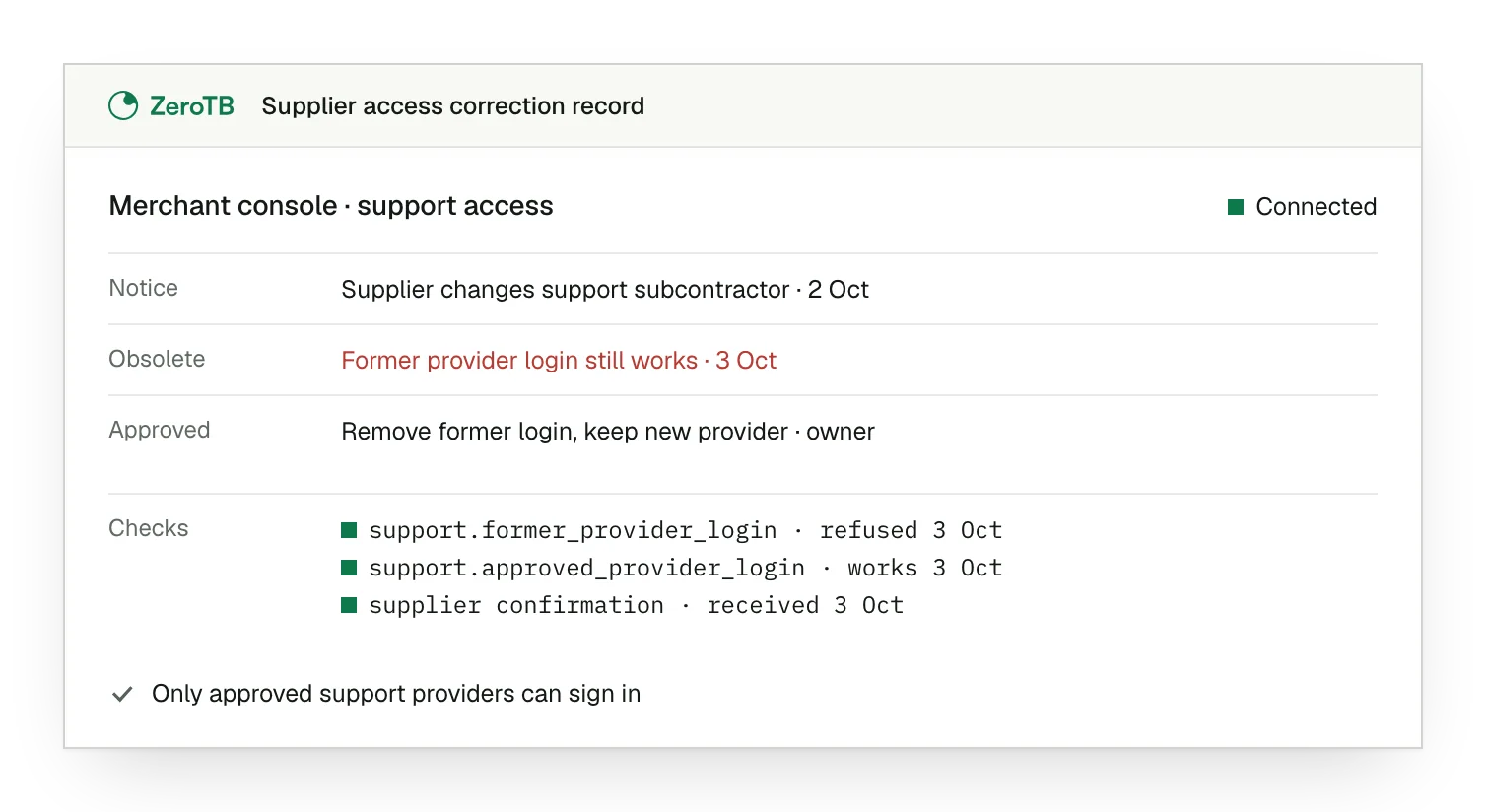
Changed provider. The supplier reports that a new support subcontractor will need access to the application.
Obsolete access. The account check finds that the old provider still has a working application login.
Approved correction. The owner authorizes removal of the old account and confirms which support access must remain.
Verified result. The old login fails, approved support access works, and the supplier confirms the access change.
Supply-chain review checklist
Connect each critical technology service to the components and providers whose failure could affect its security or availability.
Check which supplier manages each relevant risk and who decides whether the response meets the organization's requirement.
Compare supplier notifications with the assumptions behind the current assessment, including changes in access, hosting or support.
Link the proposed correction or accepted arrangement to an owner, approval and any conditions that require further review.
Retain relevant supplier evidence and local test results, with unresolved actions visible until their agreed completion conditions are met.
Sources
- ISO, ISO/IEC 27002:2022, information security controls, 2022.
- NIST, SP 800-161 Rev. 1, cybersecurity supply chain risk management practices, 2022, updated 2024.
- AICPA & CIMA, Trust Services Criteria with revised points of focus, 2022 revision.
- HHS, Summary of the HIPAA Security Rule, current guidance accessed November 4, 2026.
Related pages
Organizational controls
Read the controls that address organizational responsibilities, including how the company manages its supplier relationships.
ISO 27001
Follow the connection between individual controls, assessed risks and the information security management system.
Compliance frameworks
Use the framework libraries to find guidance on controls that share related responsibilities or evidence.
Start with the Pilot
Our team maps up to 25 commitments during the eight-week Pilot and takes two real control gaps through verified restoration. We can discuss the controls that need attention, how corrections would be approved and the evidence each completed correction would produce.