ZeroTB's software and team keep post-audit controls working for US software, AI, fintech and healthtech companies.
An agent's code can pass tests while its credential permits production changes without required review. Check its reach, permitted changes and who approves them.
AI security tools each cover one layer
AI security tools cover different jobs. SAST examines code, while control checks with repair carry failed requirements through verification.
Teams with engineering capacity may manage repairs themselves. Ask who investigates each finding, prepares corrections and tests results.
| Kind | What it covers | What it leaves open | Fits when |
|---|---|---|---|
| Code scanning and SAST | Software flaws in code | What agent credentials allow | Code reaches production |
| AI testing and red teaming | Model behaviour before launch | Access after launch | Before an AI release |
| Runtime guardrails | Unsafe interactions, including prompt injection | Repairs to settings and access | AI interacts with live users |
| MCP and connection discovery | Unreviewed servers and the access they open | Repairing that access | Engineers add connections |
| Control checks with repair | ZeroTB carries failed controls through approved repair and verification | Code flaws and runtime attacks | Findings keep returning |
Code scans miss what agent credentials allow
AppSec scanners, including SAST, examine software for flaws. Agent access checks examine accounts and connected tools, including actions absent from the code.
A code weakness needs investigation. A credential bypassing production review needs an access decision. Runtime protection and continuing control checks cover other points.
AI agent security risks grow with permissions
OWASP calls excessive functionality, permissions and autonomy excessive agency. Those permissions let agents read information, change records or run commands.
Restricted credentials and human approval limit high-impact actions. Prompt instructions leave decisions to the model. The OWASP LLM Top 10 explains excessive agency.
MCP security depends on what each connection opens
Model Context Protocol (MCP) connects applications to tools and data through servers. MCP security depends on the destination credential, its permissions and consent.
Server approval and permission scope are separate decisions. Risks include injected instructions, poisoned tool descriptions, unauthenticated servers, exposed credentials and over-broad permissions.
Test MCP security tools on an unreviewed connection
Test MCP security tools with an approved server and an unreviewed connection. Results should distinguish status and identify the client, access and owner.
Establish which clients, configurations and remote servers the tool observes. An empty findings list helps only when it identifies the connections checked.
SOC 2 scope covers agents with production access
SOC 2 examines controls for scoped systems. Agents with production access affect the access and change commitments covering those systems.
ISO 27001 requires an information security management system based on company risks. Assess connections against its scope and selected controls, even when policies stay unchanged.
Three parties review AI risk before an audit
A technical reviewer assesses production write access. The system owner decides its business purpose. A security firm assesses AI risk and recommends treatment.
Control operations support implements agreed repairs and verifies them. An independent CPA firm performs the SOC 2 examination. Agree responsibilities before engagement.
ZeroTB carries failed agent controls to verified repair
ZeroTB starts read-only, compares commitments with systems and proposes repairs. People approve changes, usually through pull requests. Runbooks and API actions are alternatives.
API actions need scope and reversibility. Failed checks keep work open. Unavailable observations remain visible. AI governance covers decisions around agent use.
Verified repairs need a later system observation
An execution log shows that an action ran. A later observation, linked to the requirement, establishes whether the repair restored the control.
The signed Verified Control Record holds commitments, before-and-after states, actions, approvals and verification. Reviewers read that history in ZeroTB and retain portable evidence.
Later agent changes can undo a repair
Repository rules, credentials and connected services change as agents work. Another observation establishes whether the control still holds.
Continuing checks need an owner who responds to failures and missing or stale observations. Retained exceptions keep their approvals and review conditions available for the next reviewer.
Example of restricting agent access
This example removes production write access from a deployment-status credential, then checks that writes fail and permitted status reads still work.
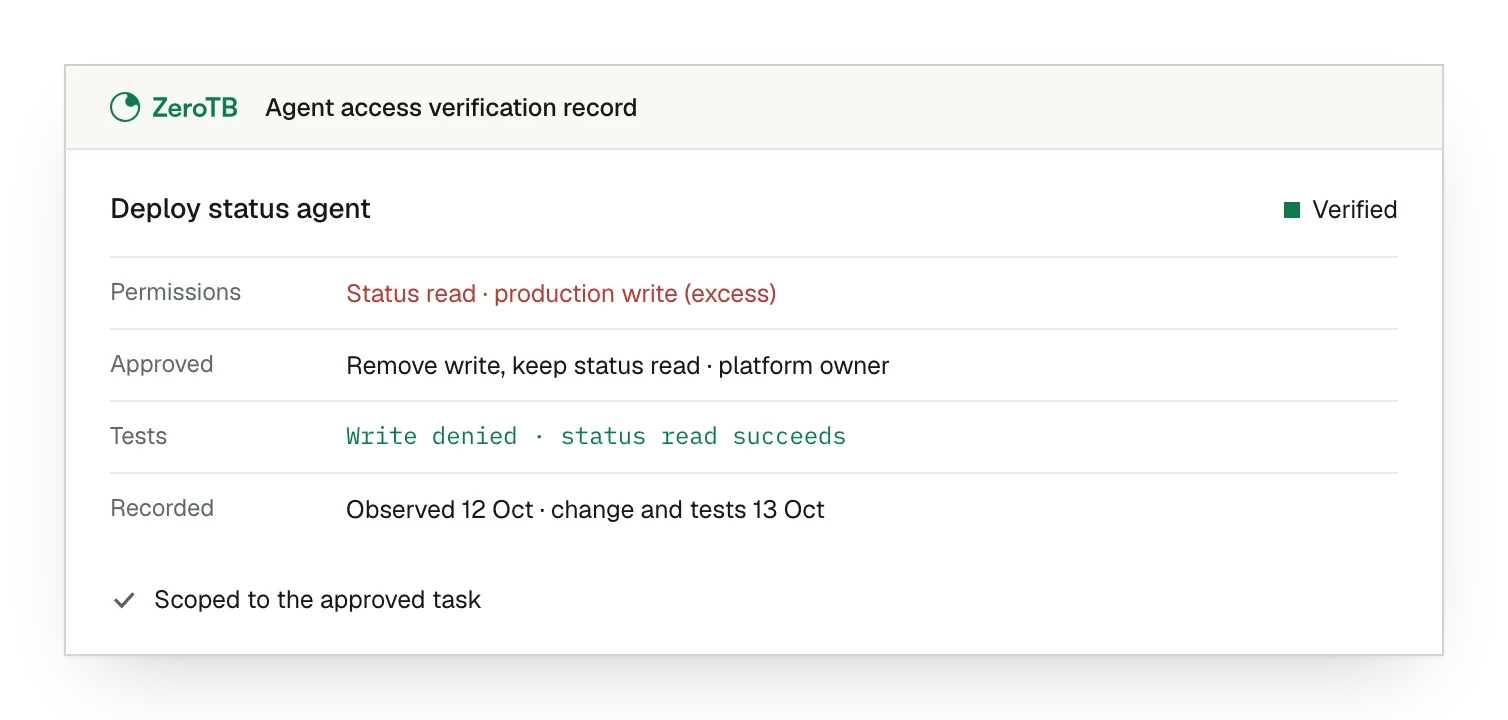
Excess write access. The credential permits production changes beyond the approved task of reading deployment status.
Owner approval. The owner approves removing write access while retaining permission to read deployment status.
Two test results. A denied write attempt appears beside a successful read of deployment status.
Recorded result. Dated observations stay with the approved change so the reviewer can examine both.
Check five things before buying AI security tools
Compare code scanning, runtime protection and control repair against the work you need completed.
Check observed clients and servers, permitted access and gaps in coverage.
Identify who approves corrections and which permissions each action needs.
Test the restricted operation and permitted task separately against the approved access rule.
Follow the requirement through approval and verification, then identify who owns further checks.
Sources
- OWASP, LLM03:2026 Excessive Agency, 2026 edition. Site guide.
- Model Context Protocol, Security Best Practices, 2026 documentation.
- AICPA & CIMA, System and Organization Controls resources, accessed November 2026.
- ISO, ISO/IEC 27001:2022 overview, 2022 edition.
FAQ
What are AI security tools?
AI security tools secure AI systems or use AI for security work. For coding agents, this guide covers protection for code, access and connections.
What are the biggest AI agent security risks?
AI agent security risks include excessive permissions, injected instructions executed through those permissions and connections nobody reviewed.
What is MCP security?
MCP security controls what Model Context Protocol connections can reach by checking approved servers, the credentials they use and the permissions those credentials carry.
Do AI security tools replace a SOC 2 audit?
AI security tools do not replace a SOC 2 audit. An independent CPA firm performs the examination. ZeroTB also does not perform audits.
Is ZeroTB an AI security tool?
ZeroTB checks compliance commitments in connected systems and carries failed controls through verified repair. It does not scan code, guard runtime or connect to coding agents.
Start with the Pilot
Discuss agent controls. The eight-week Pilot maps up to 25 commitments and takes two real control gaps through verified restoration.