Meet NIST framework outcomes with working controls
The NIST framework's CSF 2.0 sets cybersecurity outcomes, while SP 800-53 lists controls.
The NIST framework guides cybersecurity risk decisions
The NIST Cybersecurity Framework (CSF) guides voluntary cybersecurity risk management. ZeroTB's software and team maintain SOC 2, ISO 27001 and HIPAA controls for US software companies with 25 to 250 people.
Read the Core. The Core organizes outcomes into functions, categories and subcategories
Compare the Profiles. A Current Profile and Target Profile show where work is needed
Understand the tiers. Four implementation tiers describe how far a company's cybersecurity practices have progressed
NIST CSF groups outcomes into six functions
Govern
Leaders set priorities and policies, assign cybersecurity responsibilities and review how risks are managed.
Identify
Asset inventories, suppliers and risks show teams where security needs improvement.
Protect
Access safeguards, data security, training and resilience reduce how likely or damaging incidents become.
Detect
Monitoring and analysis uncover possible attacks and compromises that need attention.
Respond
Incident responders coordinate containment, analysis and communications with the people involved.
Recover
Recovery restores assets and services, with progress updates for people who depend on them.
SP 800-53 sorts NIST controls into 20 families
SP 800-53 Rev. 5 is a catalog of security and privacy controls, tailored to each company's risks, systems and requirements.
| ID | Family |
|---|---|
| AC | Access Control |
| AT | Awareness and Training |
| AU | Audit and Accountability |
| CA | Assessment, Authorization and Monitoring |
| CM | Configuration Management |
| CP | Contingency Planning |
| IA | Identification and Authentication |
| IR | Incident Response |
| MA | Maintenance |
| MP | Media Protection |
| PE | Physical and Environmental Protection |
| PL | Planning |
| PM | Program Management |
| PS | Personnel Security |
| PT | PII Processing and Transparency |
| RA | Risk Assessment |
| SA | System and Services Acquisition |
| SC | System and Communications Protection |
| SI | System and Information Integrity |
| SR | Supply Chain Risk Management |
A missed system forces rework on NIST evidence
An access review covers SOC 2 applications, but NIST scope includes another. The mapping alone cannot establish equivalent coverage.
The Current Profile overstates the outcome. The extra application stays unchecked until someone compares scopes. The team gathers evidence again for work considered complete.
A SOC 2 control is mapped
One application sits outside it
The NIST outcome stays unmet
Existing SOC 2 checks can cover NIST controls
SOC 2 or ISO 27001 checks can monitor NIST controls if they observe the conditions those controls require.
An access review serves all three programs if accounts and periods match. Missing or stale observations show that evidence is incomplete.
ZeroTB repairs SOC 2 controls that NIST reuses
ZeroTB confirms commitments from SOC 2 and ISO 27001 reports and policies with your team. We begin read-only and check systems daily.
Prepare the repair. Our team prepares runbooks, pull requests, API actions or guardrails. People approve material changes
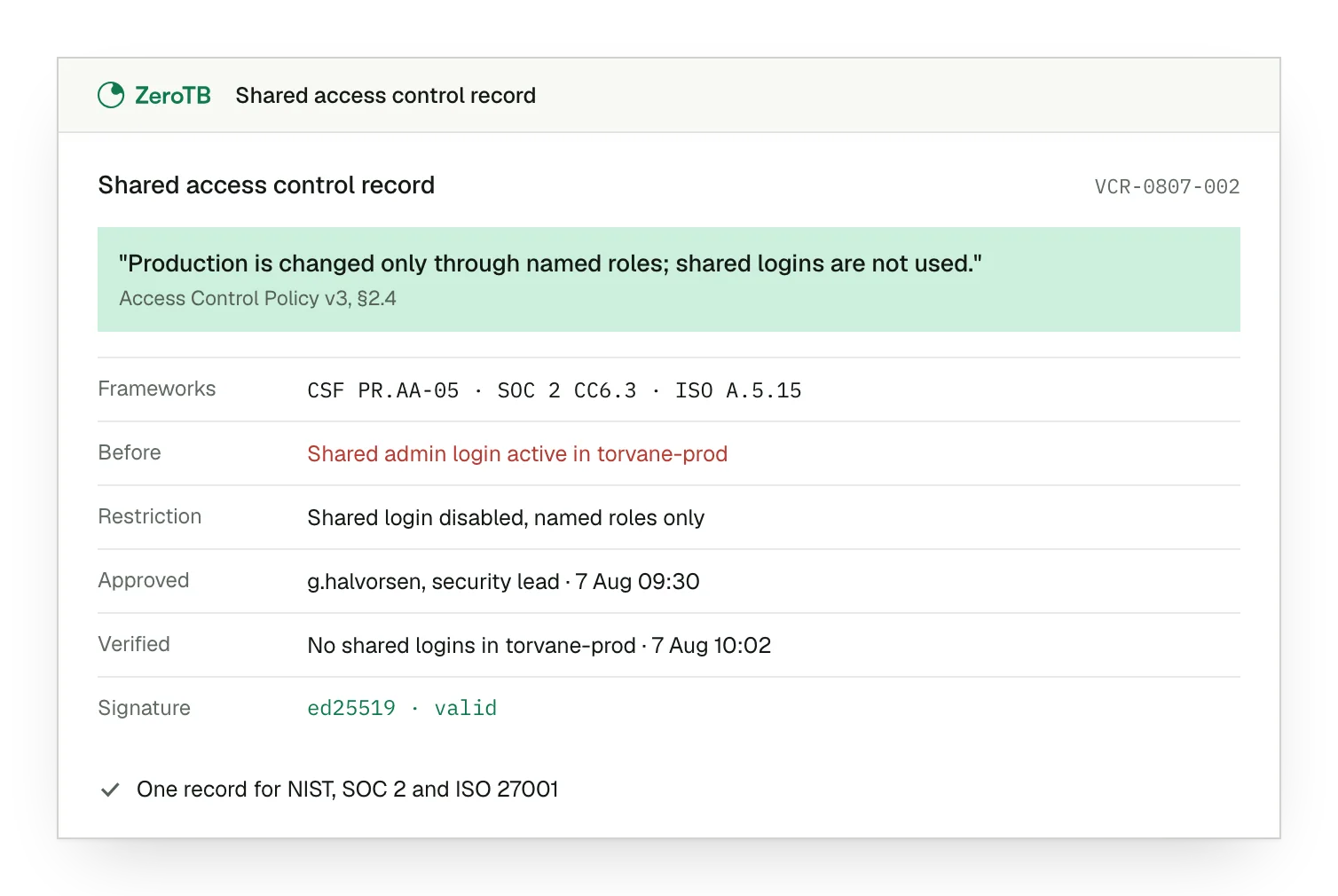
Verify the result. ZeroTB rechecks the control. Reviewers read its signed Verified Control Record in ZeroTB
Follow the evidence. The record connects the commitment, before-and-after state, action, approval and verification
Talk to our team
Talk with us about controls shared across your security programs and the gaps that keep returning.
FAQ
Is the NIST Cybersecurity Framework mandatory?
The NIST Cybersecurity Framework is voluntary. Companies use CSF to set and describe cybersecurity outcomes.
Do we need to implement every SP 800-53 control?
SP 800-53 controls are selected according to your risks, systems and requirements. Each selected control needs evidence of how it works in the system.
How do we decide which NIST outcomes to address first?
NIST priorities start with comparing a Current Profile and Target Profile. Rank gaps by business needs, risks and obligations, accounting for controls already in place.
How are NIST outcomes assessed when they depend on people and processes?
NIST outcomes involving people need evidence of decisions and activities. Policy reviews, training records and incident exercises support the assessment alongside system observations.
Can we use our existing SOC 2 commitments when adding NIST?
Existing SOC 2 commitments can support NIST outcomes. ZeroTB maintains shared controls, while framework scope, risk decisions and evidence for the NIST assessment stay with the wider program.
Does ZeroTB assess or certify NIST compliance?
ZeroTB does not assess or certify NIST compliance, perform audits or promise audit success. Our team keeps shared controls working and records each repair.
Start with the Pilot
The eight-week Pilot maps up to 25 report commitments and verifies repairs to two real gaps, providing working controls and portable evidence.