Home / Organizational controls
How does ISO 27001 A.5.5 keep contact with authorities working?
For ISO 27001 A.5.5, a company needs working arrangements for contact with the authorities relevant to its information security. Those arrangements connect the official contact details with the people who may communicate and the reasons for doing so. Review them after changes, including staff departures and new reporting channels.
The regulator's name is in the incident plan, but the employee responsible for making contact has left. Responders must now find someone who can decide what to do. A contact review should catch that break between the written instructions and the people expected to follow them.
Relevant authorities
The authorities a company needs to contact depend on where it operates and what it does. A register should make that relationship clear. For each authority, explain which part of the business or which information security matters fall within its remit.
Several authorities may be relevant to one incident. The person using the register needs enough context to choose a route and refer questions to the responsible owner. Include the reason for each entry in the review, particularly when the company changes its activities or locations.
Contact details
A useful contact entry explains how to reach the authority for a particular purpose. Include the official reporting channel or contact details, the source used to verify them and the date checked. A general website address may leave responders searching for the actual submission route.
Connect the entry to the instructions that staff would follow during an incident. If the authority publishes a new channel, update those instructions as well as the register. Otherwise, the team may continue using an obsolete route from a saved incident plan despite the corrected entry.
Communication responsibilities
Each contact arrangement needs a person authorized to speak for the organization and a substitute when that person is unavailable. Access to an email address does not establish permission to communicate. Make the decision and communication roles clear enough for responders to reach the right person.
The NCSC's incident-plan guidance recommends allowing for unavailable contacts. A role can provide continuity through staff changes, provided its current holder and backup remain identifiable. Test that the internal route reaches someone who understands the responsibility and can obtain any required approval.
Reporting decisions
Contact details tell responders where a report would go. The decision to report depends on the duties that apply to the company and the circumstances of the incident. A.5.5 sets no universal deadline, so the plan must connect responders with the people who assess those duties.
NIST's incident-response guidance describes notification through designated communicators, under incident-plan criteria and management approval. Use that distinction when reviewing the arrangement. Check how a question reaches the decision-maker as well as how an authorized message would reach the authority.
Changes after the audit
Business changes can break a contact arrangement without changing a word in the register. A departing employee may still appear as the only communicator. Expansion into another jurisdiction may introduce an authority the register omits. The earlier review will not reveal either gap.
Use these changes to identify which entries need another check. Compare the internal assignment with current responsibilities and the external route with the authority's published details. Where information is missing, record the unanswered question. A reviewer then knows what remains unknown and what has been observed to fail.
Internal exercises
An internal exercise tests whether people can follow the contact arrangement. Give participants a situation that requires an authority contact decision, then ask them to use the incident instructions. Observe where they look, whom they reach and which information they cannot find.
The exercise can stop before any external report is sent. Record that boundary with the results so a later reviewer knows what the test established. If the team wants an authority to participate, arrange that through the authorized contact separately. Internal success alone says nothing about external receipt.
Approved corrections
A failed contact arrangement may need changes in several places. Start with the instructions used in the failed exercise and the register entry behind them. If they name a departed employee, identify the replacement responsibility and every instruction that still points to the old assignment.
The owner can review those changes together, approve the communicator and backup, and retain the reason for the decision. A different problem needs a different decision. When the gap concerns an unclear reporting duty, resolve that question with the responsible people before choosing the administrative correction.
Verification after changes
After the update, repeat the part of the exercise that failed. Use the same intended result to judge the correction: responders can retrieve the instructions, reach the assigned communicator and find the official contact route. Record what happens during this retest beside the approved change.
Changing the name in a document leaves that result untested. The replacement may lack access to the instructions or may not understand the assignment. If the test exposes either problem, leave the gap open and assigned until a later check shows that the arrangement works.
Communication records
Keep enough evidence to explain the contact decision, the action taken and the result. An exercise record shows how the arrangement was tested. An actual communication record shows what was sent or received, when it happened and who acted under the organization's authority.
Store sensitive incident details with appropriate access restrictions. The contact register can point to the approved record without duplicating the full incident history. This lets a reviewer trace the communication and its authorization while keeping the general contact list usable by the staff who need it.
Continuing ownership
A repaired contact arrangement still needs someone to maintain it. Agree who will review staff changes, update instructions and follow unresolved gaps. Set review dates, and identify the changes that should prompt a check sooner, such as a new communicator or official reporting route.
The work continues between audits because the people and channels can change again. ZeroTB describes this connection between commitments, checks and approved corrections in how it works. For A.5.5, the purpose of following a gap through to verification is straightforward: the next responder can use the arrangement.
Audit evidence
These records help an auditor follow the contact arrangement and see what the organization checked after a failure.
| Requirement | What an auditor asks for | Where it comes from |
|---|---|---|
| Relevant authorities | Why the listed authorities are relevant to the company | Contact entries and the review that established their scope |
| Current contact routes | The last check of each official route used in the plan | Official contact details compared with the recorded route |
| Authorized communicators | The people assigned to communicate and the approvals they need | Approved responsibilities, backup assignments and incident instructions |
| Verified corrections | The failed test and the result after the approved change | Exercise results retained with the correction and its approval |
| Communication history | Any actual communication and the decision that permitted it | Restricted correspondence and the relevant incident record |
Related framework requirements
| Framework | Control | What it covers |
|---|---|---|
| ISO 27001 | A.5.5 | Contact arrangements with authorities relevant to information security |
| SOC 2 | CC2.3 | Communication about internal control with external parties; authority contacts are one possible part of that work |
| HIPAA | 164.308(a)(6) | Handling security incidents and documenting outcomes; related contact records can help, while breach notification remains a separate duty |
Example of restoring an escalation route
This example follows a contact assignment through two internal exercises. The first reaches a former employee. The owner approves a replacement and backup, and the second reaches the new communicator. Both results remain in the record, alongside the decision that changed the assignment.
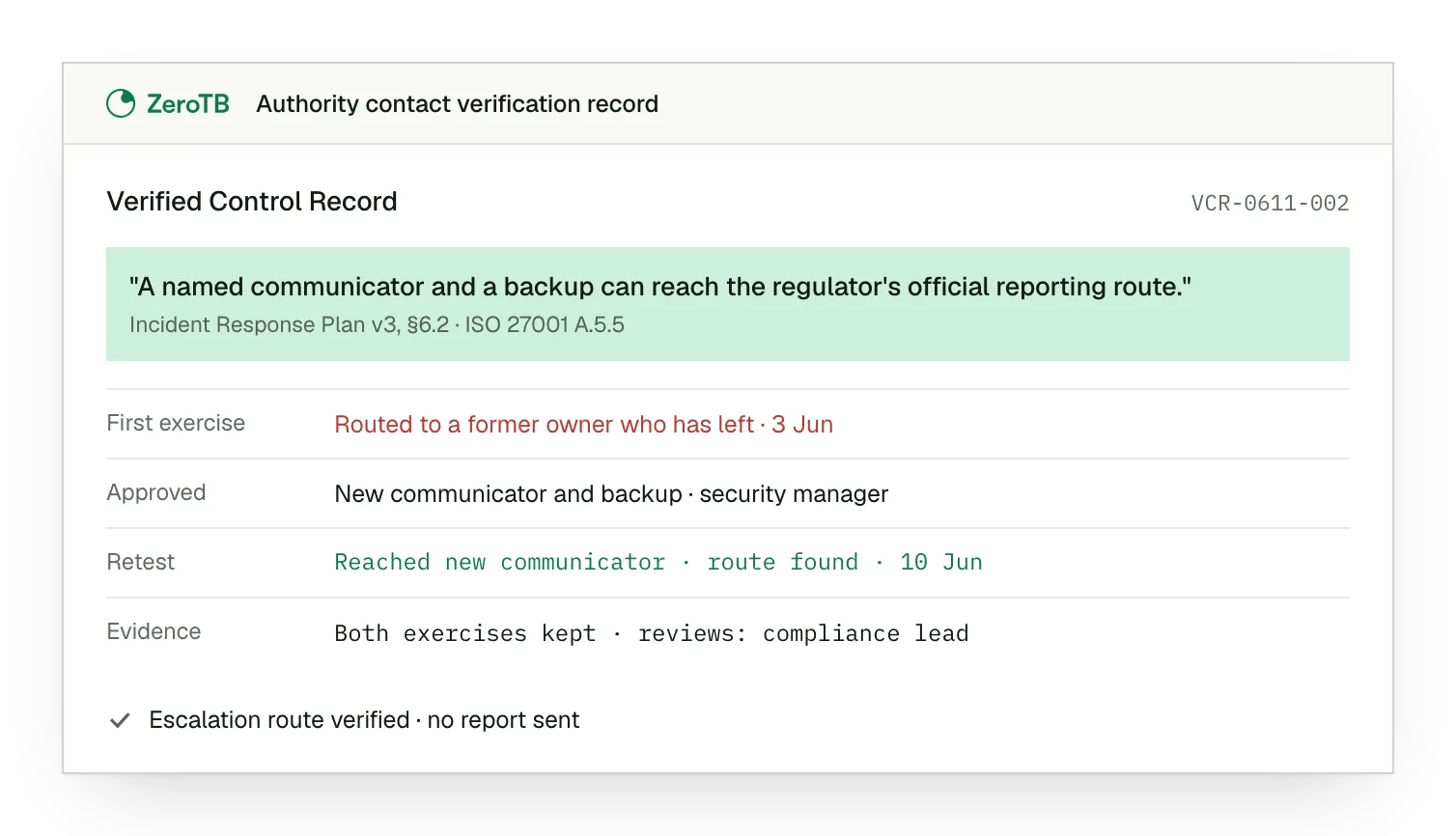
Failed internal route. The first exercise stops at an old assignment because the designated employee has left.
Approved replacement owner. The manager assigns a new communicator and backup and approves the change to the instructions.
Successful internal retest. The team reaches the new communicator and finds the official route without sending a report.
Retained test evidence. The reviewer can compare both exercises and see who approved the change and owns future reviews.
Authority contact review checklist
Identify which authorities the arrangement covers and why each one is relevant to the business.
Compare the recorded channel with the authority's published details and the route in the incident instructions.
Confirm who may communicate, who substitutes during an absence and how the required decisions reach them.
Exercise the revised internal route and record whether it resolves the failure that prompted the change.
Link the result with its approval and review owner, while restricting access to sensitive incident details.
Sources
- ISO, ISO/IEC 27002:2022 control guidance, 2022.
- NCSC, Developing your incident response plan, 2019.
- NIST, SP 800-61 Rev. 3: Incident response recommendations, 2025, RS.CO-02.
- AICPA & CIMA, Trust Services Criteria with revised points of focus, 2022 revision.
- HHS, Summary of the HIPAA Security Rule, reviewed August 2026.
Related pages
Organizational controls
Explore the other organizational controls that support an information security management system.
ISO 27001
Place authority contact arrangements within the wider program of information security controls.
Compliance frameworks
Find guidance on related responsibilities across the frameworks your organization works with.
Start with the Pilot
Talk with our team about keeping compliance controls working as responsibilities change. The eight-week Pilot maps up to 25 commitments and takes two real control gaps through approved correction and verified restoration, with evidence of the work.