Home / Organizational controls
What does ISO 27001 A.5.30 require for technology readiness for continuity?
ISO 27001 A.5.30 addresses technology readiness for continuity, so information and communication technology can support the organization's business continuity objectives. Recovery arrangements need to cover the services and dependencies currently in use, with tests against agreed recovery targets. A failed test needs corrective work and another test to establish whether recovery now meets the objective.
Recovery plans describe how to resume work after an outage. That description can become outdated while the service continues to run normally. A successful test from before a system change may leave the team with unanswered questions about the current service.
A.5.30 brings those questions back to the business objective. What needs to recover, and what result would show that the arrangement works? Business and technology owners need the same answers before they can judge whether the latest test provides enough evidence.
Business recovery objectives
Recovery arrangements need to match the business activities they support. Identify which activities must resume first and what interruption each can tolerate. Technology owners can then choose recovery arrangements and direct testing toward the services the business needs most.
A recovery time objective, or RTO, sets the target time for restoring a system. A recovery point objective, or RPO, identifies the point to which data must be recovered. NIST's contingency planning guide explains these measures and their relationship to business impact.
Recovery dependencies
A service can recover only when its required dependencies are available. Its plan needs to account for the infrastructure, configurations, permissions and external services that recovery requires. Restoring components in the wrong order can leave the application unable to function.
Trace those dependencies through the current architecture and record the recovery sequence. Include who controls each dependency and how recovery staff can reach it during the outage. That detail helps expose a procedure that assumes access or resources the team may no longer have.
Usable service recovery
A completed backup does not establish that the application can serve its users. The recovery procedure also needs to restore the surrounding service and make the recovered data usable. A successful backup job therefore answers only part of the readiness question.
Define a representative operation that demonstrates recovery, such as opening a restored record through the application. Check it alongside the agreed time and data-loss objectives. This gives the reviewer an observable result and makes the point at which recovery is complete easier to judge.
Recovery responsibilities
Recovery plans need owners who can authorize and carry out the required actions. Identify who starts recovery, who restores each dependency and who decides that the service is usable. These roles need the access required to perform their part of the procedure.
Consider whether those arrangements remain available during the outage being tested. A recovery plan that relies on an unavailable administrator or access service may stop before restoration begins. Include those dependencies in the exercise so the result tests how the team would work.
Changes after the audit
System changes can invalidate a recovery test that previously passed. For example, a migration can change the database an application needs while leaving the recovery procedure untouched. The procedure still completes its steps, but those steps recover the old store.
Access changes deserve the same review: the recovery role may have lost permission to read the current backup. Compare changed dependencies with the tested procedure and repeat the affected steps. Retain the earlier result, making clear which service version it covered.
Recovery exercise scope
Choose an exercise that can answer the recovery question under review. To examine responsibilities and decisions, a tabletop discussion may be useful. To observe people executing recovery steps, use a functional exercise in a simulated environment. The CMS exercise handbook describes both approaches.
Agree on a suitable environment and the dependencies the test will include. Record where it substitutes for production or leaves a component out. Testing just the affected steps can limit interruption, provided the conclusion remains confined to those steps and their observed results.
Measured recovery results
A useful recovery result compares observed performance with the approved objectives. Record the scenario, test scope, start and completion points, and the recovered data state. These details let the reviewer understand what the measurement includes and whether the result supports the intended operation.
Keep any unmet objective visible beside the successful parts of the test. If data restores but the application remains unavailable, record both observations. This avoids closing the exercise on an intermediate success while the business activity it supports still cannot resume.
Decisions after a failed test
A failed recovery test needs a decision about the gap before corrective work begins. Trace the shortfall to the affected dependency, permission, procedure or resource. Give the responsible owner the observed failure and a proposed correction that addresses its cause.
A material system change needs approval through the established change process. If the proposed response changes the recovery objective instead, the business owner needs to decide whether that revised objective is acceptable. Keep the original result and the decision together so the change remains understandable.
Verification after a correction
The correction needs a repeat test that addresses the original failure. A procedure update alone cannot show that recovery now works. Run the affected steps and compare the observed result with the objective; an unavailable result leaves the gap open.
Following that gap through to closure is work shared by compliance and engineering. ZeroTB's control workflow reads approved commitments, checks systems, drafts corrections for human approval and verifies the resulting state. Its Verified Control Record keeps the commitment, before-and-after state, action, approval and verification together.
Continuing readiness evidence
Recovery evidence remains useful when its scope still matches the service in operation. A test record should identify the procedure version and configuration used. Someone reviewing it after a system change can then see which parts of recovery the result supports.
Give subsequent reviews and exercises an owner, and keep unresolved limitations beside the corrective work. These records let business and technology owners discuss the gaps that remain. They can see the earlier decision and its result without assembling the history from separate tickets.
Recovery evidence
The evidence should let an auditor identify the agreed target, the tested arrangement and the outcome of corrective work.
| Requirement | What an auditor asks for | Where it comes from |
|---|---|---|
| Recovery objectives | Approved recovery targets and the business priorities behind them | Business impact analysis and continuity plans |
| Current recovery arrangements | The recovery sequence, its dependencies and the people able to perform it | Architecture records and the recovery procedure used in the exercise |
| Exercise execution | A record of participants, test scope and steps performed | The exercise plan and dated test records |
| Measured outcomes | The observed outcome against each target, including any excluded components | Recovery logs, application checks and the exercise report |
| Verified correction | The original failure, approval for its correction and the repeat test outcome | The corrective work record with its approval and repeat test result |
Related framework requirements
| Framework | Control | What it covers |
|---|---|---|
| ISO 27001 | A.5.30 | Technology preparation and testing against the organization's continuity objectives |
| SOC 2 | CC9.1 | Mitigation of potential business disruption risks within the SOC 2 examination scope |
| HIPAA | 164.308(a)(7) | Contingency planning, including backup and recovery, for systems holding electronic protected health information |
Example of repairing a recovery dependency
In this example, a database migration leaves the recovery procedure pointing to the retired store. Restoring it produces data the application cannot use. The correction changes the procedure to recover the replacement database; the repeat test checks application access and the agreed recovery objectives.
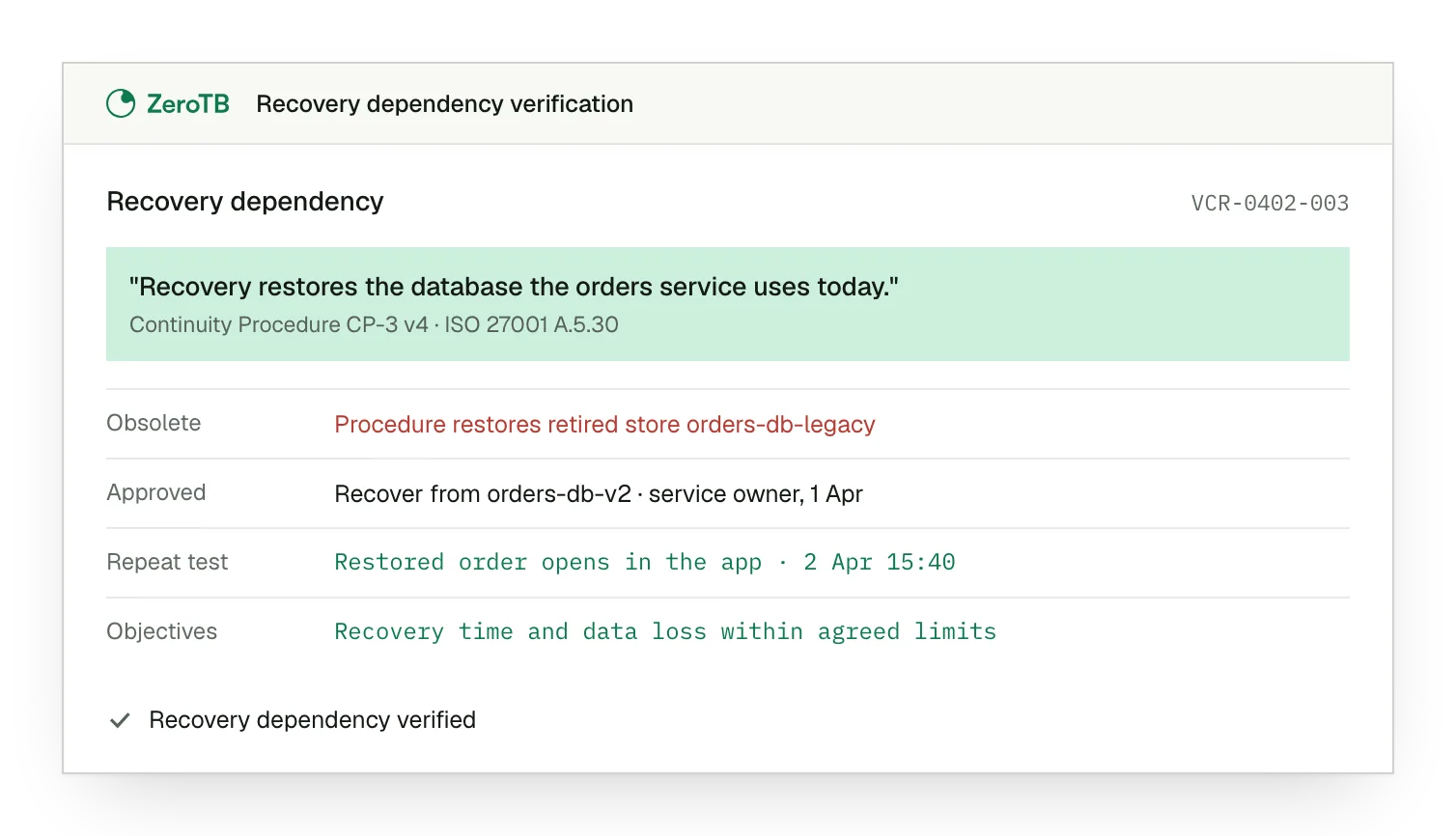
Obsolete dependency. The recovery procedure names the retired store, although the application now uses its replacement.
Approved procedure change. The service owner approves the revised steps for recovering data from the replacement database.
Successful repeat test. The application opens a restored record, with recovery time and data loss within the agreed objectives.
Recovery readiness checklist
Check that the approved time and data-loss objectives reflect the business activity the service supports.
Compare the tested recovery procedure with current infrastructure, access and data stores to identify changes requiring another test.
Specify the application operation and measurements that would demonstrate recovery, including the dependencies the exercise will cover.
Follow each failed result through its approved correction and repeat test before accepting closure of the readiness gap.
Sources
- ISO, ISO/IEC 27002:2022 control guidance, 2022.
- NIST, SP 800-34 Rev. 1: Contingency planning guide, 2010.
- CMS, Information System Contingency Plan Exercise Handbook, accessed November 4, 2026.
- AICPA & CIMA, Trust Services Criteria with revised points of focus, 2022 revision.
- HHS, HIPAA audit protocol: contingency plan, July 2018 update.
Start with the Pilot
Talk with our team about recovery readiness and the gaps that keep returning. The eight-week Pilot maps up to 25 commitments and takes two real control gaps through approved correction and verified restoration, with evidence of the completed work.