Home / Organizational controls
How does ISO 27001 A.5.18 govern access rights?
ISO 27001 A.5.18 addresses access rights from the initial grant through review, changes and removal. The organization's access rules guide these decisions as business needs change. Follow a removal decision through to the resulting permissions: rights inherited through a group can remain after a direct grant has ended.
The review says to remove access. The application still permits it. This can happen when a decision reaches the review record but the change misses a permission path. User access reviews need to account for the rights that remain after the work is marked complete.
Current business need
A.5.18 concerns how access rights are granted, reviewed, changed and removed as business needs change. An approved purpose explains why an account needs a particular permission. The organization's access rules give the owner a basis for deciding whether that purpose justifies the requested rights.
The reviewer needs to establish what the account can do and why those permissions are still required. Some permissions may remain appropriate while others need removal. This distinction matters for people who change responsibilities but continue to use the same systems.
Access review scope
Start the review with the rights an account can exercise, including those it inherits from groups. A direct assignment might allow ordinary use, while a group gives the same account administrative powers. Looking only at the direct assignment would miss that difference.
Application owners can help fill gaps in the central identity records. Their systems may contain local accounts or permissions assigned within the application itself. Include these in the review so that a decision to remove access covers the routes that would otherwise remain.
Approval before access
Before granting access, the resource owner needs to know who needs it, what it permits and why it is required. An approval based on those details gives the administrator a specific request to implement under the organization's access rules.
Keep the request and approval with the record of the grant. These records answer different questions: what did the owner authorize, and what rights did the account receive? A later reviewer can compare them with current permissions and investigate differences without repeating the original request.
Changes in responsibility
A change of role can leave valid accounts holding permissions that no longer have a business purpose. The person still works for the company, so the account stays active. Membership of a former team's group may also remain, preserving access to that team's systems.
A transfer therefore needs a decision about which existing rights should end, alongside approval for any new rights. A departure raises a broader removal question. Both events need to reach the people responsible for the affected applications, including systems outside the central identity provider.
Context for reviewers
Reviewers need to understand what a permission allows before they can decide whether to retain it. A role name may conceal broad administrative powers or access to sensitive information. The resource owner can explain those rights and relate them to the account's current purpose.
Useful review records connect the account, resource and permission with a decision and its reason. Where the reviewer cannot establish a need, the case needs an owner who can resolve it. Reusing the old approval without that context can preserve obsolete access.
Review timing
A scheduled review can miss the period between a departure and the next review date. The access control needs to cover that period by assigning responsibility for changes as they occur. A person's departure should reach whoever can remove their rights in each affected system.
The scheduled review still has a job to do. It gives owners a chance to inspect the wider account population for permissions that have accumulated or survived earlier changes. Its scope and timing should be explicit, alongside the checks triggered by departures and transfers.
Approved access changes
Assign each removal decision to someone with authority to change the affected permissions. Include the account and the intended access afterward. The owner can then follow the decision into the work required, including changes in applications managed by a different team.
Before removing a membership, consider all the access that group provides. Some resources may still be needed for the person's current responsibilities. The approved correction should preserve those rights while removing the obsolete ones, with both results specified for the check that follows.
Verification in the application
Check the result in the application. A change in the identity provider can leave another permission path intact. For group-assigned apps, Okta documents removal of either the user's group membership or the group's app assignment as the ways to end that assignment.
Group Push has a further dependency. If the app is unassigned before membership is removed, the user can remain in a downstream group. Check the resulting application permissions, including local grants, to establish whether the removal has reached all the access covered by the decision.
Temporary access exceptions
A temporary exception needs a reason, an owner and a condition for reviewing or ending it. During a handover, some rights may still serve an approved purpose. The owner needs to identify the specific access retained and the condition under which that need ends.
The next reviewer should be able to see that decision alongside the actual permissions. When the temporary need ends, the owner can approve removing the retained rights and assign the change. Keeping exceptions in the same review population helps prevent temporary access from becoming an unexplained permanent grant.
Evidence of completed changes
Evidence needs to connect the access decision with the permissions observed after the change. The reviewed account list establishes scope; the decision establishes intent. The change record explains what someone did, and the dated system observation shows whether the intended rights now apply.
An approved spreadsheet can record decisions, but the resulting changes need their own evidence. If an application observation is missing or stale, the reviewer cannot establish the current result from it. Keep the outstanding check visible until a fresh observation supports closure.
Continuing access checks
Permissions can return after a successful removal when a later change adds a group or application assignment. Keep the previous decision available for the next check. It explains the reason for removal and gives the owner a basis for investigating access that reappears.
ZeroTB handles ongoing checks and approved restoration against these commitments. Identity checks through its Okta integration connect to this work. After restoration, the Verified Control Record holds the commitment, before-and-after state, action, approval and verification for the owner to consult during subsequent reviews.
Access review evidence
The evidence should let a reviewer trace an account from its approved purpose to its current permissions.
| Requirement | What an auditor asks for | Where it comes from |
|---|---|---|
| Defined scope | Which accounts and resources the review examined | Account inventories compared with group membership and application grants |
| Authorized access | The reason for each grant and its approval | The account's access request and the resource owner's response |
| Completed review | Who made the access decision and when | Dated review decisions with reasons for retaining or changing rights |
| Managed exceptions | The purpose and review condition for temporary access | An approved exception associated with the account and retained rights |
| Verified changes | What changed and whether the intended permissions now apply | The approved action and a fresh observation from each affected system |
Related framework controls
| Framework | Control | What it covers |
|---|---|---|
| ISO 27001 | A.5.18 | Access rights granted, reviewed, changed and removed under the organization's rules |
| SOC 2 | CC6.3 | The authorization, adjustment and removal of access based on roles and responsibilities |
| HIPAA | 164.308(a)(4) | Authorization and management of access to electronic protected health information |
Example of removing inherited access
This example shows the removal of administration rights after an engineer changes teams. An old application group still provides those rights. The owner approves changing that membership while keeping access for the new role, and a subsequent check establishes the permissions that remain.
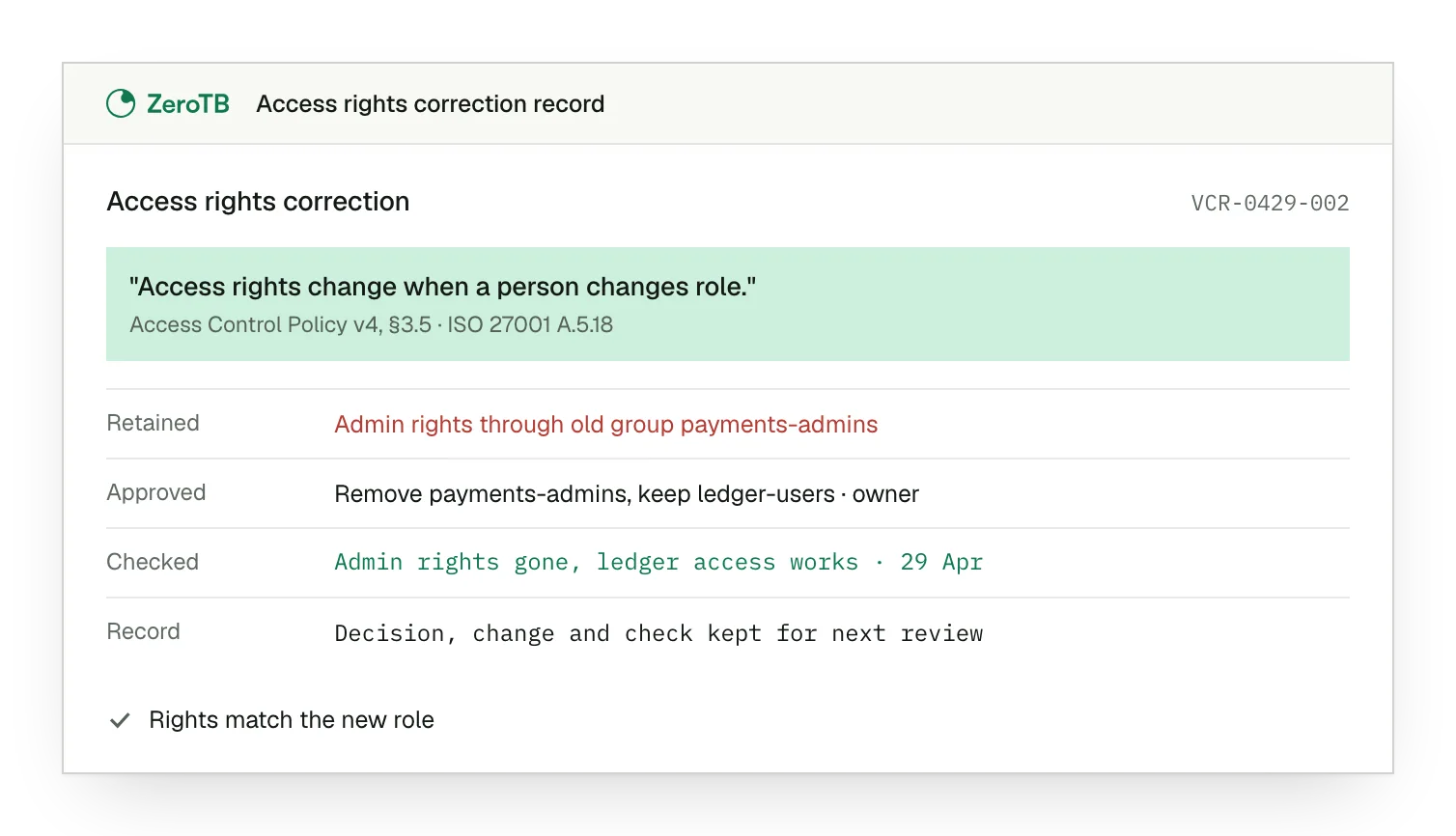
Retained administration rights. The engineer has changed teams, yet membership of the former group still provides administration rights.
Approved permission change. The owner approves the removal and records which permissions must remain for the new role.
Application result checked. After the membership change, the application shows current work access and no former administration rights.
Completed review record. The dated check sits beside the approval and action for use in later access reviews.
Access review checklist
Establish which rights the account needs now, using its current responsibilities and the owner's approved access rules.
Compare direct grants, group memberships and application roles to identify every route that provides the rights under review.
Decide which permissions should change and which must remain, including any temporary exception and its review condition.
Confirm that the approved change reached the application and that another grant does not preserve unwanted access.
Keep the decision, action and dated verification together so the next reviewer can understand the access that remains.
Sources
- ISO, ISO/IEC 27001:2022, 2022, and ISO/IEC 27002:2022, 2022: requirements and control guidance.
- Okta, Unassign users from applications and App assignments and Group Push, accessed November 2026.
- HHS, HIPAA audit protocol, 2018 update: access authorization, establishment and modification.
- ZeroTB, Control operations, 2026: approved restoration and verification records.
Related pages
Organizational controls
Read the other organizational controls that define responsibilities across an information security management system.
ISO 27001
Place access rights within the wider information security management system and its control requirements.
Compliance frameworks
Explore related controls across frameworks and the operational evidence that can support their requirements.
Start with the Pilot
Talk with our team about keeping access decisions effective. The eight-week Pilot maps up to 25 commitments and takes two real control gaps through approved correction and verified restoration, with a record of the action, approval and result.