Use the OWASP LLM Top 10 to identify risks in applications that use large language models and choose controls you can test. Trace what the application reads, what it can change and where approval applies. Keep those checks working as systems change, with evidence that each approved correction restored the control.
An application can pass its launch review and later gain access to another repository, dataset or tool. That change affects what a misleading instruction or incorrect response can do. The security review needs to follow the application into operation.
The 2026 edition
The OWASP Top 10 for LLM Applications organizes a security review around ten types of risk. The 2026 edition explains their causes and mitigations. To apply that guidance, locate the relevant data flows and actions in the application being reviewed.
The year matters when recording a risk. Excessive agency is LLM03:2026; hidden context exposure is LLM08:2026. Names and positions differ in earlier editions, so an identifier alone can mislead a reviewer. The list provides guidance, without granting certification or an audit opinion.
Prompt injection
Prompt injection, LLM01:2026, changes model behavior through the input it receives. Instructions can arrive inside a document or tool response as well as in a user's prompt. Some of that content may be invisible to the person operating the application.
Test what happens when the model follows a hostile instruction. Which data can it reach, and which operations can it request? Those limits need enforcement outside the model, so an instruction cannot grant access that the application should refuse.
Sensitive information disclosure
Sensitive information disclosure, LLM02:2026, includes leaks through the answer and through less visible outputs. An application may place confidential data in a tool argument or a log. Protecting only the chat response leaves those other routes open.
Limit the data supplied to what the task requires, then examine who can read the resulting outputs. Stored conversations and diagnostic records need access checks too. Their contents may remain available long after the person has finished using the application.
Excessive agency
LLM03:2026 concerns the damage an application can cause through its available tools, permissions and autonomy. If an agent's job is to propose code changes, require a reviewer to approve them before they can reach production.
Assess tools and account permissions together. A narrow tool can still operate through an account with broad rights. Enforce approval at the point of action, and test whether the agent can use another route to perform the same restricted operation.
Supply chain
Supply chain risk, LLM04:2026, includes weaknesses in the models, packages and external services that an application uses. Identify each dependency's source and deployed version. These details establish what was reviewed and help an engineer locate components that need attention.
Approval of one version does not settle the risk of a later update. Keep changes connected to the review record, including a change of provider. When a weakness emerges, the record should help locate affected applications and plan the correction.
Data and model poisoning
Data and model poisoning, LLM05:2026, can alter an application's behavior through tampered data or models. The relevant inputs include training material, model updates and retrieved content. Establish who may change them and how a new version enters the application.
Keep the material's origin and change history available for investigation. If behavior changes after an update, those records help identify what the application used. Tests can then inform the decision to correct that material, retain it or restore an earlier version.
Unbounded consumption
LLM06:2026 concerns requests that exhaust computing capacity, interrupt service or drive up costs. A single task may trigger repeated model calls or expensive processing. Limits need to account for the work each request can cause after it enters the application.
Set workload limits where the service can enforce them, including limits on requests, execution and spending where appropriate. Test how the application stops work that exceeds them. An alert is useful only if someone can respond before further consumption causes harm.
Misinformation
LLM07:2026 concerns incorrect output that people or systems rely on. A plausible answer can contain an unsupported claim, an inaccurate reference or a faulty recommendation. The consequence depends on the decision or action that follows from it.
For consequential decisions, check the answer against evidence suited to the task. A citation needs to support the specific claim it accompanies. Where the output triggers an action, define what requires review and how the system handles missing or conflicting evidence.
Hidden context exposure
Hidden context exposure, LLM08:2026, can reveal internal instructions and details of how the application works. Plan for those details to become visible. Someone who learns the instructions must still need permission to access a protected resource or perform an operation.
Store credentials outside the model's context. The application or connected system must enforce permissions independently of the instructions given to the model. Error messages and diagnostic output also deserve review, since they can disclose details the recipient has no reason to receive.
Vector and embedding weaknesses
LLM09:2026 concerns weaknesses in the way an application stores, separates and retrieves embedded information. Retrieval can supply relevant material that the requesting user has no right to read. Similarity between documents does not establish permission to access them.
Apply access checks before retrieved content reaches the model. Test separation between users or tenants, including after document permissions change. The review should establish whether the retrieval system continues to honor the source's access rules as it indexes new material.
Improper output handling
LLM10:2026 concerns generated output that another component uses without adequate validation or safe handling. The receiving component may render text, execute a command or accept generated code. Each destination needs checks appropriate to the operation it performs.
Treat generated content as an input at that boundary. Validate its structure, constrain the permitted operation and use safe execution or rendering methods. Code produced by an assistant still needs the review and testing required for the change being made.
Agentic applications
Agents that choose tools and carry out several actions need an assessment of the whole workflow. OWASP's Top 10 for Agentic Applications is a separate list. It addresses agent behavior across tools, identities and connected actions, alongside risks in the underlying LLM application.
Use both lists when those capabilities are present. Record which project and edition each risk reference belongs to, then trace the agent's authority across its actions. The coding agents page discusses the engineering controls around these workflows.
SOC 2 findings
An OWASP LLM risk may become a SOC 2 finding if it exposes a failure in a control covered by the examination. Establish that connection through the company's commitments, the affected system and evidence of the failure. The auditor evaluates its significance.
For a coding agent that bypasses required review, examine the repository rule alongside the agent's rights and change history. Together, those records show whether the change or access control operated. An OWASP category describes the risk but cannot decide the audit conclusion.
Ongoing control checks
A launch review describes one configuration; later changes can alter the protection it established. New tool permissions, retrieval sources and deployment routes need current observations. Otherwise, an earlier assessment can remain on file while the application operates under different conditions.
ZeroTB's AI security control operations check approved commitments and draft corrections for approval. Verification then establishes the resulting state for the Verified Control Record. Application security testing also examines behavior that configuration checks alone cannot establish.
Example of restoring required code review
Required code review must apply to the agent's route into a repository. Here, an added permission allows direct merges that bypass review. The correction removes that permission, and testing establishes that the agent can still propose changes while approval remains necessary.
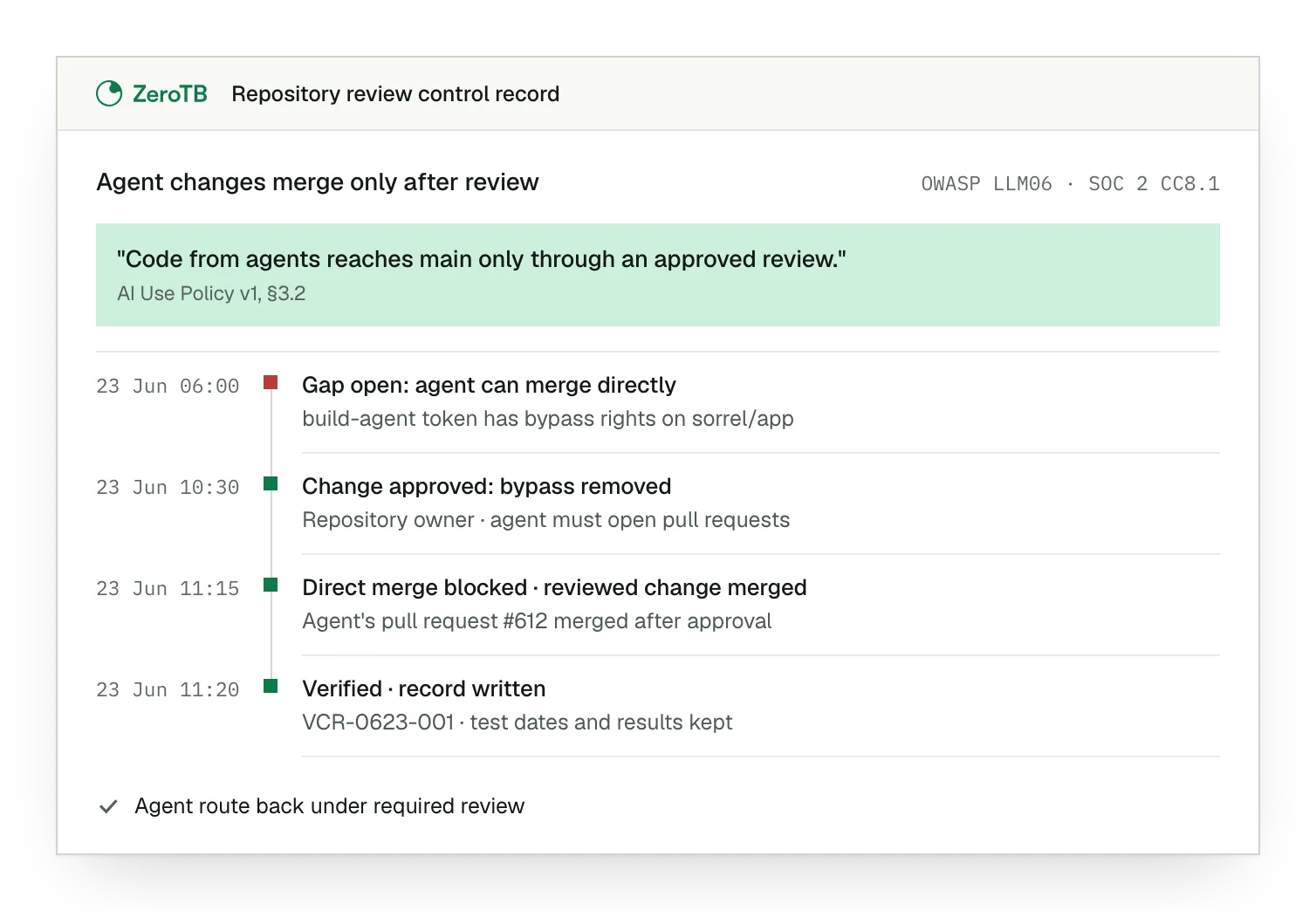
Review bypass detected. A repository check finds an agent permission that allows merges without the required review.
Permission change approved. The owner approves removing that permission so the agent must submit changes for review.
Review requirement tested. Tests show a blocked direct merge and a permitted change after the required approval.
Restoration evidence retained. The record keeps the test dates and results with the change and its approval.
LLM control review checklist
Follow the application's inputs and outputs through its tools and accounts to establish what it can reach.
For each applicable risk, define the expected condition and the system observation that would show a failure.
Agree which actions the application may take and which changes require a person's approval before they proceed.
Test both outcomes after the change: the unwanted operation fails, and the permitted workflow continues to work.
Retain the rule, gap, approval, change and test results together, then assign responsibility for the next check.
Sources
- OWASP GenAI Security Project, OWASP Top 10 for LLM Applications: canonical list and individual risk guidance, 2026.
- OWASP GenAI Security Project, Top 10 for Agentic Applications 2026, published 2025.
- AICPA & CIMA, Trust Services Criteria with revised points of focus, 2022 revision.
Related pages
AI security
Read how ongoing checks and verified corrections support the engineering controls around applications that use AI.
Coding agents
Explore the repository permissions and approval requirements that need to hold as coding agents perform their work.
Healthtech
See how healthtech companies maintain controls across the engineering systems that support their data and compliance commitments.
Start with the Pilot
Our team can discuss the controls around your AI applications. The Pilot maps up to 25 commitments over eight weeks and takes two real control gaps through approved correction and verified restoration. You receive the records of those changes and results.