Home / Organizational controls
How does ISO 27001 A.5.36 check compliance with security rules?
ISO 27001 A.5.36 concerns whether an organization's everyday work follows its information security rules. Review the practice covered by each rule, investigate differences and check the outcome of any correction. The evidence should let a later reviewer understand what happened and why the organization accepted the result.
Work can move to another application or team while the policy governing it stays the same. At the next review, policy approval and staff acknowledgements will still be on file. The question is whether the rule continues to hold where that work now happens.
Rules in practice
A.5.36 concerns whether the organization follows the information security rules it has adopted. Those rules give the review its reference point. A policy might restrict access to company information, while a supporting standard specifies which accounts or devices can provide that access.
Policy approval establishes what the organization intends to do. Acknowledgements show that staff received the rule, while records of their work and system settings show how it operates. A reviewer needs the evidence that answers the particular requirement, with a clear explanation of the conclusion.
Review scope
A rule can cover more than the systems of the department that owns it. The reviewer needs to identify the activities, systems and people within its scope. Otherwise, successful checks in one department could conceal a gap in another department doing work under the same policy.
Changes since the last review deserve attention here. A team may have adopted another application to handle company information already covered by a rule. Including that application in the review boundary makes the coverage explicit. The record should also identify any part of the operation still waiting for examination.
Evidence for each rule
The right evidence depends on what the rule asks people or systems to do. An account restriction can be checked against configuration settings. An access-approval rule calls for examination of completed requests: who approved them, what they approved and whether that decision preceded the access granted.
A rule may need both kinds of evidence. The settings show the technical restriction; the request records explain the decisions behind it. Automated observations can supply the first part, while a reviewer examines the second. Neither source alone necessarily answers every part of that particular rule.
Current observations
An observation describes the operation at the time of the check. If a configuration changes afterward, the reviewer needs to examine the changed state before accepting a current result. The date and scope of the original observation explain which conclusions it can still support.
A failed connection creates a similar problem: the last observation remains available, but fresh evidence stops arriving. The review should show that loss of visibility. A stale or unavailable observation gives the owner a reason to arrange another check, even when the last recorded result was successful.
Review timing
Review timing should follow the rule's exposure to change. Frequent system changes can justify frequent checks of a clear technical condition. A rule that depends on managerial judgment may need a scheduled review of decisions, supplemented by checks when the underlying process changes.
The schedule also needs someone to review failures and arrange a response. Continuous control monitoring helps identify changes between reviews, but an observation still needs a decision about its meaning. A useful review plan connects the check to the responsible owner and the expected response.
Causes of deviations
The investigation needs to explain the difference between the rule and the observed practice. First, the reviewer checks that the observation covers the activity in question. If the evidence is incomplete or the requirement is unclear, that uncertainty needs resolution before a correction can be chosen.
For a confirmed gap, the cause determines the work. Maintenance might have changed a setting that enforced the rule. Restoring the setting repairs the immediate condition, while examining the maintenance process may explain how the protection was lost. The correction can then address both the condition and its cause.
Approved exceptions
A reviewer needs to know whether an apparent deviation has an approved exception. That decision should identify the permitted difference, its scope and the reason the owner accepted it. Review conditions explain when the permission needs another decision, so an old approval has a clear boundary.
An exception for temporary work may cease to apply when that work ends. The owner then needs to decide whether to remove the exception or authorize a continued arrangement. If the requirement itself changes, the policy approval process establishes the revised rule that future reviews will use.
Corrective action
The owner needs enough detail to judge a correction's effect on ongoing work. A proposal identifies the affected operation, explains the cause and describes the result the change should produce. Approval can then address the actual change, including how necessary work will continue afterward.
ZeroTB prepares the corrective work by connecting the approved commitment with the observed gap. People authorize the action through the appropriate route for the system or process involved. Keeping that authorization with the change gives the reviewer a clear basis for testing and accepting the result.
Verification and closure
A deviation can close when a new check establishes that the agreed condition holds. The check needs to cover the affected scope after the correction. Where access changes, testing should also establish that necessary approved work can continue through the permitted route.
A completed change ticket establishes that someone recorded the work as done. Verification supplies the evidence for accepting its result. The Verified Control Record connects the commitment, before-and-after state, action, approval and check. A failed test or missing observation leaves the outcome unresolved and visible to its owner.
Operational and independent reviews
A.5.36 examines whether an organization follows its own security rules; A.5.35 concerns independent review of its security approach and implementation. The reviews can draw on some of the same records. Their different purposes still require appropriate arrangements for who performs each review and how it runs.
A record from an operational review gives the independent reviewer a starting point for examining a deviation. It should make the original reasoning understandable: the scope examined, the evidence available and the grounds for accepting the outcome. The independent reviewer can assess those decisions without participating in the corrective work.
Evidence for a compliance review
A reviewer should be able to follow the finding through these records and understand why it was closed.
| Requirement | What an auditor asks for | Where it comes from |
|---|---|---|
| Defined review scope | The rule in force during the review and the operations examined | Policy versions, supporting standards and the review plan |
| Relevant observations | Observations tied to the relevant part of the rule, with dates and scope | System observations, activity records and samples of decisions |
| Documented review decisions | The assessment of each finding and the owner assigned to resolve it | Completed review records and assigned corrective work |
| Controlled exceptions | The decision permitting different practice and the conditions for reviewing that permission | Exception records linked to the affected rule and operation |
| Verified corrections | The authorized change and the subsequent test of its effect on the operation | Change records and before-and-after evidence in the verification record |
Related framework requirements
| Framework | Control | What it covers |
|---|---|---|
| ISO 27001 | A.5.36 | Checking practice against the information security rules adopted by the organization |
| SOC 2 | CC4.2 | Assessing and communicating deficiencies in controls to those responsible for correcting them |
| HIPAA | 164.308(a)(8) | Evaluating security policies and procedures against Security Rule requirements, periodically and after relevant environmental or operational changes |
Example of restoring approved account use
This example follows a review of a work-account policy. The policy has been acknowledged, yet a personal account can reach company information. The reviewer records that difference, and the owner approves a restriction. Testing then checks both the personal account and the permitted work account.
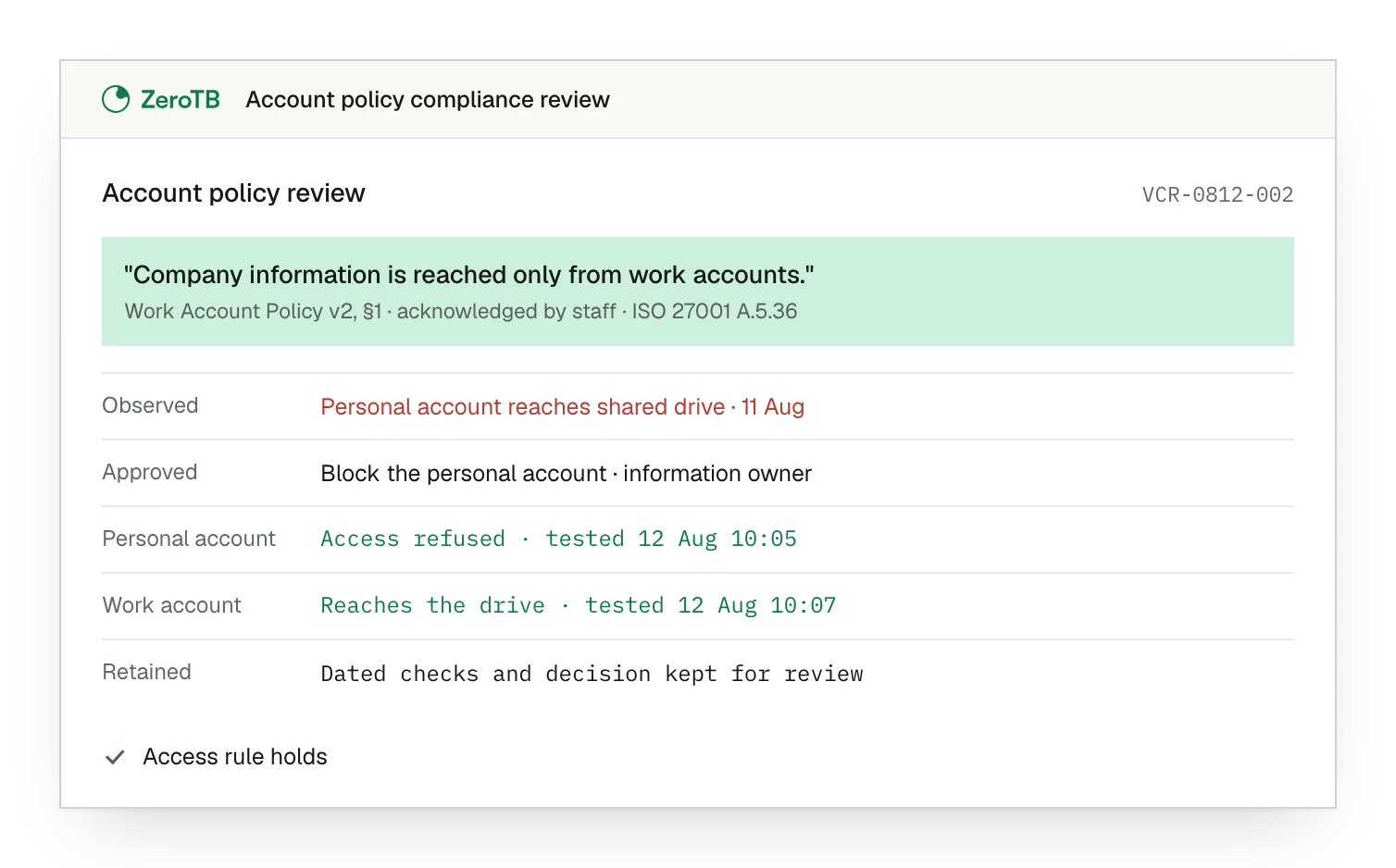
Rule and observation. The review finds personal-account access to company information despite the acknowledged work-account policy.
Approved access restriction. The owner approves blocking the personal account after considering the effect on permitted work.
Verified access result. After the restriction, personal-account access fails and the permitted work account can still reach the information.
Review evidence retained. The dated checks remain with the decision, allowing another reviewer to examine the basis for closure.
Compliance review checklist
Identify the applicable rule and the activities, systems and people that the review needs to cover.
Choose observations that show the required practice, including human decisions where system settings cannot establish the full result.
Establish the cause, identify the responsible owner and distinguish a permitted exception from an unresolved gap.
Agree the intended result and authorize a correction that addresses the cause while preserving necessary operations.
Test the affected operation after correction and retain the dated result with the original finding and approval.
Sources
- ISO, ISO/IEC 27002:2022 information security control guidance, 2022.
- AICPA & CIMA, 2017 Trust Services Criteria with revised points of focus, 2022 revision.
- HHS, HIPAA audit protocol, evaluation standard, 2018 update.
Related pages
Organizational controls
Find the other organizational controls that support information security responsibilities and reviews.
ISO 27001
Read how individual controls fit within an information security management system.
Compliance frameworks
Explore the control libraries for the frameworks that apply to the organization.
Start with the Pilot
Talk with our team about the security rules that are difficult to keep working. The eight-week Pilot maps up to 25 commitments and takes two real control gaps through approved correction and verified restoration, with evidence of the results.