Home / Organizational controls
What does ISO 27001 A.5.23 require for cloud service security?
ISO 27001 A.5.23 covers security from choosing a cloud service through using it and leaving it. An organization must understand the work it keeps and the work its provider performs. Review each service against its approved purpose, check customer-controlled settings and establish how information will be returned or deleted at exit.
The approved supplier list may stay unchanged for months while teams add accounts and features. Those additions can affect where information goes and who can reach it. A.5.23 brings the review back to the service arrangement: does it still cover how the organization uses the cloud?
Approved cloud use
A cloud service needs an approved purpose and security requirements before it holds company information. The decision should identify the information involved, who needs access and which business activities depend on the service. These details give the review a concrete basis for judging whether the proposed arrangement fits.
Service terms also affect that decision. Support, incident communication, information handling and eventual return or deletion can matter throughout the relationship. Agree how the service will meet the relevant requirements while there is still a choice about its use and the information placed in it.
Service inventory
A cloud inventory is useful when it identifies the service behind a workload and the decision that permits its use. A list of provider names gives little help with that task. One provider can host several accounts for teams with different information, access needs and business purposes.
The inventory should make those differences visible, with an owner for each relevant service or account. Compare the listed use with the accounts now operating. When an account has changed hands, the review needs to establish who can decide whether its use and access remain appropriate.
Shared responsibilities
Buying a managed service changes the division of security work between the customer and provider. The details depend on the service. AWS's explanation of shared responsibility makes this distinction explicit: customers need to understand the tasks left with them for the services they select and use.
Take each relevant requirement through that division. Which part does the provider perform, and which part can the customer configure? Recording both answers gives the service owner somewhere to direct a finding. It also identifies which party can supply evidence when the arrangement is reviewed.
Provider assurance
The scope of a provider report determines what it can tell the reviewer about a cloud service. Check which services and period it covers, then relate that coverage to the work assigned to the provider. This establishes where the report contributes to the service assessment.
There is still the customer’s configuration to examine. A team may have opened sharing on a storage area after the provider report was issued. Its current permissions require a separate observation. Keep that observation with the provider evidence so the review covers both sides of the arrangement.
Cloud configuration
To check a cloud commitment, identify the resources it covers and the condition that must hold on them. For an internal storage area, that might mean confirming public access is blocked. The check must show which resource was inspected and what access the observation found.
Cloud and infrastructure controls connect these observations to the approved requirement. The date matters too: an old result may predate a change to sharing. When evidence is stale or a connection fails, the record needs to show that the current state remains unresolved until it can be checked.
Changes during service use
Keeping a cloud service approved involves reviewing changes to its use. A new feature may add an information flow that the initial review never considered. An owner leaving creates a different issue: the account can continue running while nobody is responsible for decisions about it.
The response depends on what changed. A configuration gap has an approved condition to restore. A proposed new use calls for a decision about whether that use is acceptable. Both need an owner who can act, with a route to the provider when the finding concerns its work.
Corrective decisions
Approval gives a cloud correction its intended result, including what must keep working. A service owner considering tighter sharing needs to know whether the change will affect an application. The proposal should identify the access to remove and the approved access that the application still needs.
ZeroTB prepares the proposed correction from the commitment, and people approve material actions. The decision also records any exception the owner accepts. Once that decision is attached to the finding, the result can be judged against what was agreed, including the access that was meant to remain.
Verification and closure
A cloud gap can close once a new check establishes that the approved change achieved its purpose. A change request marked complete tells the reviewer that work was done. The reviewer still needs to see its effect on the resource and access covered by the finding.
For an access change, test both the blocked route and the approved workload. Keep those results in the Verified Control Record with the commitment, earlier state, action and approval. A failed test or missing observation leaves work outstanding, even when the change itself has been applied.
Service exit
The exit arrangement should account for information left with the provider and systems that still depend on the service. Those dependencies can survive a decision to cancel the subscription. Identify what must be returned or deleted and what needs to remain available during the transition.
Completion can require evidence from both parties. The customer can check removal of access it controls, while the provider must confirm actions on information it holds. Record any unfinished action and its owner. That keeps the remaining responsibility visible until the agreed exit conditions have been met.
Cloud service evidence
These records connect the decision to use a cloud service with evidence of how it operates and how gaps were resolved.
| Requirement | What an auditor asks for | Where it comes from |
|---|---|---|
| Approved use | The purpose and information covered by the approval | Assessment and approval linked to the cloud inventory |
| Assigned responsibilities | Tasks allocated to each party and owners for customer responsibilities | Service terms and the record of agreed duties |
| Provider assurance | Evidence relevant to the provider's part of the service | Provider reports and an assessment of their coverage |
| Customer configuration | Observations of settings covered by the cloud commitment | Configuration checks, including AWS observations for services used there |
| Verified correction | The approval, change and test that support closing a gap | Before-and-after state linked to the action and verification result |
| Service exit | Evidence that agreed return, deletion and transition work is complete | Provider confirmations and customer records of exit checks |
Related framework requirements
| Framework | Control | What it covers |
|---|---|---|
| ISO 27001 | A.5.23 | Security across the lifecycle of the cloud services an organization uses |
| SOC 2 | CC9.2 | Management of risks associated with vendors and business partners |
| HIPAA | 164.308(b)(1) | Business associate arrangements concerning protection of electronic protected health information, where the relationship applies |
Example of restoring restricted cloud access
Public sharing on a new storage area can breach the rule for an already approved cloud account. This example follows one such gap. The owner agrees to restrict sharing while keeping application access, and the verification checks both conditions before the finding closes.
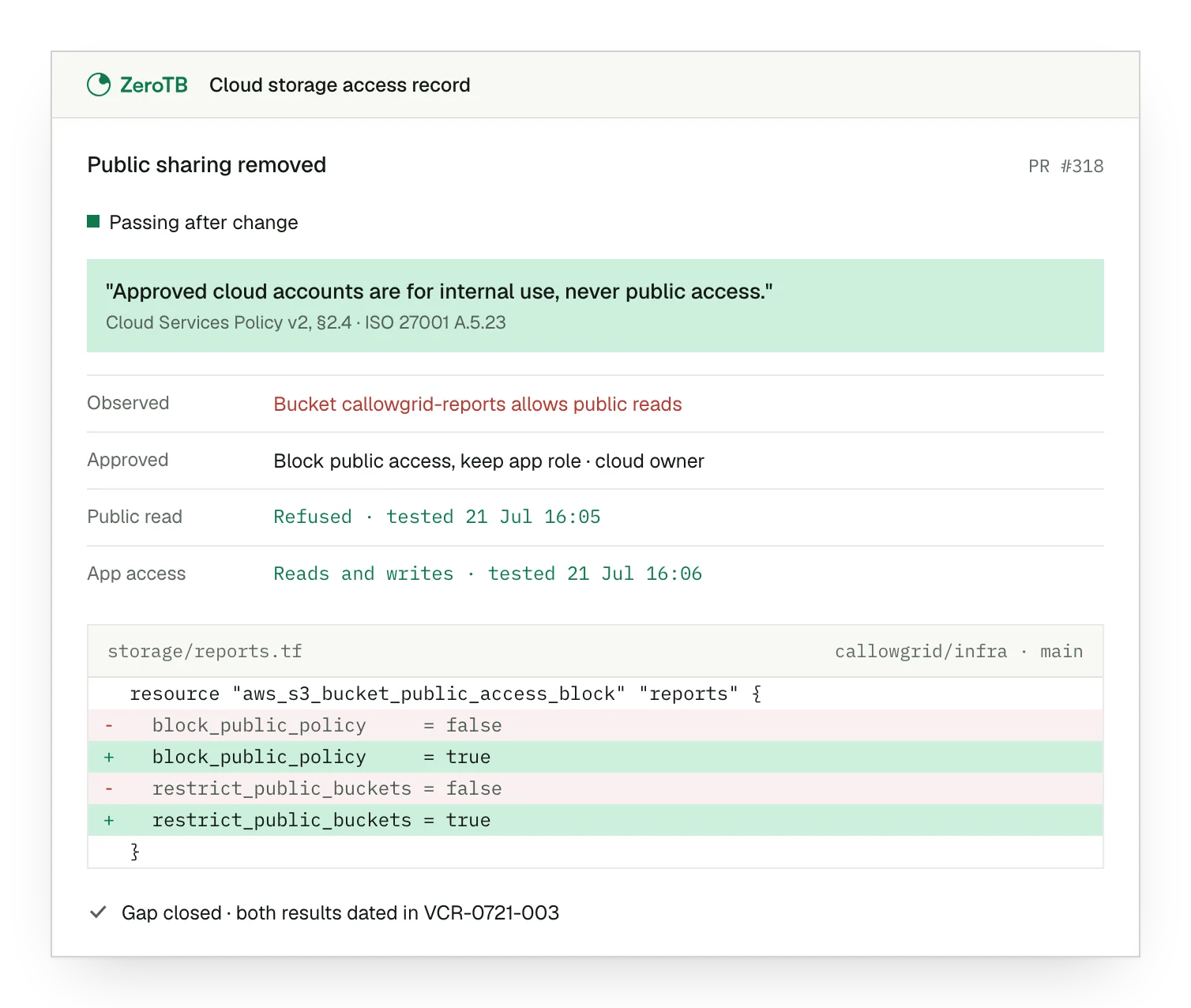
Approved service use. The account's internal-use rule covers the new storage area and excludes public access.
Sharing gap. An observation of the new resource finds that its sharing setting permits public access.
Owner decision. The approved correction removes that route while preserving the access needed by the application.
Verified result. Public access fails, application access works, and the record keeps both test results with their dates.
Cloud service review checklist
Identify the use covered by the cloud commitment and decide whether newly added accounts belong within it.
Confirm who can decide the next action when a finding involves work shared between customer and provider.
Review the access that will change and agree which legitimate use must continue after the correction.
Compare the fresh observation with the intended result, including access that was meant to remain available.
Establish what happens to information and service dependencies at exit, including responsibility for confirming the agreed actions.
Sources
- ISO, ISO/IEC 27002:2022 control guidance, 2022.
- AWS, Shared responsibility model, accessed November 4, 2026.
- AICPA & CIMA, Trust Services Criteria with revised points of focus, 2022 revision.
- HHS, Guidance on HIPAA and cloud computing, accessed November 4, 2026.
Related pages
Organizational controls
Browse the organizational controls that assign responsibilities across information security activities and supplier relationships.
ISO 27001
See how individual controls fit within an information security management system and its ongoing operation.
Compliance frameworks
Explore related requirements across frameworks and the operational controls that can support their implementation.
Start with the Pilot
Talk with our team about keeping cloud controls operating. The eight-week Pilot maps up to 25 commitments and takes two real control gaps through approved correction and verified restoration, with evidence of the changes and their results.