Home / Organizational controls
What does ISO 27001 A.5.3 require for segregation of duties?
ISO 27001 A.5.3 calls for segregation of duties where responsibilities conflict. If someone can make a sensitive change and approve it themselves, another person may never examine the decision. Check the permissions behind those duties, separate them where practical and arrange independent oversight for conflicts that must remain.
A second role in a procedure does little if the same person controls both accounts. The starting point for this organizational control is the work itself: who can submit it, who can approve it and who can remove the requirement for approval.
Conflicting responsibilities
A.5.3 addresses combinations of duties that let one person make a sensitive change without an independent check. Consider who requests, approves, executes and reviews an action. A conflict matters when combining those responsibilities could let an error or misuse escape review. Start with actions that affect sensitive production systems.
The division should reflect the action and its risk. Routine tasks may sit with one person, while a sensitive decision needs another person's judgment. Describe the prohibited combination precisely enough that someone can compare it with permissions and recent work.
Separation within a workflow
Separate the decisions that create a conflict, then make the workflow enforce that separation. A change author may prepare and submit work while another person approves it. The system must preserve that distinction through the steps where approval is required.
Two accounts controlled by the same person still leave that person making both decisions. Connect account identities to the people using them when testing the workflow. For change and development controls, examine how the author's work reaches the reviewer and what can proceed without that review.
Combined account permissions
Look at the person's permissions as a whole. Access through a group can combine with a direct grant to give them both sides of an approval. Review each system involved in the action, since the conflicting rights may sit in different places.
For every conflict, trace the rights back to their grants. Removing a direct permission will achieve little if a group still provides it. That detail gives the owner a basis for deciding which access can go while preserving the person's remaining responsibilities.
Authority over approval rules
The person who controls an approval rule may also be able to evade it. A requirement for a second reviewer provides little protection if the author can switch it off before submitting work. Check the administrative permissions behind the rule as well as its current setting.
Look for rights to change the reviewer requirement, grant a bypass or assign an approval role. If someone must keep those rights alongside their normal work, decide who will review their use. That review needs to include changes to the safeguard itself.
Independent review
An independent reviewer needs enough information and authority to challenge the action. The review should make the proposed change, its scope and its likely effect clear. A reviewer who cannot judge those details may record approval without providing the intended check. The reviewer must be able to withhold approval.
Record who made the review decision and which work they considered. If the proposed work changes after approval, assess whether that approval still applies. This helps establish what the reviewer accepted when the action proceeded.
Small-team exceptions
Limited staffing can make complete separation difficult. The owner still needs to identify the conflicting duties and decide how another person will oversee the affected work. Describe why the exception is needed, which actions it covers and the conditions for reviewing or ending it.
Reviewing completed work leaves a period in which an error may already have consequences. Account for that delay when deciding whether later review is suitable for the risk. The reviewer needs records showing what happened, who acted and whether the action stayed within the exception.
Temporary access
Temporary access can leave a permanent conflict when nobody checks that the extra rights have ended. An urgent release may require additional authority that combines previously separated duties. Record the purpose, scope and end condition when the owner authorizes that access.
At the end of the exception, compare actual permissions with the intended roles again. An expired ticket does not establish that the system removed the grant. Retain the observation showing which rights ended and which remain, so the next reviewer can understand the resulting access.
Approved correction
A proposed correction must explain which authority will end and which work can continue. Put the conflicting permissions beside the commitment they breach, then identify the grant or rule to change. The owner can judge that proposal together with any exception that will remain afterward.
ZeroTB reads the commitment, checks the system and drafts a correction for a person to approve. After authorized action, it checks the result again. The Verified Control Record preserves the commitment, before-and-after state, action, approval and verification, showing which conflicting rights the change removed.
Workflow verification
A useful verification tests what the person can no longer do and what the team can still complete. Attempt self-approval and any bypass affected by the correction. Then follow the intended route through an independent reviewer, checking that their approval allows the work to proceed.
A failed self-approval attempt is only part of the result. The change could have blocked everyone, including the intended reviewer. Keep the gap open if the approved route fails or current observations are unavailable. Save dated results for both tests once they establish the intended behavior.
Continuing checks
Separation needs another check when people, permissions or approval workflows change. A transfer, new group membership or revised workflow can combine duties that were previously separate. Assign responsibility for checking those changes and for investigating any conflict the checks reveal.
Keep the latest observations connected to the earlier correction and its exceptions. The owner can then see whether a new grant has exceeded an approved exception. If observations are stale or missing, obtain current evidence before concluding that the division of duties still holds.
Evidence for segregation of duties
The evidence should connect the approved division of duties to actual permissions, independent decisions and tested results.
| Requirement | What an auditor asks for | Where it comes from |
|---|---|---|
| Defined conflicts | Sensitive actions, conflicting duties and the approved division of responsibility for each workflow | Role descriptions and the approved control or procedure governing the work |
| Effective separation | The combined rights of each person, including authority to change or bypass approval rules | Account permissions, group memberships and workflow settings reviewed together |
| Independent decisions | Who reviewed the action, what they considered and which version they approved | Approval records linked to change requests and the work that proceeded |
| Controlled exceptions | The reason for retaining a conflict, its scope, oversight and review or expiry conditions | Exception decisions and records showing that the agreed oversight occurred |
| Tested correction | The conflict before the change, its approval and tests of prohibited and permitted actions afterward | Permission comparisons and workflow test results linked in the Verified Control Record |
Related framework requirements
| Framework | Control | What it covers |
|---|---|---|
| ISO 27001 | A.5.3 | Division of duties where combining responsibilities would let a person act without an independent check |
| SOC 2 | CC5.1 | Controls selected and developed to address risk, with consideration of how responsibilities are divided |
| HIPAA | 164.308(a)(4) | Policies for authorizing, reviewing and changing access to electronic protected health information within the applicable scope |
Example of restoring independent approval
Removing a temporary administrator grant can restore the second person's part in a release. In this example, the engineer had retained permission to disable review. The owner approves removing that grant, leaving normal delivery access and the separate reviewer's approval rights intact.
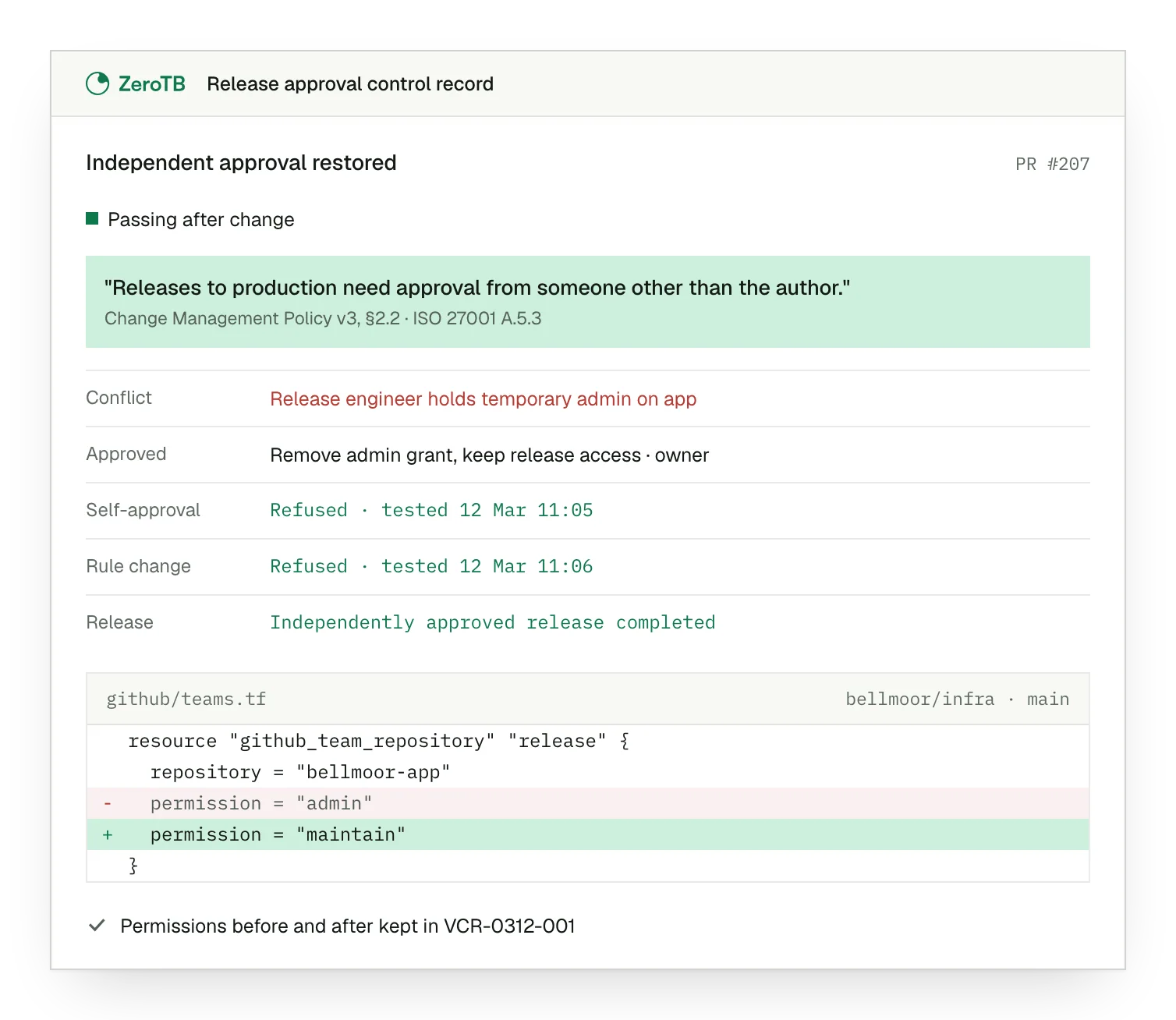
Conflicting permission. A temporary administrator grant lets the release engineer switch off the required review.
Approved removal. The owner agrees to remove the grant and keep the permissions needed for normal releases.
Workflow tests. Attempts to approve or change the rule fail; a separately approved release still completes.
Retained evidence. The permission comparison sits beside the decision and test results, with dates for each observation.
Segregation of duties checklist
Identify a sensitive action and the combination of duties that could let an error or misuse escape review.
Compare actual account rights, group memberships and authority to change approval rules with the intended separation.
Agree which conflicting rights to remove and document the oversight for any exception the owner retains.
Attempt the prohibited action, then confirm that an independently approved action can still complete through the intended route.
Retain dated evidence with the decision and identify who checks subsequent permission changes and exception conditions.
Sources
- ISO, ISO/IEC 27002:2022 control guidance, 2022.
- AICPA & CIMA, Trust Services Criteria with revised points of focus, 2022 revision.
- HHS, HIPAA audit protocol, July 2018 update.
- ZeroTB, Control operation and verified restoration, 2026.
Related pages
Organizational controls
See how this duty relates to the other organizational controls in an ISO 27001 program.
ISO 27001 framework
Read about the management system in which the organization selects and operates these controls.
Compliance frameworks
Find control guidance for SOC 2, ISO 27001 and HIPAA in the framework libraries.
Start with the Pilot
Talk to our team about keeping approval controls working as access changes. The Pilot lasts eight weeks: we map up to 25 commitments and take two real control gaps through approved correction and verified restoration, with records of the work.