Home / Organizational controls
What does ISO 27001 A.5.22 require for reviewing supplier services?
ISO 27001 A.5.22 asks organizations to keep reviewing supplier services as delivery arrangements and security practices change. The review checks whether the service still meets agreed security requirements. When it finds a gap, assign the response and examine the result before deciding that the issue is resolved.
The register says a supplier was reviewed. The supporting report covers last year's service, and nobody has examined the changes since then. A.5.22 addresses this continuing oversight: the owner needs a current basis for deciding whether the relationship remains acceptable.
Agreed security requirements
Supplier monitoring starts with the security requirements agreed for the service. Those requirements give the reviewer something specific to compare with current performance and practices. Identify the relevant agreement, the service it covers and the security commitments that need continued attention.
Keep the scope precise when one supplier provides several services. Approval for one service may rely on different information, access or delivery arrangements from another. A review record should make that distinction visible so the owner can explain which use of the supplier remains acceptable.
Review depth
Review effort should reflect the harm a supplier failure could cause. A service holding sensitive information or supporting an essential operation deserves closer examination than a limited service with little access. The risk assessment explains why the review needs that depth.
For a critical service, examine the information needed to judge its security and continued delivery, including relevant incidents and unresolved findings. A smaller review may suit a lower-risk relationship. Record the basis for that choice so a change in dependence can prompt a deeper assessment.
Review timing
A review schedule should allow earlier attention when an incident or service change affects security. Set the interval around the risk and how often the service changes. Receiving an annual report does not settle when to examine issues that arise during the year.
Decide who receives change notices and incident reports, and which events require that person to reopen the review. A missed commitment may also need action before renewal. Add the resulting findings to the service record so they remain part of the next scheduled assessment.
Service changes
A supplier change matters when it changes the security assumptions behind the agreement. A revised delivery arrangement, security practice or service feature can affect an existing requirement. The review should establish what changed, which service is affected and whether its agreed protections still hold.
Ask for information that explains the effect of the change on the relationship. A general announcement may leave the relevant security question unanswered. Where the change creates a gap, the owner needs a decision about corrective action, additional safeguards or continued use under revised conditions.
Changes in use
A customer can outgrow the scope of a supplier review by changing how it uses the service. More users, different information or additional access may increase the consequences of failure. Those changes deserve attention even when the supplier has changed nothing.
The business owner should describe the proposed use to the reviewer. Compare it with the agreement and the scope of the previous assessment, then identify any additional security requirements. The earlier approval can support the decision only where its assumptions still fit the new use.
Evidence scope
A supplier report is useful only for the service, controls and period it covers. Read those boundaries alongside the agreed requirements. A recent document can still leave an important question unanswered if the relevant service or security practice falls outside its scope.
Keep report findings with the review, including the supplier's response and any follow-up needed. Where evidence is missing or outdated, identify the unanswered question and request suitable information. The review remains unresolved on that point until the owner has enough evidence to make a decision.
Review findings
A completed review should explain what the reviewer concluded and what remains unresolved. Connect each finding to the relevant requirement and the information examined. This lets the owner distinguish a demonstrated failure from a question that still needs evidence before anyone can assess it.
Record the consequence for the service alongside the finding. A missed report, a failed security measure and an unexplained change may require different responses. The record should show which response the owner chose and why, with an action owner and follow-up date where work remains.
Corrective action
Corrective action depends on who can change the thing that failed. The supplier may need to restore a security practice or deliver missing information. An internal team may need to change access or how it uses the service. Agree responsibilities with those people.
Record the expected result, the date for follow-up and any approval needed for the work. Specify the evidence that will allow the reviewer to close the finding. If the supplier misses its date, the relationship owner needs to decide what to do about the continuing gap.
Verification and acceptance
Close a corrective action when evidence establishes the agreed result. The supplier's statement that work is complete should lead to a check suited to the issue. For a missing report, that includes examining whether the delivered report answers the question that kept the review open.
If the result remains inadequate, keep the finding visible and reassess the response. An owner may accept residual risk under defined conditions, require further safeguards or reconsider the service. Record that decision separately from a verified correction so later reviewers understand what remains unresolved.
Review continuity
A review record should let another person understand the decision without reconstructing the supplier correspondence. Keep the service and review period beside the information examined, findings and response. Show which actions remain open and which results gave the reviewer grounds to close them.
Then assign the next check and decide where overdue work goes. This is part of ZeroTB's security governance work: checking approved commitments, assigning action and retaining the result in a Verified Control Record. The supplier relationship needs that continuing attention as its service and evidence change.
Supplier review evidence
The evidence should show what the reviewer examined, what needed action and why the owner accepted the result.
| Requirement | What an auditor asks for | Where it comes from |
|---|---|---|
| Agreed service requirements | Which service was reviewed and which security requirements applied | The agreement and service register, with the approved security requirements |
| Continuing review | When the review happened, what it examined and why that interval was chosen | Dated reviews with the supplier reports and incident information they examined |
| Assessed service changes | What changed in the service and how the owner assessed its security effects | The supplier notice, assessment of the change and recorded decision |
| Managed findings | Who agreed to resolve the finding, what they would do and by when | The finding linked to correspondence and the agreed action |
| Verified correction | What the correction achieved and what justified closing the finding | The evidence examined after the correction, with the dated closure decision |
Related framework controls
| Framework | Control | What it covers |
|---|---|---|
| ISO 27001 | A.5.22 | Continuing review of supplier services and the security effects of changes |
| SOC 2 | CC9.2 | Assessment and management of risks arising from vendors and business partners |
| HIPAA | 164.308(b)(1) | Assurances that business associates appropriately safeguard electronic protected health information within the covered relationship |
Example of restoring supplier reporting
Consider a supplier that has missed the monthly security report required by its agreement. The service is running, but the reviewer lacks evidence for the latest period. Resolving the finding means obtaining the report and examining what it says about the service.
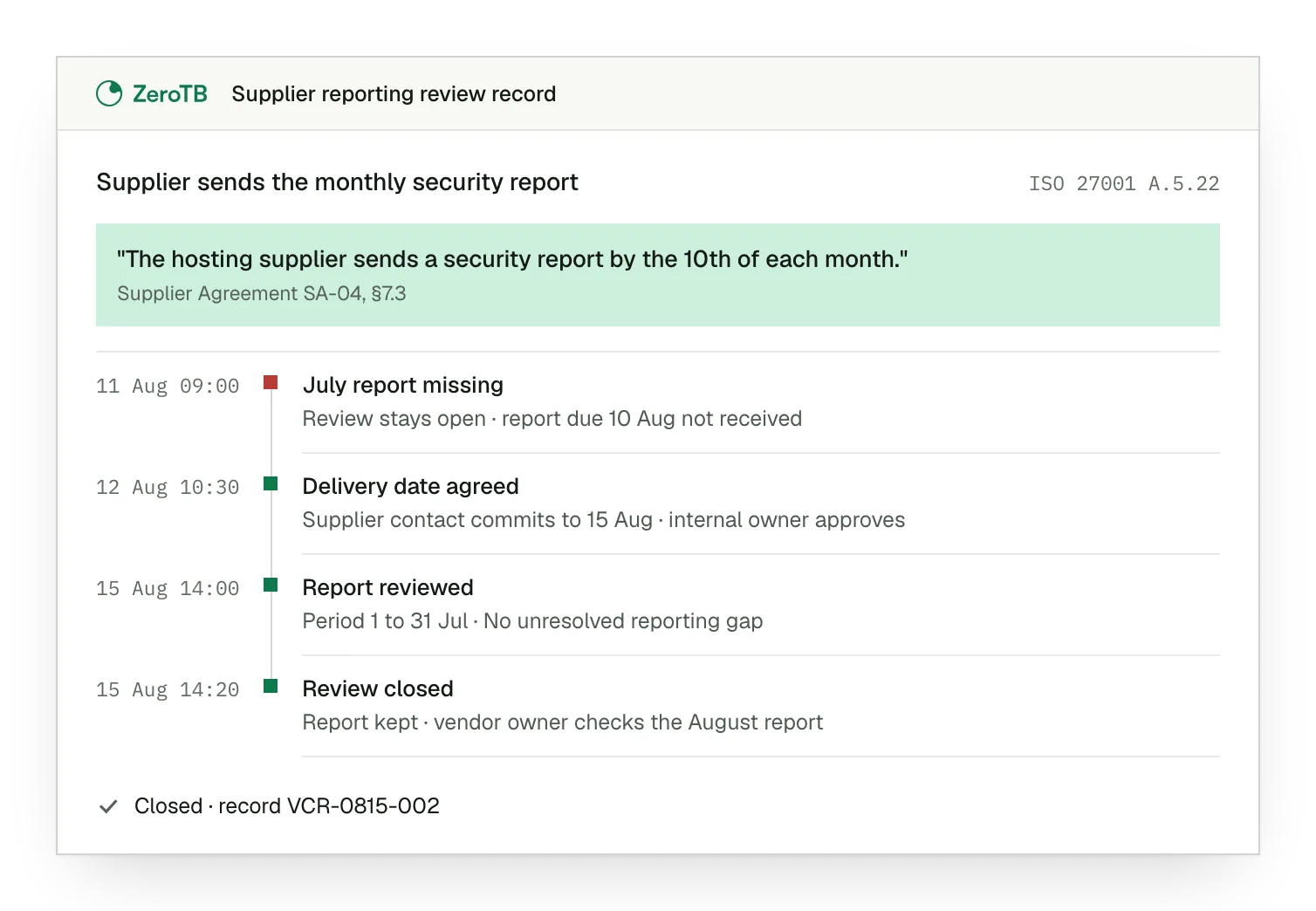
Missing report. The review remains open because the agreed report for the latest month has not arrived.
Assigned follow-up. The supplier contact commits to a delivery date, with the internal owner's approval recorded alongside.
Reviewed evidence. The reviewer examines the delivered report, confirms its period and records the findings and response.
Continuing oversight. The closure decision retains that evidence, and an owner checks when the next report arrives.
Supplier review checklist
Select a service and confirm which security requirement the review needs to test against current evidence.
Compare current service information with the approved scope, including changes since the previous review and unresolved findings.
Agree a corrective action with the responsible party, including approval, a follow-up date and the expected result.
Examine evidence of the correction before closing the finding, and record any separate decision to accept residual risk.
Keep the decision with its evidence, then assign an owner and conditions for the next review.
Sources
- ISO, ISO/IEC 27001:2022, 2022: information security management system requirements.
- ISO, ISO/IEC 27002:2022, 2022: guidance on information security controls.
- AICPA & CIMA, Trust Services Criteria with revised points of focus, 2022 revision.
- HHS, Summary of the HIPAA Security Rule, accessed November 4, 2026: business associate safeguards and written arrangements.
- ZeroTB, Compliance control operations, 2026: approved actions and verification of control results.
Related pages
Organizational controls
Read the other organizational controls, including those concerned with supplier relationships and security responsibilities.
ISO 27001
Read about the wider information security management system that gives individual controls their purpose and scope.
Compliance frameworks
Browse the framework library for related requirements and guidance on keeping controls in operation.
Start with the Pilot
Talk with our team about keeping compliance controls working. The eight-week Pilot maps up to 25 commitments and takes two real control gaps through approved correction and verified restoration, with a record of the actions and results.