Home / Organizational controls
How does ISO 27001 A.5.8 keep security inside project work?
ISO 27001 A.5.8 concerns security throughout a project, from the first plan to delivery. Decide which information needs protection and how the project will protect it. When scope changes, revisit those decisions; before handoff, test the controls and agree who takes responsibility for keeping them working.
The security review at kickoff covers the project as it was understood then. Delivery may introduce another supplier, a new data source or different access permissions. These changes need security decisions of their own, with enough detail for the receiving team to understand what it is accepting.
Project scope
A.5.8 applies to business projects as well as technology projects. Moving a process to a supplier can change access to information even when no software changes. Review the information affected by the project, the people handling it and the systems they use.
Keep that scope with the project record and connect it to the wider ISO 27001 program. When someone proposes additional work, the reviewer can compare it with the assessed information and dependencies. That comparison identifies which assumptions still hold and which need another decision.
Early security requirements
Agree security requirements while the team can still change the design. A risk assessment becomes useful to delivery when it explains what the finished work must protect. Specify the intended result and how the team will test it before accepting the work.
For software, NIST's Secure Software Development Framework recommends adding security practices to the development lifecycle. Include the relevant requirements in design reviews and acceptance criteria. If a requirement first appears when the software is ready to deliver, the team may have to revise work it has already completed.
Information used during delivery
The review also covers information used during the project itself. A team can expose information through shared documents or test files before it delivers anything. Include temporary working arrangements in the assessment, together with the controls intended for the service when it begins operating.
Supplier trials need a decision about the information shared and the duration of access. Permission to use data for a trial should have a defined end. If access is still needed afterward, record the reason and approval so the operating team understands why it remains.
Decisions and responsibilities
Each security requirement needs an owner who can resolve questions before they delay delivery. The project owner coordinates decisions, while the delivery team implements the agreed protections. Security specialists help assess the risks and define the evidence needed to judge whether those protections work.
Record who can accept remaining risk and who will operate each control after handoff. Those decisions may involve different people. Identifying them early gives the project a route for resolving disputed requirements and prevents acceptance from depending on someone who lacks the authority to decide.
Changes to the agreed scope
A scope change can make the original security assessment incomplete. New data, an added supplier or a different access arrangement may change the risks the team assessed. Compare the changed work with the assumptions behind the last review before treating its approval as sufficient.
Keep the change decision connected to any revised requirements and delivery tasks. A note that security reviewed the project at kickoff cannot explain how later changes were handled. The record should show what changed, which protection it affected and how the team addressed that effect.
Reviews proportionate to risk
Review effort should reflect the information and risks affected by the change. A small adjustment within an assessed process may need only confirmation that existing protections remain suitable. For a new external data flow, assess the information involved, who receives it and what access they need.
Set review points around decisions that can change exposure, such as scope approval, supplier selection and acceptance. The team can record these decisions in its existing project plan. Record why that level of review was sufficient so the next reviewer can assess whether it still applies.
Corrections before acceptance
A project security gap needs a decision about the delivered state before someone changes it. Describe the requirement, the observed gap and the proposed correction together. The responsible owner can then judge whether the correction protects the information and allows the intended work to continue.
Record the approval before implementing the correction. If the project proceeds with an unresolved risk, retain the acceptance decision, its reason and any conditions for review. A decision to accept risk leaves a different record from a test showing that a control has been restored.
Tests of delivered controls
Acceptance tests should show that the delivered controls meet the agreed security requirements. Use the expected result to choose the test, then retain the actual result with its date and the version tested. This lets a reviewer connect the evidence to the work being accepted.
For access controls, test both restricted access and the access needed for approved work. Missing or failed results leave the requirement unresolved. If implementation changes after testing, identify which results remain relevant and repeat the affected checks before relying on them for the acceptance decision.
Ownership after handoff
Handoff needs an operating owner for each control. The receiving team needs to know what it is taking responsibility for, which checks continue and where to send a failure. Transfer unresolved risks with the decisions that accepted them and the conditions for reviewing them again.
Review project accounts, trial permissions and working copies of information before closing the project. Some may still have an approved purpose; others should be removed. Record those decisions at handoff so the receiving team can tell which arrangements belong in the service it now operates.
Checks during operation
Acceptance evidence has a date, and later changes can affect the tested control. The operating team needs current observations to judge whether the accepted protection still works. Give failed checks an owner who can investigate the cause and arrange a correction when one is needed.
ZeroTB follows approved commitments into the systems where they operate. A repair leaves a Verified Control Record: the commitment, observations before and after, action, approval and verification. The record gives the operating owner an account of the repair to keep alongside the original project evidence.
Project security evidence
The project record should let a reviewer trace a security requirement through the decisions, tests and handoff that followed.
| Requirement | What an auditor asks for | Where it comes from |
|---|---|---|
| Project scope | Which information and dependencies the team assessed | Scope document and risk assessment |
| Security requirements | What the team agreed to protect and how acceptance would be judged | Requirements and acceptance criteria |
| Scope changes | How a later change affected the assessment and delivery work | Change decisions and revised tasks |
| Corrections | Who approved the action and what risk remained | Gap record and risk decisions |
| Acceptance tests | Whether the delivered version met the agreed protection | Dated tests and observed results |
| Operating ownership | Who received the controls and how checks continue | Accepted handoff and operating procedures |
Related framework requirements
| Framework | Control | What it covers |
|---|---|---|
| ISO 27001 | A.5.8 | Bringing security into project decisions from planning through delivery |
| SOC 2 | CC3.4 | Assessing changes that affect internal control, including relevant changes introduced by a project |
| HIPAA | 45 CFR 164.308(a)(1) | Assessing and managing risks to electronic protected health information when a project handles that information |
Example of closing a project security gap
In this example, a project adds a customer-data import after the first security review. Files arrive in a location that people outside the approved project group can access. The owner approves restricting access, and the team tests the permissions before accepting the import.
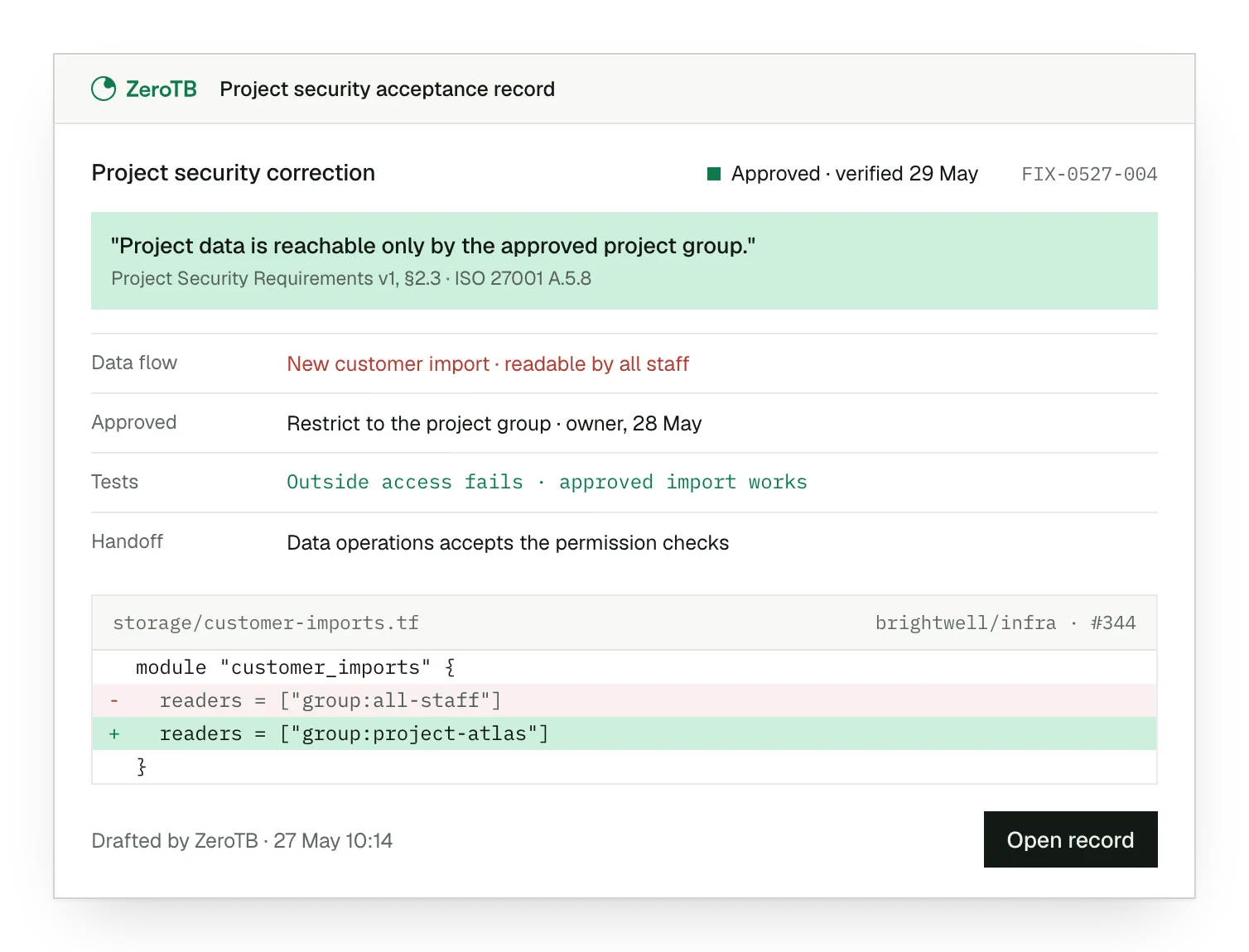
Changed data flow. The added import appears beside the access requirement from the project's security review.
Approved access correction. The owner agrees to remove access for people outside the approved project group.
Tested permissions. The import works for the approved group, and a test confirms that outside access fails.
Operating responsibility. The team receiving the import accepts permission checks and the responsibility for handling failures.
Project security review checklist
Compare the current project scope with the information, access and dependencies covered by its last security assessment.
Follow each material scope change to its risk decision, revised requirements and the delivery work needed to address them.
Check that each gap has a proposed correction or an explicit risk decision from the responsible owner.
Match test results to the delivered version and agreed protection, including access needed for the intended work.
Confirm who receives each control, how checks continue and where failures go after the project team finishes.
Sources
- ISO, ISO/IEC 27001:2022, 2022.
- ISO, ISO/IEC 27002:2022, 2022.
- NIST, Secure Software Development Framework, SP 800-218, 2022.
- AICPA & CIMA, Trust Services Criteria with revised points of focus, 2022 revision.
- HHS, Guidance on risk analysis, accessed November 4, 2026.
Related pages
Organizational controls
Explore the responsibilities that support information security across the organization, including project decisions and ownership.
ISO 27001
Place project security within the wider information security management system and its approach to risk.
Compliance frameworks
Find guidance on the other frameworks that may apply to the information and systems involved.
Start with the Pilot
Talk with our team about keeping project commitments working after delivery. The eight-week Pilot maps up to 25 commitments and takes two real control gaps through approved correction and verified restoration, with a record of the work.