ZeroTB keeps your secure development lifecycle's review and release controls working after the audit.
Works with the stack you already run


ZeroTB has undergone an independent audit and operates this control lifecycle in its own compliance program. Its report is available under NDA.
A secure SDLC needs gates that stay enforced
A secure software development life cycle includes security throughout development. ZeroTB keeps review and release controls working for US software, AI, fintech and healthtech companies with 25 to 250 people.
Policy sets the gates. Your SDLC policy names the reviews and checks each change needs
Security in every phase. Security covers requirements, design, implementation, testing, deployment and maintenance
Deepest surface today. Change and development is where ZeroTB works most fully today
Removed required checks cost change management findings
Tests still run, but an optional check cannot stop a merge. Auditors can find a gap where the development policy requires that check.
The required check is removed
Merges proceed without the check
The policy requirement goes unenforced
ZeroTB checks branch protection, reviews and CI gates
ZeroTB checks the review and release rules behind SOC 2 change management under CC8.1 and ISO 27001 A.8.32.
We check whether covered GitHub branches have the protections your commitment requires.
We identify where changes can proceed without the approvals your process requires.
We check that CI gates hold changes until the required release checks pass.
We identify each requirement's affected systems, owner and expected evidence.
ZeroTB repairs each gap through your change process
Repairs follow your IT change management process. ZeroTB prepares the changes to repository rules and release checks for people to authorize.
Confirm the requirement
Your team confirms the policy's meaning and which systems its rule covers.
Locate the gap
We check daily for failed gates, including repaired rules that disappear again.
Propose the repair
We prepare a runbook, pull request or preventive guardrail for your team's approval.
Verify before closing
ZeroTB checks the repaired gate before closing the gap.
Engineering gets a fix, compliance gets evidence
Engineers receive the proposed repository fix to assess. The signed Verified Control Record gives compliance and auditors its repair history in ZeroTB.
The gap explained
The owner sees the source clause beside the branch setting that falls short.
A defined change
Engineering gets a specific proposed fix to assess before it ships.
Verified Control Record
The signed record retains commitment, before-and-after state, action, approval and verification.
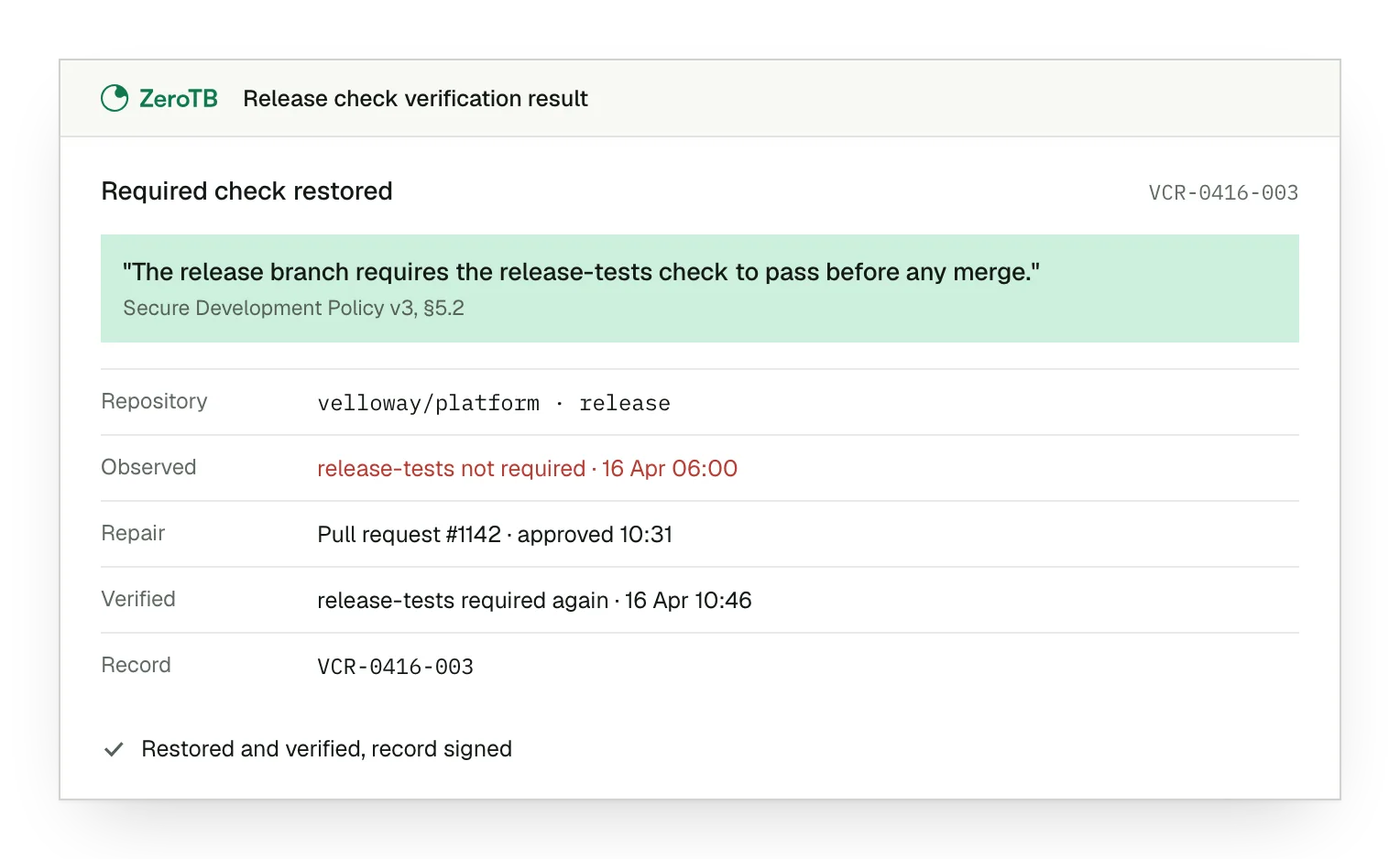
Example of restoring a required check
In this example, the test still runs, but merges no longer require it. The repair restores that requirement on the release branch.
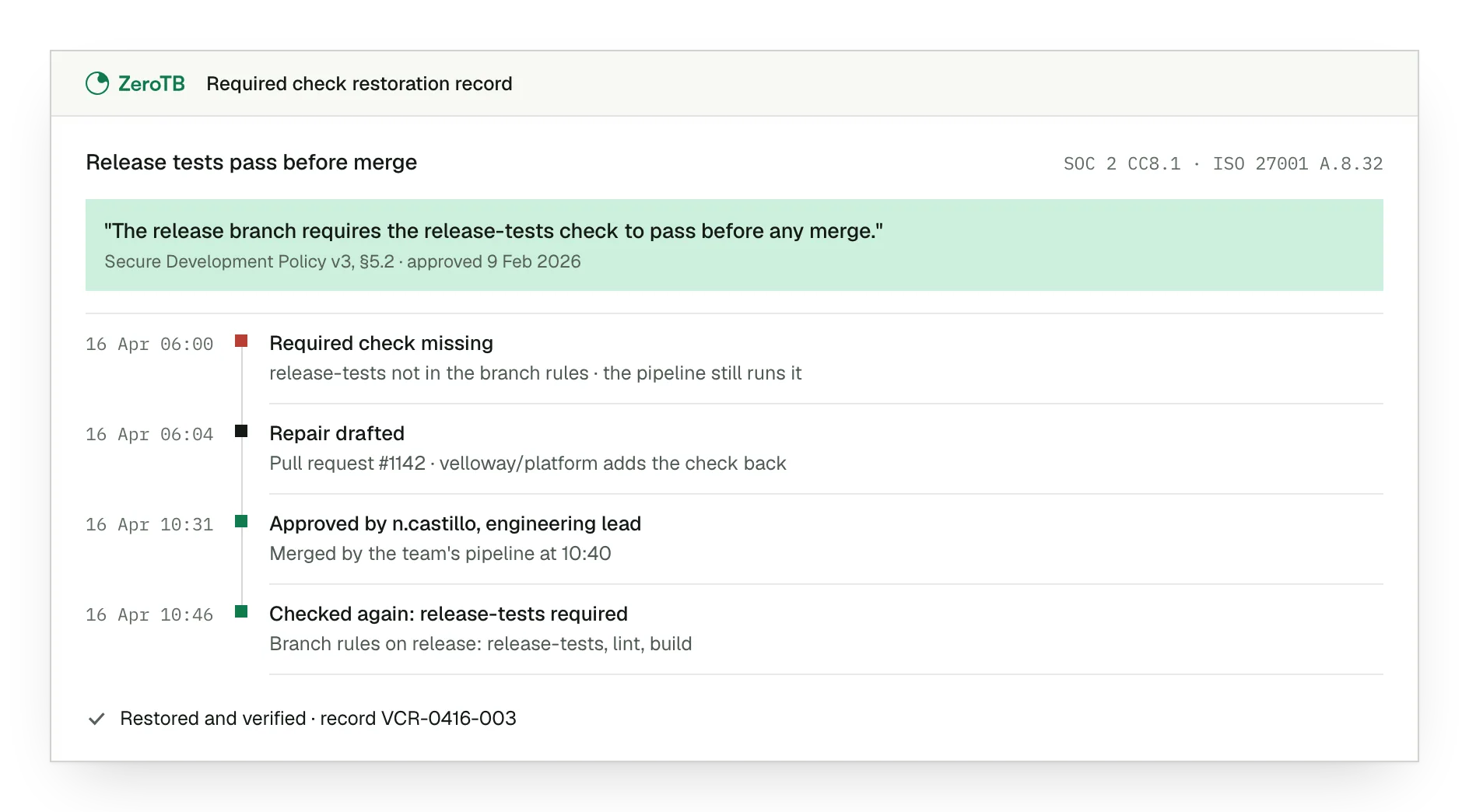
Policy requirement. The development commitment requires the release branch to enforce this check.
Missing enforcement. The pipeline runs the test, but the branch permits merges without it.
Verified result. The repaired branch configuration requires the check to pass before merging.
Agent pull requests get the same required reviews
An agentic SDLC puts code and configuration changes in agents' hands. Your review policy still applies to their pull requests.
Same review rules. Agent pull requests face the required reviews set by your SDLC policy
More changes, same gates. Each additional agent change creates another opportunity to skip a required gate
Guardrails against recurrence. ZeroTB can propose a guardrail when further agent changes could undo a repair
Talk to our team
Talk with us about reviews, release checks and the work coding agents add as changes reach production.
FAQ
Can we use our SDLC policy if it predates coding agents?
Your SDLC policy still supplies the requirements for agent-written changes. Your team confirms their meaning, including any adopted practices from the NIST Secure Software Development Framework.
How do we show branch protection held for the whole audit period?
Daily checks keep branch-protection observations across the Type 2 audit period between periodic tests. The history lets your auditor examine when rules held and when they failed.
Where does ZeroTB fit beside our code scanners?
A code scanner examines code, while a branch rule makes its passing result a condition of merging. ZeroTB keeps that rule working within your secure development lifecycle.
What if an agent adds commits after a pull request was approved?
GitHub can require another review by dismissing stale approvals or requiring approval of the latest push. ZeroTB compares those settings with your policy for agent-written changes.
Can a protected branch still let someone bypass required reviews?
Administrators and bypass roles can skip a protected branch's review rule by default. A separate setting applies the restrictions to those roles too.
Can we start without granting write access to our repositories?
Your repositories can start with read-only access. Write permissions cover specific action classes and remain revocable. ZeroTB proposes material changes through pull requests that your team reviews.
Start with the Pilot
The eight-week Pilot maps up to 25 commitments and takes two real control gaps through verified restoration.