Home / Organizational controls
How does ISO 27001 A.5.29 keep information secure during a disruption?
Under ISO 27001 A.5.29, the organization plans how it will protect information during a disruption. That includes work carried out with temporary access, different systems or fewer staff. Decide who can approve those arrangements, how to check them during use and what must happen before they end.
An outage can leave security work unfinished after the service returns. An emergency account may still have access, or files may remain on a temporary sharing route. A recovery review needs to account for those arrangements and establish what should happen to each one.
Security during disruption
A.5.29 concerns the protection of information while normal operations are disrupted. Availability is part of that task, alongside confidentiality and integrity. Work that continues through an outage still needs protection against unauthorized disclosure and changes, even when the usual systems or locations are unavailable.
Start with the activities that must continue and the information they need. Identify who will use that information, where it will move and which protections may be affected. This gives the owner a basis for choosing temporary arrangements suited to the disruption and its consequences.
Unavailable dependencies
Staff need access to security instructions and decisions even when the systems they usually rely on have failed. The continuity plan itself may sit on an unavailable shared drive. An approval request may depend on the identity service that responders are trying to recover.
Trace those dependencies before an outage. Establish another approved way to obtain the current procedure and reach someone who can make the decision. Check that responders can use that route under the planned conditions, including when the person who normally approves access is absent.
Emergency authority
An owner must decide whether a temporary arrangement can be used and when its use must end. Give that person enough information to judge the request: its purpose, the users and information involved, and the protection available while normal operations are disrupted.
The response procedure should identify who takes that decision if the usual owner cannot act. Record the authorization, its limits and the reason for granting it. When the arrangement changes, the owner can use that record to decide whether the original approval still covers it.
Alternative safeguards
Choose an alternative safeguard by considering the information it will protect and the work that must continue. For a temporary sharing route, that means deciding which files belong there and who needs access. The owner also needs a way to enforce those decisions.
There may be no suitable route available. In that case, explain to the responsible owner which work would have to pause and why. Keep the decision with the approved safeguards and exceptions, so responders know the conditions under which they may continue.
Checks during disruption
Check temporary arrangements while they are in use, because the disruption can change their risks and scope. Additional users may join a recovery effort, or work may move to another system. Compare these changes with the approved purpose and safeguards before treating the arrangement as acceptable.
Assign someone to review the relevant access and activity records at intervals suited to the situation. If the usual records are unavailable, record that limitation and decide how to obtain a useful observation. A missing check leaves a question open about whether the protection is working.
Temporary access after recovery
Temporary access can survive the outage that justified it. Restoring the main service may leave an emergency group, shared folder or privileged account active elsewhere. The people who restore availability may have no reason to inspect every temporary route used by another team during the disruption.
Keep an inventory of those arrangements and review it with their owners when conditions change. For each retained route, establish its continuing purpose and review conditions. Remove access that no longer has an approved use, including rights granted to people whose recovery work has ended.
Return to normal operation
The return to normal operation needs a security check before closure. Ask the system owner whether work still depends on emergency access. If it does, agree how that work will move to the approved route before removing the temporary rights that currently support it.
After approval and removal, test whether the emergency route denies access. Also test that staff can do the required work through the approved route. Record both results. Where either result fails or cannot be obtained, leave the issue open and assign responsibility for the unresolved check.
Evidence across the disruption
A reviewer should be able to follow the temporary arrangement from its approval to its closure. Retain the initial conditions and the reason for using it, then add the observations made during use. The return checks complete that history by showing what happened after recovery.
In ZeroTB, the Verified Control Record holds the commitment, before-and-after state, action, approval and verification. This gives the reviewer the decision and its result in the same record. The control process describes the work that connects a gap to an approved, checked correction.
Exercises and plan updates
Use exercises and incident reviews to find security steps that the continuity plan cannot yet support. A plan may name an approver who cannot be reached or require a check that depends on an unavailable system. Exercising those steps reveals where the response needs another arrangement.
Include the return to normal work in the exercise, with checks for temporary access and sharing routes. Assign an owner to each gap and update the procedure after resolving it. Review the plan when changes to systems, responsibilities or working locations alter how people would carry it out.
Evidence for review
Use these records to explain how security decisions held through the disruption and the return to normal work.
| Requirement | What an auditor asks for | Where it comes from |
|---|---|---|
| Security planning | Activities and information in scope, with protections needed during disrupted operations | Continuity plans and assessments of the affected information, systems and working arrangements |
| Temporary authority | The purpose, owner, approval and review conditions for each temporary arrangement | Emergency decisions and exception records linked to the disruption and affected access |
| Alternative safeguards | The protections chosen for temporary systems, access and information handling | Approved procedures, membership lists and settings for the alternative arrangements in use |
| Checks during use | Observations showing whether temporary arrangements continued to meet their approved conditions | Dated access reviews, activity records and actions assigned when checks found a gap |
| Verified return | Evidence that unnecessary access ended and approved work could continue securely | Before-and-after observations, approved changes and tests retained with the recovery record |
Framework relationships
| Framework | Control | What it covers |
|---|---|---|
| ISO 27001 | A.5.29 | Planning for information to remain protected when the organization cannot operate in its usual way |
| SOC 2 | CC9.1 | Assessing disruption risks and choosing measures to reduce their effects on the business |
| HIPAA | 164.308(a)(7) | Plans for emergencies affecting systems with electronic protected health information, including safeguards while critical work continues |
Example of closing emergency sharing
A temporary folder needs a recorded closure even after staff have stopped using it. This example follows a recovery group that retained access after the outage ended. The owner confirms that work has returned to the normal service, approves removal and checks the resulting access.
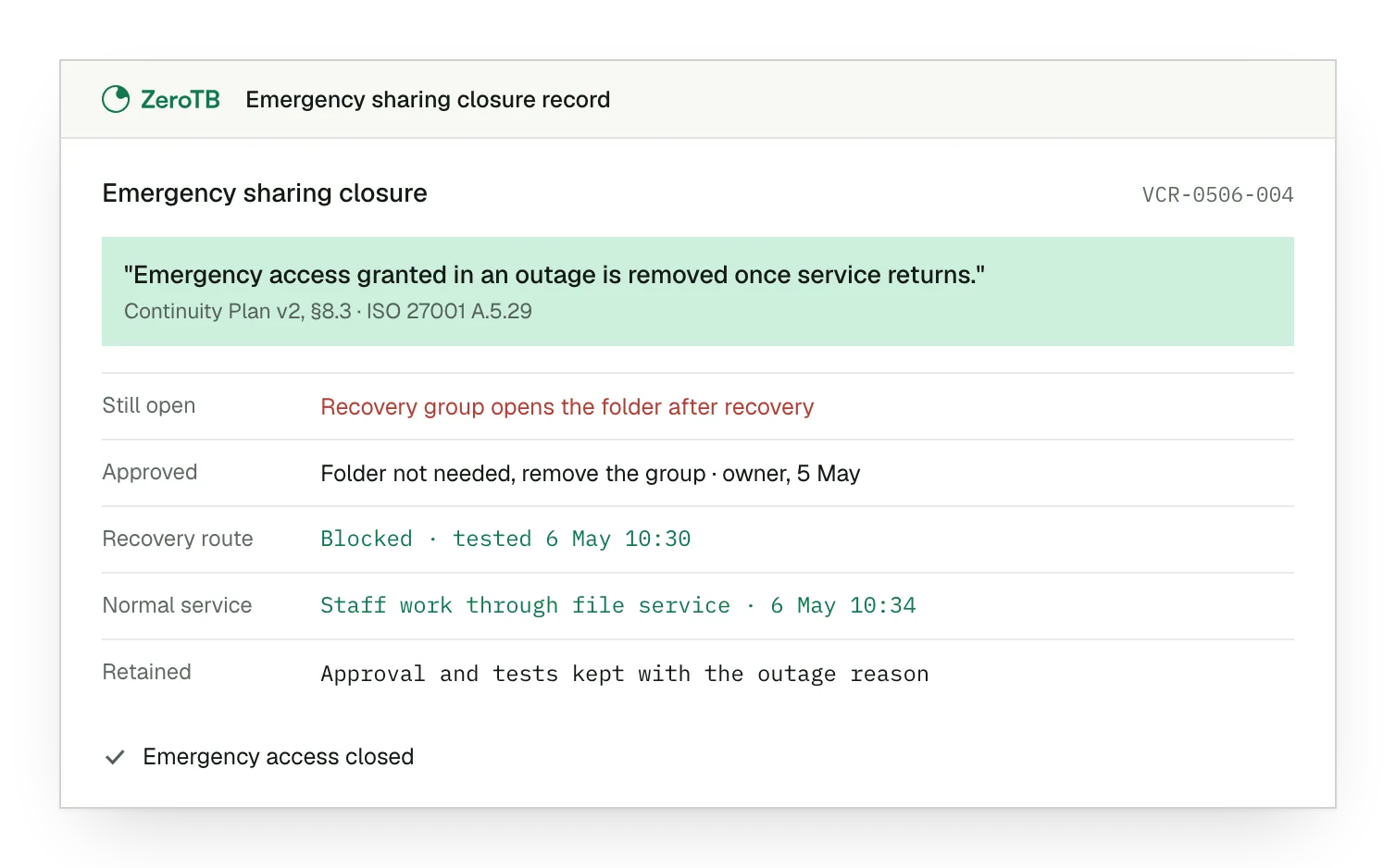
Temporary route retained. The recovery group still has permission to open the folder although normal service has returned.
Closure decision recorded. The owner confirms that the folder is no longer needed and authorizes removing the group's access.
Access results checked. The group cannot open the folder, while staff can complete their work through the approved service.
Recovery evidence retained. The approval and test results remain with the explanation of why the folder was used.
Disruption security checklist
Check whether staff can obtain security instructions and approval if the systems they usually use become unavailable.
Decide who can approve an emergency arrangement and set its limits, including who takes over when that person is absent.
Inspect the access still in use and ask its owner whether it remains within the approved purpose and conditions.
Agree the tests that will show emergency access has ended and staff can work through the approved route.
Record what an exercise or incident revealed, then assign someone to correct the procedure and check the change.
Sources
- ISO, ISO/IEC 27001:2022, 2022, information security management system requirements.
- ISO, ISO/IEC 27002:2022, 2022, guidance for information security controls.
- AICPA & CIMA, Trust Services Criteria with revised points of focus, 2022 revision.
- HHS, October 2026 OCR cybersecurity newsletter, 2026, contingency planning and emergency operations.
Related pages
Organizational controls
Find the related controls on security responsibilities and the ways an organization handles information.
ISO 27001
See where individual controls belong in an information security management system and its ongoing operation.
Compliance frameworks
Read about the other frameworks and find their requirements in the individual control libraries.
Start with the Pilot
Talk with our team about the controls that need attention between audits. In the eight-week Pilot, we map up to 25 commitments and take two real control gaps through approved correction and verified restoration, with evidence of each repair.