Home / Organizational controls
What does ISO 27001 A.5.32 require for intellectual property rights?
ISO 27001 A.5.32 calls for procedures that protect intellectual property rights. For software and other protected material, the company needs to establish what it has permission to do and whether actual use stays within those rights. Review changes in use, resolve any gaps and keep evidence of the resulting correction.
Buying software answers only part of the control question. The same software can later appear in another environment or a customer deliverable, under terms agreed for its original use. A.5.32 needs a way to connect that later activity with the permission obtained for it.
Material within scope
A.5.32 extends beyond software licenses to the protected material a company uses or holds. Start with the material and the work it supports: an installed application, a document included in a service or an image used in a product. Each has rights to consider.
The scope also includes company-owned material used by staff or third parties. Knowing who holds the rights and who uses the material helps establish responsibility for its protection. Those decisions belong within the wider information security program described in the ISO 27001 framework.
Permitted use
The terms attached to material determine which activities the company has permission to carry out. A purchase may permit an installation within a particular scope. Copying that software, modifying it or distributing it can raise further questions that the original purchase record does not answer.
Retain the applicable terms with the version and use reviewed. Any limits relevant to approval should be clear in the record. That gives a later reviewer the basis for assessing a change, including the point at which an owner or specialist needs to interpret the permission again.
Actual use
A rights record becomes useful when it can be compared with where and how the material is used. Installed software, active services and product contents can each reveal uses that an older asset list misses. The comparison needs observations from the places within scope.
An inventory can establish that software is present, while the rights record explains whether that presence is permitted. Match the two using an identifiable product or version. Where an environment is unavailable for inspection, record the missing coverage and the date of the last observation.
Distribution and reuse
Material entering a customer deliverable needs a review of the rights that apply to distribution. Approval for an internal use may cover a narrower activity. The review therefore needs to identify the destination and decide whether the existing terms permit the proposed use there.
For code obtained online, the fact that a repository is public does not settle this decision. GitHub's guidance on unlicensed code distinguishes public access from general permission to use, modify or distribute its contents. The review must still establish which permission applies to the company's activity.
Ownership and decisions
Rights reviews often cross team boundaries because the agreement and the system are owned in different places. Procurement may know which terms were purchased. Engineering may know where the software is installed. A decision about an extra copy needs evidence from both.
The appropriate owner or specialist resolves unclear terms for the use under review. Record what was decided and the scope of that decision, so the person making a system change can act on it. Observations of a system describe use; they do not grant rights.
Review triggers
An approval needs another review when the use changes in a way that could affect permission. That might be an additional installation, an upgraded version or distribution through a new route. The change record should identify which material and earlier decision need attention.
Scheduled reviews provide another opportunity to find changes that escaped this route. Comparing current use with recorded permission reveals where the earlier decision still applies and where it needs revisiting. Any unresolved use needs an owner with authority to obtain a decision or arrange a correction.
Correction choices
A discrepancy may call for additional permission, replacement of the material or an end to the affected use. The owner needs to consider each relevant option against the terms and the work involved. The decision should specify what will be allowed after the correction.
If removal is chosen, identify the copies and locations it affects. A permitted installation may still be needed for daily work even when another copy must go. If replacement is chosen, identify the product or process that will change and how its required work will continue.
Verification after correction
Verification must test the use that caused the gap against the approved correction. If the team removes an extra installation, a fresh observation should confirm its removal from the affected environment. A completed change request alone leaves that question unanswered.
If the team obtains additional rights, compare the new permission with the observed use and record its effective scope. If it replaces material, inspect the resulting deliverable or system. Each option needs evidence suited to the decision, including any locations that could retain the earlier material after the change.
Evidence for later review
The evidence should let another reviewer reconstruct the permission, the use and the decision without repeating the investigation. Keep purchase or permission records, applicable terms and dated observations together. Identify the affected material precisely enough to distinguish it from another version or a similar product.
For a correction, retain the original discrepancy, the approved action and the result of verification. These records explain why the owner accepted the resulting use. They also give the next review a starting point when a renewal, product change or additional installation alters the situation again.
Ongoing control operation
Keeping the control operating means repeating the comparison as the material and its use change. The recorded decision establishes what is permitted; current observations show whether that decision still fits. Assigning responsibility for the next review keeps that comparison from depending on the next audit.
This is where ZeroTB's control operation model applies: an approved commitment guides the check, a proposed fix goes through human approval, and verification establishes the result. The Verified Control Record retains that commitment, the before-and-after state, the action, its approval and the verification.
Audit evidence
These records help an auditor trace the permission, the activity reviewed and the decision to close a discrepancy.
| Requirement | What an auditor asks for | Where it comes from |
|---|---|---|
| Defined scope | Which material is covered, where it is used and who reviews the rights | Asset and content records with the relevant activities and their responsible owners |
| Established permission | What the company has permission to do with the material under review | The relevant license or agreement, purchase evidence and any separately granted permission |
| Reviewed use | How the reviewer compared actual use with the permission held for it | Inventories and dated observations from the affected systems, products or other deliverables |
| Resolved questions | Who decided whether a changed or uncertain use could proceed, and on what basis | The owner's decision, its scope and the terms considered when making that decision |
| Verified correction | What changed and how the reviewer established that the rights gap was resolved | The approved action and subsequent inspection, retained alongside the applicable permission records |
Related framework requirements
| Framework | Control | What it covers |
|---|---|---|
| ISO 27001 | A.5.32 | Procedures for protecting rights in software and other intellectual property used or held by the company |
| SOC 2 | CC5.3 | Policies implemented through procedures; procedures for rights reviews relate to this wider criterion |
| HIPAA | Security Rule | Safeguards for electronic protected health information, with no direct counterpart for this intellectual property requirement |
Example of correcting an extra installation
In this example, an inventory identifies an additional installation that the recorded license does not cover. The owner approves removing it because the extra copy has no remaining purpose. After removal, inspection confirms that only the permitted installation remains in use.
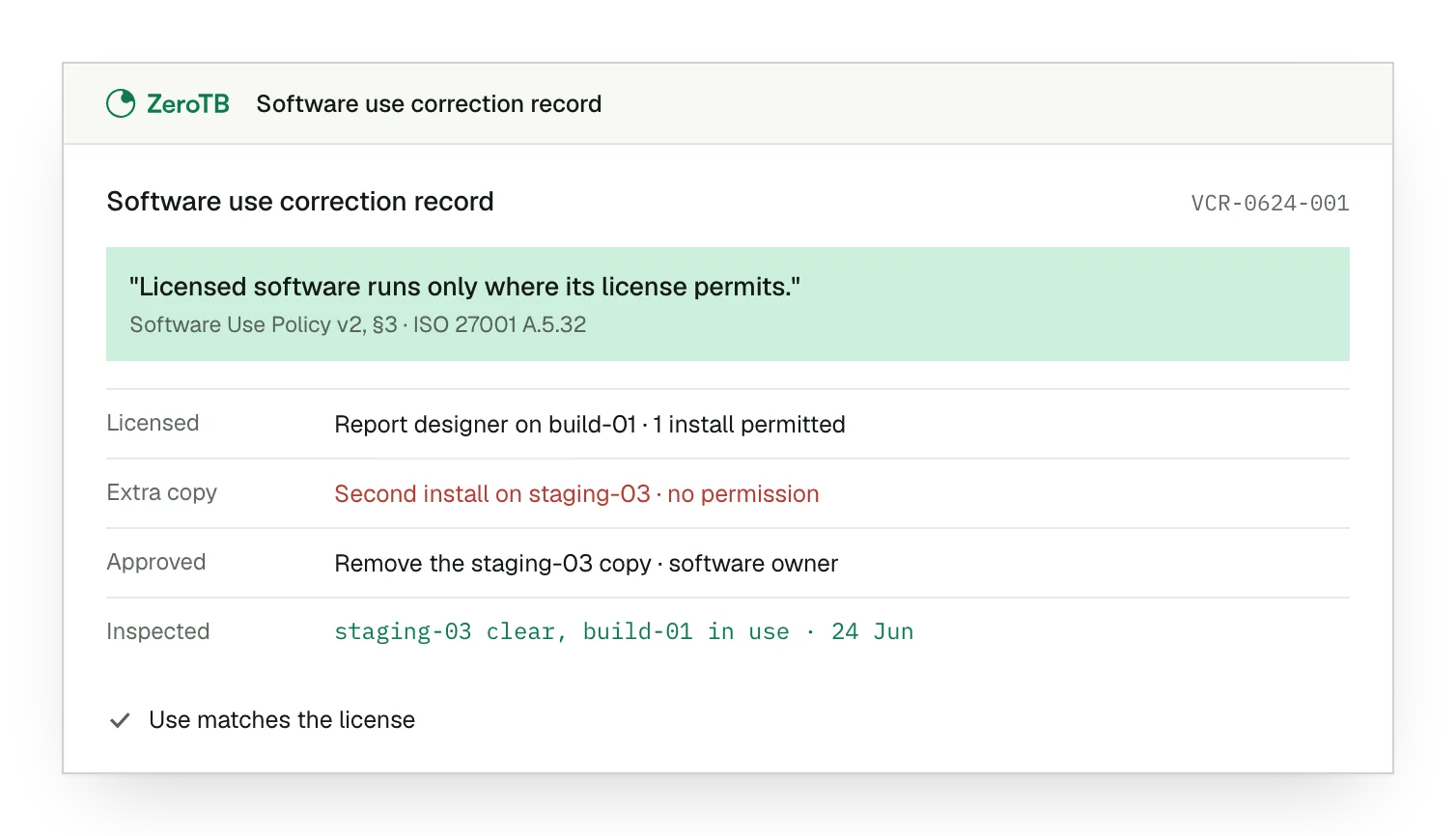
Recorded permission. The original installation appears beside the license terms that permit its continuing use.
Additional copy. The second environment contains an installation for which the existing agreement provides no permission.
Approved removal. The owner's decision identifies the extra copy and authorizes its removal from that environment.
Verified result. The dated inspection shows the additional copy removed and the permitted installation still in use.
Intellectual property review checklist
Identify the material and version under review, together with its source and the activity that uses it.
Examine where the material runs or appears in deliverables, and compare those observations with the permission held.
Record the appropriate owner's or specialist's decision about unclear terms, including the approved response to a discrepancy.
Inspect the affected location after the action and compare the result with the use the owner approved.
Keep an owner for further checks and record which changes will require another review of the rights.
Sources
- ISO, ISO/IEC 27002:2022, 2022.
- European Commission IP Helpdesk, ISO certification and IP, accessed November 4, 2026.
- GitHub, Choose a License: No license, accessed November 4, 2026.
- AICPA & CIMA, Trust Services Criteria with revised points of focus, 2022 revision.
Related pages
Organizational controls
Read the other organizational controls that establish responsibilities for managing information security across the company.
ISO 27001
See how the management system brings individual control decisions into the company's information security program.
Compliance frameworks
Browse the framework libraries to understand the requirements that apply across different compliance programs.
Start with the Pilot
Talk with our team about keeping controls working between audits. During the eight-week Pilot, we map up to 25 commitments and take two real control gaps through approved correction and verified restoration. The work leaves a record of each correction.