Home / Organizational controls
What does ISO 27001 A.5.11 require for asset return?
ISO 27001 A.5.11 concerns asset return when a person leaves or their working arrangement changes. Check the equipment and information due back against what the company actually receives. Keep a recorded outcome for every item, follow up on incomplete returns and check account removal separately.
The departure ticket alone cannot show whether every asset came back. The reviewer needs to compare the issued list with the receipts. If a laptop has arrived while an external drive remains with the contractor, the case still needs an owner and a recovery action.
Return scope
Company equipment and information both belong in the return process. An employee may hold a laptop and files; a contractor may also hold removable media. Their working agreements and company policy determine what must return when the arrangement changes or comes to an end.
Check the information held outside the main workspace as well as the physical items. Receiving a laptop does not account for project files held elsewhere. The record needs to show the action taken for each asset, so that the recipient can identify any work still outstanding.
Asset records
A return can be reconciled only when the issued-asset record identifies what the person holds. Compare the assignment history with the departure checklist before deciding that the list is complete. Equipment issued after the original onboarding date can otherwise disappear from the return request.
Use an asset identifier that the recipient can match to the item received. Record the person responsible for it and any transfer that changed its custody. Where the records disagree, resolve the discrepancy with the asset owner before treating an item as missing or returned.
Return triggers
Review assigned assets when someone leaves or their role or contract changes. The person may continue working for the company while losing the need for particular equipment or information. The owner needs to distinguish what must return from what the new arrangement allows them to keep.
Record that decision against the affected assets, including who will receive them and the agreed return date. IT and the person's manager can then work from the same list. When a return is late, the list also identifies the recipient who needs to follow up.
Receipt checks
Check the parcel's contents before recording the assets as received. A shipping notice is useful for tracking delivery, but the recipient still needs to identify the equipment and inspect its condition. Only then can the record explain which expected items have actually come back.
For remote returns, keep the delivery reference beside the original request. That lets the owner trace a parcel that has yet to arrive. After delivery, record the date, match the asset identifiers and note any damage or omissions that require a decision from the owner.
Company information
Returning equipment can leave company information outside the organization's approved workspace. The return review should account for relevant files, documents and removable media in the person's custody. It should also establish where the organization can retrieve the information needed to continue the work.
The information owner decides the appropriate transfer and handling of retained copies under the agreed policy. Record that outcome separately from the equipment receipt. A device that has been erased may still leave a project handover incomplete if the organization cannot retrieve the required files.
Access removal
A completed equipment return leaves account status untested. A person could hand over a laptop and still sign in from another device. Account removal also leaves physical custody untested: disabling the accounts gives no evidence that equipment has arrived. Each part needs its own result.
The return case and access review should refer to the same departure decision. IT can keep receipts with the asset list and record account status in the access work. This makes it possible to see which part is complete and which owner still has work to do.
Missing and damaged assets
A missing or damaged asset needs a recorded decision about recovery and the information it may contain. The asset owner should establish the last known custody and the next action. Any concern about exposed information also needs the organization's established security assessment and response process.
Keep the asset's actual status visible while that work continues. An approved alternative arrangement should state what was agreed, who approved it and what remains unresolved. Recording a loss explains the outcome; it cannot establish that the asset was received or that its information was recovered.
Recovery decisions
Before approving a recovery action, the owner needs to know what it is meant to achieve. Identify the item or information still outstanding and who can recover it. Keep the proposed action and expected result together, with approval for any decision that changes risk.
ZeroTB follows approved commitments through observations, proposed corrections and checks on the result, retaining evidence from that work. A physical return still depends on the recipient's confirmation. The approved recovery plan and the later receipt answer different questions: what was authorized, and what the organization received.
Verified closure
Compare the expected assets with the outcomes before closing a return case. Receipts establish which items arrived, and the information handover records explain what the company recovered. Approved exceptions need to remain identifiable, along with an owner and next action for anything still outstanding.
Keep the dated observations that supported closure. A reviewer can then follow the discrepancy through the action and see why the owner accepted the result. The Verified Control Record retains that connection between the commitment, before-and-after state, action, approval and verification of a restored control.
Ongoing checks
Repeated return gaps can reveal a missing check in the departure process. If later-issued equipment repeatedly escapes the checklist, reconcile the asset register when the return begins. If shipping notices lead to premature closure, make receipt inspection the condition for completing that part of the case.
Check a later return after changing the process to see whether the same gap recurs. Retain an owner for unresolved discrepancies between the asset register and departure records. This keeps the correction useful as people change roles, contracts end and equipment passes between different members of the team.
Asset return evidence
These records explain what was due back, what arrived and how the owner dealt with the difference.
| Requirement | What an auditor asks for | Where it comes from |
|---|---|---|
| Defined return duty | Which assets had to return and who was responsible | Company policy, working agreement and departure or role-change decision |
| Complete asset list | What the person held when the return began | Asset assignments, subsequent transfers and the information handover list |
| Confirmed receipt | Which items arrived, when, in what condition and with whom | The recipient's inspection of the items against their identifiers |
| Resolved exceptions | What happened to missing or damaged items | Recovery tasks and approved exceptions, with security assessments where relevant |
| Verified correction | Why the owner accepted the result and closed the gap | The approval and dated observations retained with the control record |
Related framework requirements
| Framework | Control | What it covers |
|---|---|---|
| ISO 27001 | A.5.11 | Bringing company assets back when employment or another working arrangement ends or changes |
| SOC 2 | CC6.5 | The related disposal concern: protecting information as physical assets leave the organization's control |
| HIPAA | 164.310(d)(1) | Handling receipt, removal and movement of devices and media that contain electronic protected health information |
Example of recovering a missing drive
The return in this example has a receipt for a laptop and none for the contractor's external drive. Comparing the receipts with the assigned assets exposes the omission. The owner follows up, and the recipient checks the drive before the case can close.
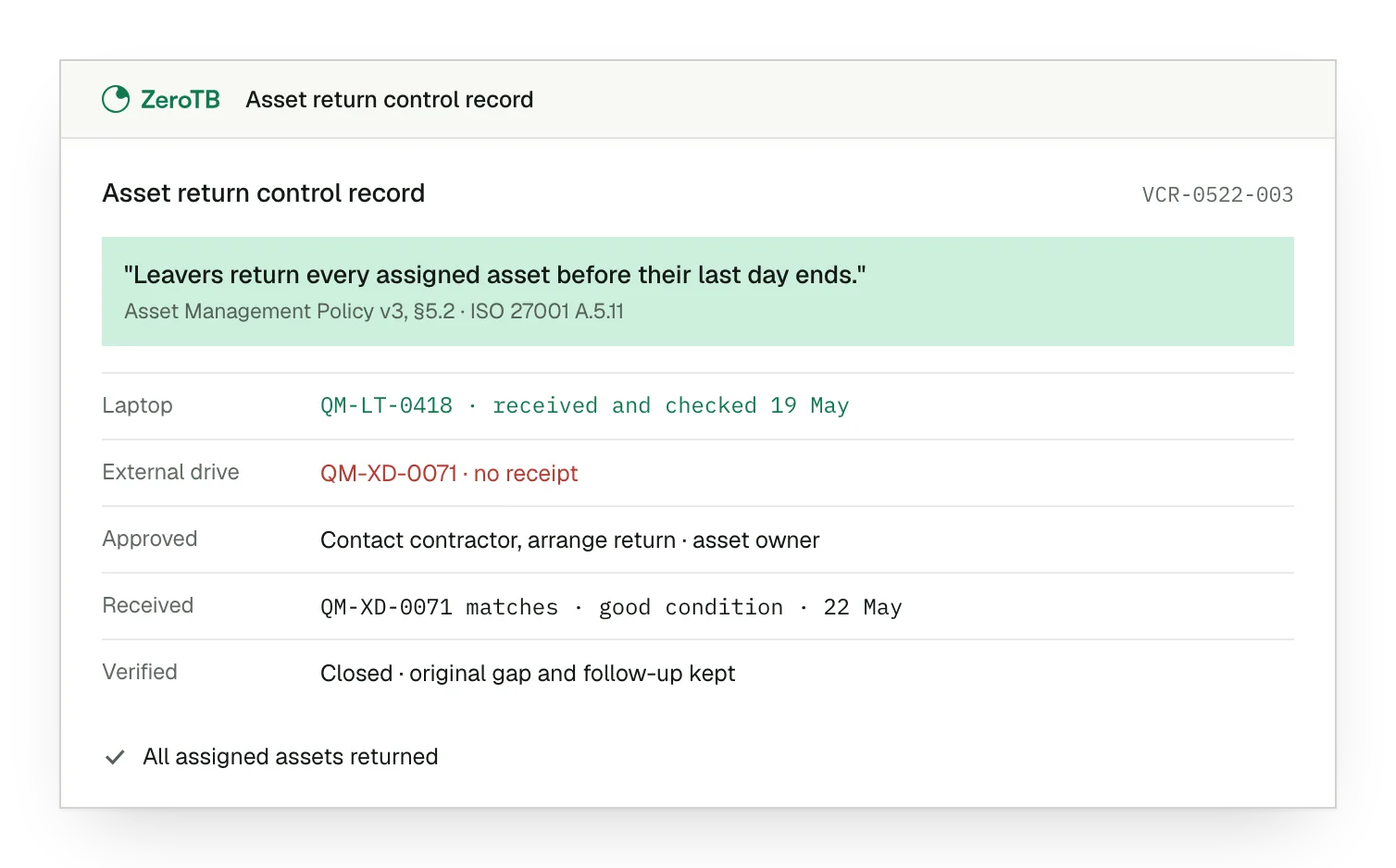
Outstanding item. The assigned drive remains open beside the laptop that the recipient has already checked.
Approved follow-up. The owner authorizes contact with the contractor and arrangements to bring the drive back.
Confirmed receipt. The arriving drive matches the expected identifier, and the recipient records its condition and receipt date.
Verified outcome. The receipt supports closure, while the record keeps the original gap and approved recovery action.
Asset return checklist
Identify what the agreement and policy say must return, including the equipment and information within that duty.
Read the issued-asset list alongside the receipts and information handover results, then identify anything still outstanding.
Establish who can act on the gap and obtain approval for the proposed recovery and expected result.
Inspect the returned items and information handover against that expectation, with account removal checked as a separate action.
Keep the decision and dated observations together, then check a later return for evidence that the process improved.
Sources
- ISO, ISO/IEC 27001:2022, 2022. Information security management system requirements.
- ISO, ISO/IEC 27002:2022, 2022. Guidance on information security controls.
- AICPA & CIMA, 2017 Trust Services Criteria with revised points of focus, 2022 revision. Related SOC 2 criteria.
- HHS, HIPAA audit protocol, 2018 update. Device and media control evidence.
Start with the Pilot
Talk with our team about the controls that need attention between audits. Through the eight-week Pilot, we map up to 25 commitments, take two real gaps through approved correction and verified restoration, and retain the evidence from that work.