Home / Organizational controls
What does ISO 27001 A.5.2 require for security responsibilities?
ISO 27001 A.5.2 concerns defining and assigning security responsibilities to suit the organization. Give each duty a clear owner, with the authority and support needed to perform it. After staffing changes, check that assignments, approval requests and escalations reach the people who now hold those responsibilities.
A security duty can lose its owner while the policy that describes it stays unchanged. The next access review or incident exposes the gap. Keeping responsibilities current means connecting the documented assignment to the people and processes that carry out the work.
Security duties
A.5.2 starts with a clear allocation of the security work the organization needs. A role title gives only part of that answer. The assignment also needs to explain what the person does and which systems, information or processes the duty covers.
An access review, for example, can involve a coordinator, application owners and an exception approver. Each contributes a different decision or action. Describing those contributions helps the team find who needs to act when a review stalls, even if everyone involved reports to the same manager.
Decision authority
Responsibility needs to come with a way to act on the finding. An access reviewer might see that an account should be removed, yet have no permission to remove it. The assignment should say whether the reviewer decides or asks the application owner.
That distinction becomes important when the proposed action changes risk. The owner may be able to approve a routine correction while an exception requires management's decision. Agree where such requests go and who answers them, so work can continue when the reviewer reaches that limit.
Responsibility records
A colleague should be able to use the responsibility record to find someone who can answer a request. A title such as application owner is useful only when it leads to the current holder. Keep that connection current as people change roles.
The record can be a register, an existing policy or another document the team uses. Include the duty and its scope, who owns it, who approves decisions and where to escalate. Keeping these together helps someone follow the assignment without reconstructing it from several different documents.
Combined roles
A small team can assign several security duties to one person if that person can perform them. The assignment needs to fit the person's knowledge, available time and decision rights. Several duties under one name can hide a workload that nobody has assessed.
Conflicting duties need a separate decision. A person who makes a sensitive change may also be listed as its reviewer. Consider that arrangement alongside A.5.3 on separating conflicting duties. A documented division of work helps the team identify where another reviewer or other safeguards are needed.
Staff changes
A handover needs to include the security duties that the departing person leaves behind. Some will be visible in policies; others appear in review schedules or outstanding approval requests. Changing the organization chart can leave all those assignments pointing to the old owner.
Work through what is still open with the replacement: an unfinished review, an exception awaiting a decision, or a request nobody has answered. If the role remains vacant, management can appoint an interim owner. Record that person's authority and the conditions for reviewing the temporary assignment.
Task routing
Updating a register does not necessarily change who receives the next security task. The recurring task may keep a saved assignee. An approval request may go to a group with different members. Check each route against the allocation that management has agreed.
Follow the request far enough to establish who will decide it. Delivery to a shared mailbox leaves that question open unless someone in the group owns the duty. The same check should cover absence and escalation, including where a request goes when its first recipient cannot act.
Approved reassignment
Management needs to approve the new owner and their decision rights before a duty changes hands. A proposed transfer can name the work, the current holder, the replacement and the effective date. Those details give the approver a concrete decision.
Once approved, the transfer needs to reach the assignment rules as well as the responsibility record. The replacement also needs the relevant evidence and procedures, within the agreed permissions. Keep any limits with the approval so a later reviewer can understand the authority under which the person acted.
Verification in practice
A completed task shows whether the new assignment works beyond the responsibility record. Follow a review or approval request through its revised route. Check that the intended recipient receives it, can inspect the necessary information and can make or obtain the expected decision.
Keep the ownership gap open if the request fails to arrive or the recipient lacks authority. Record the observed result and the correction still needed. Once the route works, retain that evidence with the approved reassignment; a changed name alone leaves the outcome of the transfer unclear.
Continuing ownership
Ownership checks need an owner of their own as staffing and responsibilities continue to change. Compare current role holders with operating assignments after relevant changes, and agree a review schedule. Include backup arrangements so absence does not leave time-sensitive security work without a decision.
This is part of the work ZeroTB supports through security governance and control operations: commitment-led assignments, escalation and verification of completed work. People retain the decisions about who holds a duty. The operating records show when a duty has no current owner or work remains unanswered.
Evidence for responsibility changes
These records connect the assigned duty with the decisions and completed work that show how it operates.
| Requirement | What an auditor asks for | Where it comes from |
|---|---|---|
| Defined duties | The work each security role covers and the person who currently holds it | Approved policies, role descriptions and the responsibility register |
| Decision authority | The decisions an owner can make and the route for decisions beyond that authority | Management approvals, delegation records and escalation procedures |
| Accepted transfer | The replacement owner, effective date and unfinished work included in the handover | Approved reassignment and handover records |
| Working assignment | Evidence that tasks and approval requests reach the current owner | Assignment settings, approval rules and dated task history |
| Verified correction | The ownership gap, approved change and observed result after the transfer | Completed work linked to the approval and verification record |
Related framework requirements
| Framework | Control | What it covers |
|---|---|---|
| ISO 27001 | A.5.2 | The security work the organization needs and the people assigned to perform it |
| SOC 2 | CC1.3 | How structure, reporting, authority and responsibility support the organization’s objectives |
| HIPAA | 164.308(a)(2) | Who holds responsibility as the security official for required security policies and procedures |
Example of restoring review ownership
An approved handover should let the new owner complete the work. Here, an access review still waits for a team lead who has left. The example follows the request after management approves a replacement, through the routing change to a recorded decision.
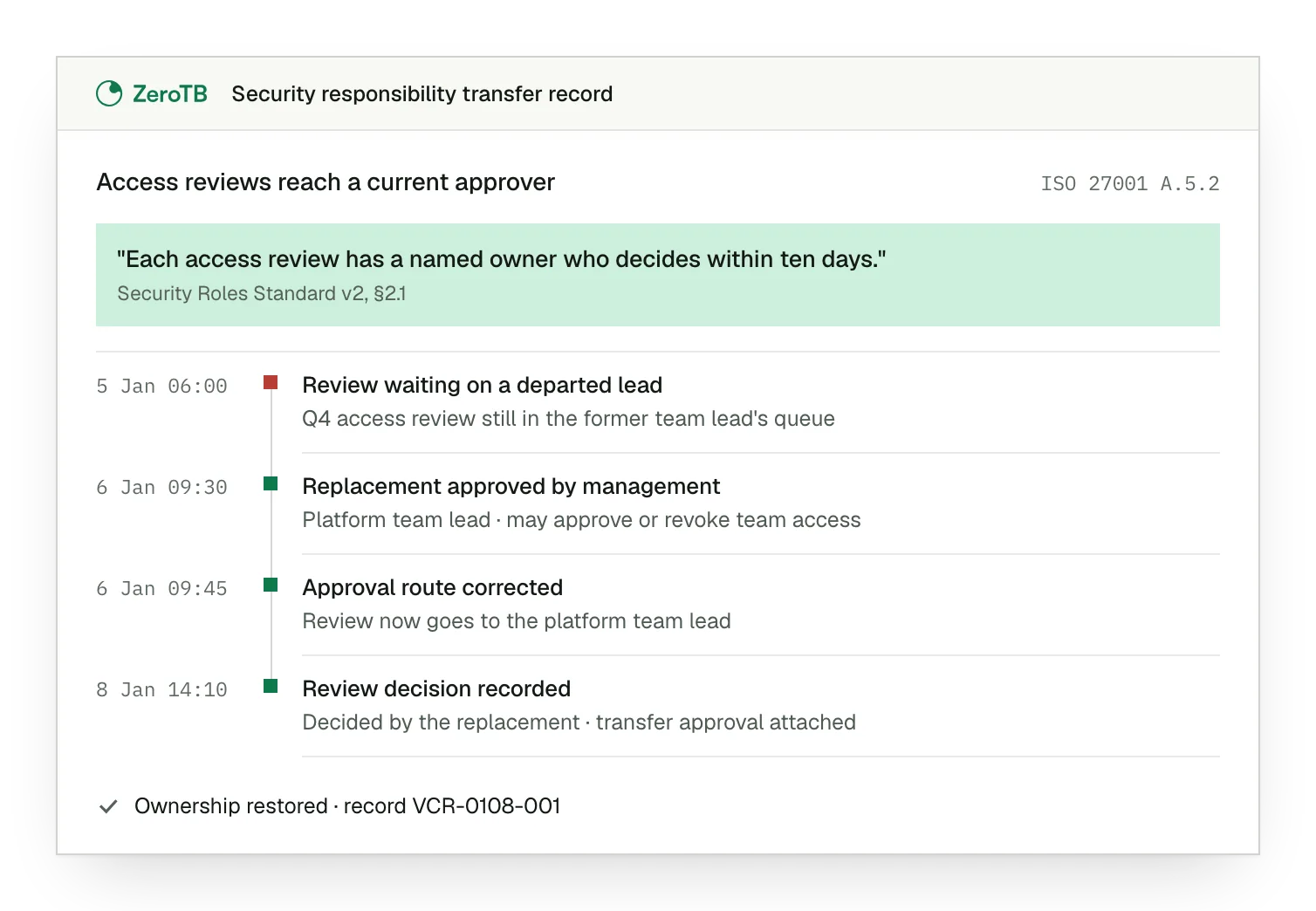
Missed approval request. The access review waits in the former lead’s queue even though that person has left.
Agreed new owner. The approval names a replacement role holder and sets the limits of their access decisions.
Corrected approval route. The request now reaches the replacement, who has the agreed permissions to review it.
Completed review decision. A dated decision shows that the replacement acted, with the transfer approval kept beside it.
Responsibility review checklist
Identify the duty, its scope and current role holder, then compare that record with the work actually assigned.
Check which decisions the owner can make and who resolves requests beyond that authority, including conflicting duties.
Confirm that the approved transfer covers unfinished work, relevant permissions and a workable arrangement for absence or vacancy.
Follow a task to its current recipient and check that the person can make or obtain the required decision.
Keep the assignment, approval and dated outcome together, with an owner responsible for checking future changes to the arrangement.
Sources
- ISO, ISO/IEC 27001:2022, 2022: information security management system requirements.
- ISO, ISO/IEC 27002:2022, 2022: guidance for information security controls.
- AICPA & CIMA, Trust Services Criteria with revised points of focus, 2022 revision: CC1.3.
- HHS, HIPAA audit protocol, July 2018 update: assigned security responsibility.
- ZeroTB, Control operations and human approval, 2026.
Related pages
Organizational controls
Explore the responsibilities and processes covered by the organizational controls in ISO 27001.
ISO 27001
Place individual security duties within the wider information security management system and its controls.
Compliance frameworks
Find guidance on related controls across the frameworks that apply to the organization.
Start with the Pilot
Talk with our team about keeping security responsibilities and controls working as the company changes. The eight-week Pilot maps up to 25 commitments and takes two real control gaps through approved correction and verified restoration, with evidence of the results.