Home / Organizational controls
What does ISO 27001 A.5.17 require for handling passwords and other secrets?
ISO 27001 A.5.17 concerns the handling of passwords and other authentication information, from issue through use and replacement. Include recovery in those handling rules. After a disclosure, establish whether the exposed credential still works and retain evidence of its withdrawal without putting the secret into that evidence.
Solving a support problem can leave a credential problem behind. A service secret copied into the ticket may still work after the integration has been repaired. The remaining task is to end that exposed access and establish that the service can continue with the approved replacement.
Credential scope
A.5.17 concerns the authentication information that lets a person or service establish access. Passwords, recovery codes and service credentials can all need protection. The handling rules should follow that information from its initial issue through use, recovery and eventual replacement or withdrawal.
The review also needs to reach credentials outside the main identity provider. An application can maintain separate credentials, and an integration can depend on a secret owned by another team. Each needs an identifiable owner who can authorize changes when handling fails.
Secure issuance
A credential should reach only the person or service entitled to use it. The issuance procedure needs to establish that entitlement before anything is sent. This matters particularly in support work, where the requester may be unfamiliar and may be asking for an immediate response.
After delivery, the recipient needs to know where the credential can be kept and how to report its disclosure. Explain recovery at the same time. Without a usable recovery route, a person locked out of an account may turn to a support channel that exposes authentication information.
Storage by purpose
The storage decision starts with what the application needs to do. A system checking a user's password can store a password hash for comparison, without retaining a readable password. OWASP's password storage guidance describes suitable ways to make that comparison securely.
A service presenting a credential to another system needs to retrieve its value. That creates a different storage problem. A password manager or secrets manager can restrict who retrieves the value, but those permissions still need review against the access the organization has approved.
Account recovery
Recovery can hand control of an account to someone who cannot use its usual sign-in method. The process therefore needs another way to establish who is making the request. Examine that route separately from normal login, including the steps handled by support staff.
For reset tokens, OWASP recommends secure storage, expiry and a single permitted use. Its guidance also covers notifying the account holder and invalidating sessions. Use those details when designing recovery procedures, while keeping the organization's approved scope clear: a technical reference does not define that scope.
Copies outside approved systems
A support workflow can expose a secret even when its normal storage is well controlled. Someone copies a working credential into a ticket to resolve an integration problem. Once the issue is resolved, the ticket still contains something that can grant access.
Deleting that text cannot establish whether someone already copied it elsewhere. The response needs to identify who could have seen the secret and which systems still accept it. Those facts inform the owner's decision to replace or revoke it and to investigate any suspected misuse.
Replacement decisions
A service owner needs to know which applications and jobs use the exposed credential. That knowledge affects how it can be replaced: a change at the receiving system can interrupt a service that still presents the old value. Identify those dependencies before choosing the change sequence.
The approval should say which credential will change, who may act and what access should remain afterward. Sometimes the exposure calls for immediate revocation. In that case, include the expected interruption in the decision so the owner can account for its effect on the dependent service.
Verification after replacement
Verification must establish that the old credential has lost access and the approved replacement works. Updating the value in a secret store does not show whether the receiving system still accepts the old credential. Test the service with the replacement, then confirm that the receiving system rejects the previous credential.
Agree on those checks before the change so the owner knows what will count as success. Keep the gap open when either result is missing or inconclusive. A dated observation from the affected system gives the reviewer a basis for deciding whether access now matches the approved rule.
Evidence without secrets
Evidence should let a reviewer trace the correction without reading the secret that was changed. Use the credential's identifier to connect the exposure, approval and dated tests. Include the systems tested, so the reviewer can see exactly which access the result establishes.
The Verified Control Record keeps the approval with those results. Before adding a screenshot or log, check what it contains. A secret value in an attachment creates another copy for the response to address, even if the attachment was intended only to document the correction.
Checks after closure
A replacement leaves unfinished work if the same handling practice will expose the next credential. Support staff need a way to diagnose an integration without asking for its secret in a ticket. Correct that procedure alongside the credential change, then check how it is used.
Some observations come from identity workflows in Okta or Google Workspace; others come from the support process itself. Identity settings cannot show what staff put in a ticket. Give each check an owner who can investigate a failure as the systems and procedures change.
Authentication evidence
Useful evidence shows who could receive or use a credential, how a gap was corrected and what the final checks established.
| Requirement | What an auditor asks for | Where it comes from |
|---|---|---|
| Defined handling rules | Approved instructions for issuing, protecting, recovering and replacing authentication information | Authentication policy and procedures for the systems within scope |
| Controlled issuance | A record connecting the recipient, authorized access and approved delivery method | Account requests and issuance events, with secret values excluded |
| Protected storage | Evidence of who can retrieve stored secrets and why that access is permitted | Secret-store permissions and the decisions authorizing access |
| Controlled recovery | Evidence that the requester was checked and the approved recovery route was followed | Recovery procedures and redacted reset events |
| Approved replacement | The affected credential, service dependencies and decision to replace or revoke access | Change record and approval from the responsible owner |
| Verified result | Dated results showing old access rejected and intended access working | System observations linked to the approval in the Verified Control Record |
Framework mapping
| Framework | Control | What it covers |
|---|---|---|
| ISO 27001 | A.5.17 | Handling authentication information throughout its issue, use and replacement |
| SOC 2 | CC6.1 | Logical access protections for systems and information within the defined scope |
| HIPAA | 164.312(d) | Verifying the identity of people or entities seeking access to electronic protected health information |
Example of replacing an exposed service secret
A replacement needs to end the exposed access while preserving the service that depends on it. This example follows an integration credential copied into a support ticket. Its record shows the owner's decision and the tests used to establish whether the change worked.
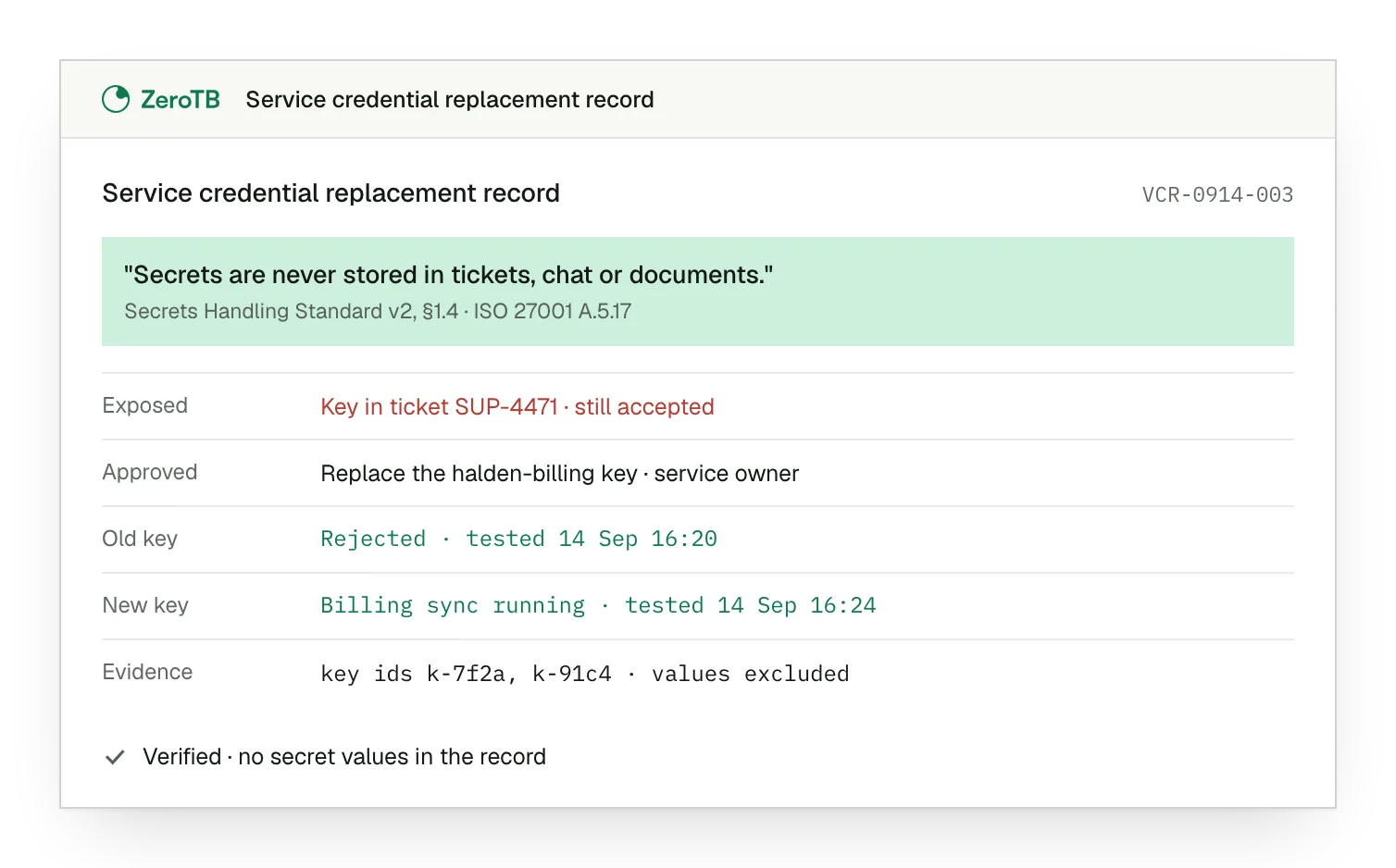
Exposed credential. The ticket history retains an integration credential that the receiving system still accepts.
Replacement approval. The owner identifies the dependent integration and approves replacing the credential it uses.
Access checks. Tests show the previous credential rejected and the integration running successfully with the replacement.
Safe evidence. Identifiers connect the approval to dated results, with both secret values excluded from evidence.
Credential handling checklist
Read the approved handling rule and establish which credentials it covers, including those held outside the identity provider.
Follow the credential into the ticket or message history and identify who could have read or copied it.
Ask the owner to decide the replacement sequence with the affected services and their continued access in view.
Check that the receiving system rejects the previous credential and that the intended user or service can still authenticate.
Remove secret values from the evidence, then retain the credential identifiers, owner approval and dated results together.
Sources
- ISO, ISO/IEC 27002:2022, 2022, control guidance reference.
- OWASP, Password storage, accessed November 2026.
- OWASP, Forgot password, accessed November 2026.
- OWASP, Secrets management, accessed November 2026.
- AICPA & CIMA, Trust Services Criteria with revised points of focus, 2022 revision.
- HHS, HIPAA audit protocol, 2018 update, person or entity authentication.
Related pages
Organizational controls
Read the related organizational controls to understand the responsibilities around authentication information and its handling.
ISO 27001
Explore the information security management system that gives individual controls their purpose and organizational scope.
Compliance frameworks
Browse the framework library for related requirements and the operating evidence that supports their review.
Start with the Pilot
Talk with our team about credential handling and the controls that need continuing attention. The eight-week Pilot maps up to 25 commitments and takes two real control gaps through approved correction and verified restoration, with evidence of the results.