Home / Organizational controls
What does ISO 27001 A.5.12 require for information classification?
ISO 27001 A.5.12 addresses information classification: deciding how much protection information needs and assigning a category that reflects that decision. Consider confidentiality, integrity, availability and relevant obligations. The owner should be able to explain the category and revisit it when circumstances change, with handling rules that put the decision into practice.
A classification register can look complete while a dataset has changed underneath it. Perhaps a team has added customer records to material once used only for testing. The review needs to account for those records and the rules people now need when handling them.
Protection needs
The protection decision depends on what could go wrong with the information. Consider disclosure, unauthorized alterations and the effects of losing access. A dataset used for an important business activity may need protection against errors or outages even when its contents can be shared openly.
Business use is part of that assessment, along with relevant legal duties and customer agreements. Keep the reason for the category with the decision. A later reviewer can then see which obligation or dependency matters and revisit it if the circumstances have changed.
Classification categories
A useful classification scheme gives people clear reasons to choose one category over another. Each category should describe the information it covers and the treatment it requires. Terms such as internal or confidential need enough explanation for different teams to apply them consistently.
Keep distinctions that change a handling decision. If two categories lead to the same protections, consider whether their separation helps anyone decide what to do. If one category groups information with very different needs, make the criteria clearer before relying on it across the organization.
Information ownership
The information owner explains why the information needs a particular category. That requires knowledge of its purpose, the people who depend on it and any obligations attached to its use. Someone reviewing an ambiguous case needs that context before deciding how to treat it.
The system owner may be a different person, with control over the storage location and its permissions. Record who makes the classification decision and who applies the resulting protections. Otherwise, an agreed change can remain in the register while the affected system continues to allow the old access.
Handling rules
Each category needs handling rules that people can apply where they use the information. Those rules should explain permitted storage, access and sharing. A classification becomes useful when someone can use it to decide whether a particular action is allowed.
Compare those rules with the settings and practices in the affected systems. An approved category can coexist with a broadly shared folder or an export in an unsuitable location. The review needs to establish whether the actual treatment matches the protection decision.
Classification and labels
Classification decides the protection category; a label communicates that decision. A.5.13 addresses how labels convey the classification. A clear label helps a recipient understand the applicable handling rules, including when information moves away from the place where someone first classified it.
A label alone does not show that access or sharing follows those rules. Check the category, the way it is communicated and the relevant protections as separate parts of the review. This keeps a labeling correction from being mistaken for a completed access correction.
Changes to information
Changes to contents or use can make an earlier classification inappropriate. Test data that later includes real customer records is one example. The dataset's name may stay the same, but disclosure now has consequences that the original assessment did not consider.
A new recipient or a revised customer agreement can also warrant another look at the category. Review these changes when they occur, alongside scheduled reviews. The information owner can then decide whether the existing category accounts for the changed circumstances or needs to be revised.
Copies and transfers
A classification review needs to follow the information into the copies people actually use. An export may preserve sensitive contents while losing the label or context that explained their treatment. Correcting the original dataset can therefore leave another copy under the old handling rules.
Identify the destinations involved in the affected workflow and who controls each one. Compare their handling arrangements with the classification decision. Where another team or recipient manages a copy, communicate the revised requirements and obtain evidence appropriate to the part of the workflow they control.
Classification review
A revised category needs a recorded reason and an owner's decision. Compare the information's current contents, purpose and obligations with the classification criteria. Explain what changed and why the selected category now fits, including any difference from the earlier assessment.
Stronger restrictions can affect legitimate work, so identify the access that must remain available. A lower category also needs a reason: the absence of recent problems does not explain reduced protection. Where the context is unclear, retain the existing safeguards while the owner resolves the question.
Approved corrections
Putting a revised classification into practice means changing any handling arrangements that no longer fit. Compare current permissions, storage and sharing with that decision, then propose the necessary changes. The responsible owner approves the action after reviewing the expected protection and the access needed for continuing work.
ZeroTB's control workflow connects the commitment, observed gap and proposed correction, then verifies the state after authorized action. For this review, test that prohibited access is blocked and permitted work remains possible. Keep the decision, approval and results together in the Verified Control Record.
Continuing checks
Someone needs to own the review after a correction has been completed. Later changes may add a recipient, move the information or alter its contents. Each can affect protection, so responsibility for reviewing those changes should remain clear after the original gap is closed.
If an affected copy cannot be inspected, its handling remains an open question. Record the gap and who will resolve it. Keep dated observations that identify the locations examined, so another reviewer can tell what the team confirmed and where further evidence is still needed.
Classification evidence
A reviewer should be able to follow the category decision into the handling rules and see evidence that those rules apply.
| Requirement | What an auditor asks for | Where it comes from |
|---|---|---|
| Classification scheme | The categories available and the criteria used to decide which protection each needs | The approved policy, with the handling rules for each category alongside it |
| Classification decision | Who chose the current category, why it fits and when it was last reviewed | The inventory entry and decision record, including the relevant purpose and obligations |
| Coverage of copies | Which repositories, exports and recipients the team included in its review | Records of the affected workflow and the locations where it uses the information |
| Applied handling rules | How storage, access and sharing follow the rules for the chosen category | Settings from the affected systems, with observations of how people handle the information |
| Verified correction | What changed after approval and how the team tested the resulting protection | The approved change and dated test results in the verification evidence |
Framework relationships
| Framework | Control | What it covers |
|---|---|---|
| ISO 27001 | A.5.12 | Deciding which protection category fits the information, its use and its relevant obligations |
| SOC 2 | CC6.1 | Controlling logical access to systems and information; classification helps explain the protection selected |
| HIPAA | 164.308(a)(1) | Identifying and managing risks to electronic protected health information in the regulated organization |
Example of correcting dataset access
A test dataset needs a fresh classification decision after real customer records enter it. In this example, the information owner assigns a more restrictive category. The system owner corrects access to the dataset and its export, then tests the resulting permissions.
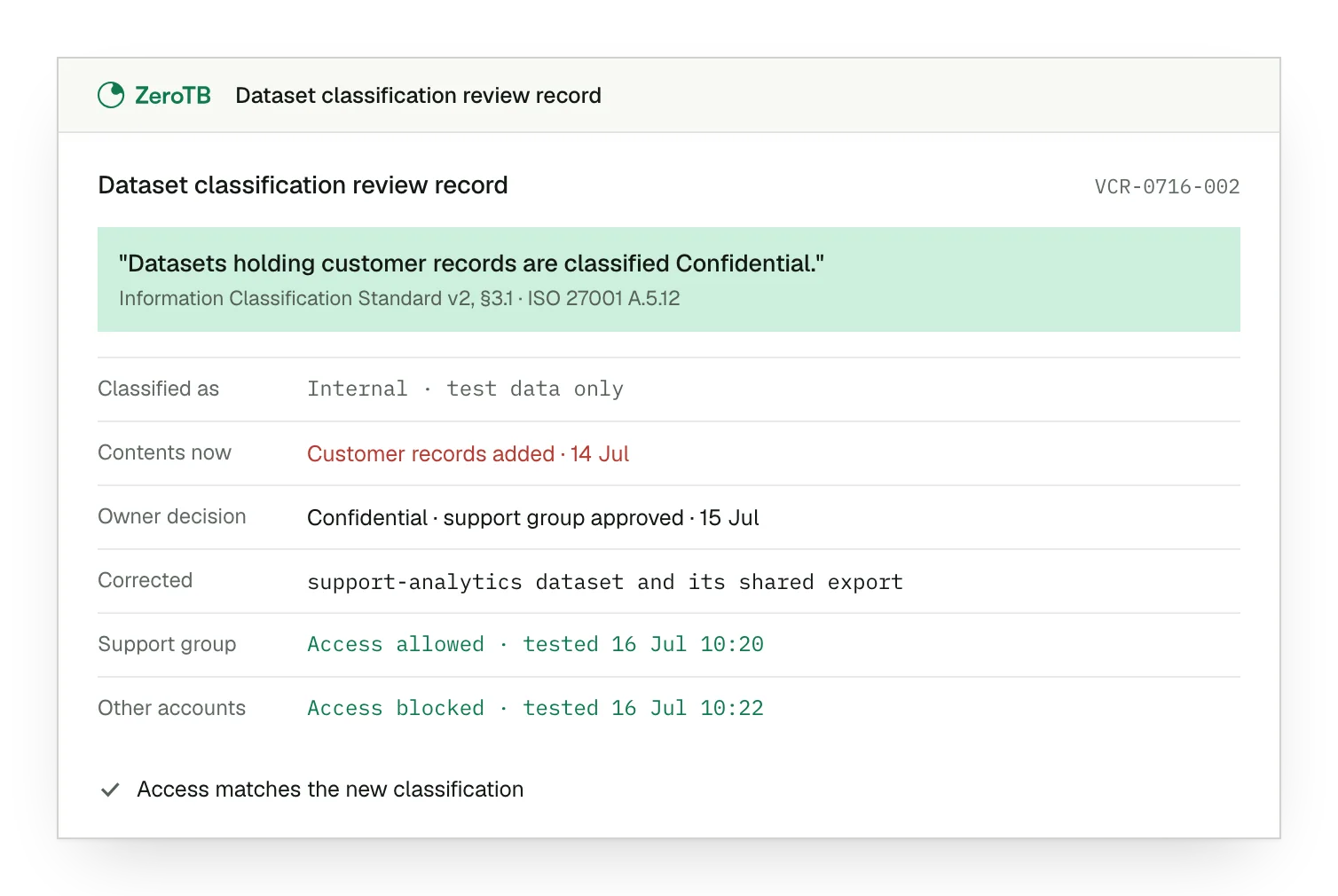
Changed contents. The dataset now contains customer records that the original test classification did not cover.
Owner decision. The information owner records the new category and approves access for the designated support group.
Affected export. The correction covers the working dataset and its exported copy in a shared folder.
Verified access. Tests confirm that the support group retains access and other internal accounts are blocked.
Classification review checklist
Identify the information, its owner and the current category before comparing its contents with the approved classification criteria.
Record why the category fits the information's current use, protection needs and obligations, including the reason for any change.
Check the affected storage, permissions, sharing and copies against the rules associated with the approved category.
Test the approved changes against the expected protection and required access, then retain the results with the approval.
Record who reviews later changes to contents, recipients or storage, and how unresolved observations reach that owner.
Sources
- ISO, ISO/IEC 27002:2022, 2022: the control guidance that accompanies the ISO 27001 requirements.
- NIST, Data classification practices, 2021 project description: why classifications need associated rules for handling data.
- AICPA & CIMA, Trust Services Criteria with revised points of focus, 2022 revision: criteria used to assess controls in a SOC 2 engagement.
- HHS, Summary of the HIPAA Security Rule, accessed November 4, 2026: the scope of the current rule and its risk analysis requirements.
Related pages
Organizational controls
Explore the responsibilities and decisions that support the operation of ISO 27001 organizational controls.
ISO 27001
Place information classification within the wider information security management system and its control requirements.
Compliance frameworks
Find guidance for other frameworks and the controls that support related security and compliance obligations.
Start with the Pilot
Talk with our team about keeping classification and handling aligned as information changes. The eight-week Pilot maps up to 25 commitments and takes two real control gaps through approved correction and verified restoration, with evidence of the completed work.