Home / Organizational controls
What does ISO 27001 A.5.26 require for responding to incidents?
ISO 27001 A.5.26 concerns responding to information security incidents through the organization's agreed procedures. Coordinate the people making response decisions, preserve relevant evidence and verify the conditions for recovery. The response record should explain what happened, who authorized significant actions and why the team accepted the resulting state.
A service can be available again while the access route used during an incident remains open in the affected systems. That leaves the incident lead with a separate question: what evidence supports resuming normal operation? A.5.26 connects the response procedure with the actions and decisions made during an incident.
Response scope
A.5.26 covers the response to an information security incident under the organization's procedures. Those procedures guide containment, investigation, correction, recovery and communication as the incident requires. They also identify the authority needed when an action could affect a service or its evidence.
Other organizational controls address responsibilities around this work. The question here is how the response proceeds once an incident is underway. Responders need to use the procedure on the systems affected and explain decisions that change as they learn more.
Incident ownership
The incident lead coordinates decisions that cross team boundaries. Isolating a system can require both the service owner's knowledge of dependencies and a security responder's assessment of exposure. Someone needs to bring those assessments together, decide the next action and identify unresolved questions.
Authority belongs in the procedure before responders need to use it, including when they should seek more help. If the lead changes during a response, the handover must carry the current scope, actions already taken and decisions still waiting. Otherwise, work can stop or be repeated.
Response drift
A response procedure can become outdated as systems and responsibilities change. Team changes can leave an escalation route without an owner. System changes can make a recovery instruction unsafe or leave responders uncertain about which service depends on the affected component.
During a response, departures from the procedure need a recorded reason and a responsible decision-maker. Afterwards, those departures help identify where the procedure needs repair. Reviewing them against the actual incident gives the update a concrete purpose and a way to assess whether it helps.
Containment decisions
Containment decisions depend on what an action will stop and what else it will affect. Isolation may prevent further damage while interrupting a needed service. The incident lead must weigh those consequences using the facts available, including the risk of leaving the system connected.
Define emergency authority so that responders know when they can act and when they must escalate. Keep the reason for each significant decision. NIST's incident response guidance discusses the trade-offs when investigation needs and recovery priorities favor different response actions.
Evidence preservation
Recovery changes can remove information that an investigation still needs. A server rebuild may erase a useful log; replacing credentials may change the state responders are examining. Decisions about preserving evidence need to happen while that information is still available.
Follow the organization's evidence procedures when collecting and retaining that material. Record where it came from, when it was collected and how it was handled. Protect access as well: incident records may reveal sensitive details about systems, affected information or the people involved.
Coordinated communication
Responders need a shared record of what is known and what has already been done. Without it, one team can reverse another team's containment or repeat a change that interrupts service. Keep confirmed observations separate from questions that still need investigation.
Assign responsibility for external updates too. The person making those decisions needs to consider the applicable contractual and regulatory obligations, including recipients and timing. Keep the approved messages and delivery records with the incident history so later reviewers can follow the communication.
Recovery conditions
Recovery needs evidence that the affected service can operate with the required security protections. Service availability answers whether an operation works. Security verification addresses the relevant exposure, including whether the route used during the incident remains available after the repair.
Agree the expected security and operational results before accepting recovery. Tests should address the affected control and the necessary service behavior, with dated observations attached. If a test fails or the state remains unknown, the recovery decision needs further work or explicit treatment of that uncertainty.
Closure decisions
The incident lead needs a reasoned closure decision that identifies any work still outstanding. That decision should refer to the recovery conditions, their results and any remaining exposure. A completed service ticket alone gives the reviewer little basis for understanding why the response ended.
Some improvements can continue after the immediate response closes. Assign each an owner and a review point, and retain its connection to the incident. The lead can then see which conditions allowed recovery and which improvements remain assigned for later work.
Continuing corrective work
A control gap can remain open after the immediate response has ended. Once service resumes, the repair competes with other engineering work. Give it an owner, describe the state the control should reach and decide how the completed change will be checked.
This is where ZeroTB's control restoration process supports follow-up: it checks approved commitments, drafts corrections for human approval and verifies the result. The completed repair leaves a Verified Control Record. The incident owner can connect that record to the gap found during the response.
Response evidence
The response record should explain how the team reached its recovery decision. A timeline supplies the order of events; links to observations, actions and approvals supply the reasons. Together, they let a reviewer assess a decision using the information available when it was made.
Retain the underlying evidence with access appropriate to its contents. One incident record can inform reviews under several frameworks, each with a different scope. Be precise about what a test establishes: a successful recovery check supports the condition tested, with other response responsibilities assessed separately.
Evidence for review
The following records help a reviewer assess how the team applied its response procedure.
| Requirement | What an auditor asks for | Where it comes from |
|---|---|---|
| Applied response procedure | Which procedure responders used and why they departed from it | The approved procedure and the incident record of decisions and deviations |
| Clear response authority | Who coordinated the response and approved actions affecting services or evidence | Assignments and approvals recorded during the incident, including changes at handover |
| Preserved incident evidence | What responders observed and how they collected and handled the evidence | The affected systems, investigation notes and records of evidence collection |
| Coordinated communication | What messages were approved, who received them and when | Copies of approved updates and the records showing their delivery |
| Supported recovery decision | Which checks supported recovery and who owns work left after closure | Recovery test results and approvals linked to the remaining corrective actions |
Related framework requirements
| Framework | Control | What it covers |
|---|---|---|
| ISO 27001 | A.5.26 | Executing the agreed procedures for response to information security incidents |
| SOC 2 | CC7.4 | An established program for responding when security incidents are identified |
| HIPAA | 164.308(a)(6) | Security incident response, mitigation of harmful effects and documentation of incidents and outcomes within the Security Rule's scope |
Example of verified credential replacement
In this example, replacing a compromised credential has restored the service, but the old credential still authenticates. The record follows the remaining repair: revoke that credential, test that it fails, and confirm that the service continues to work. The approval and both tests stay together.
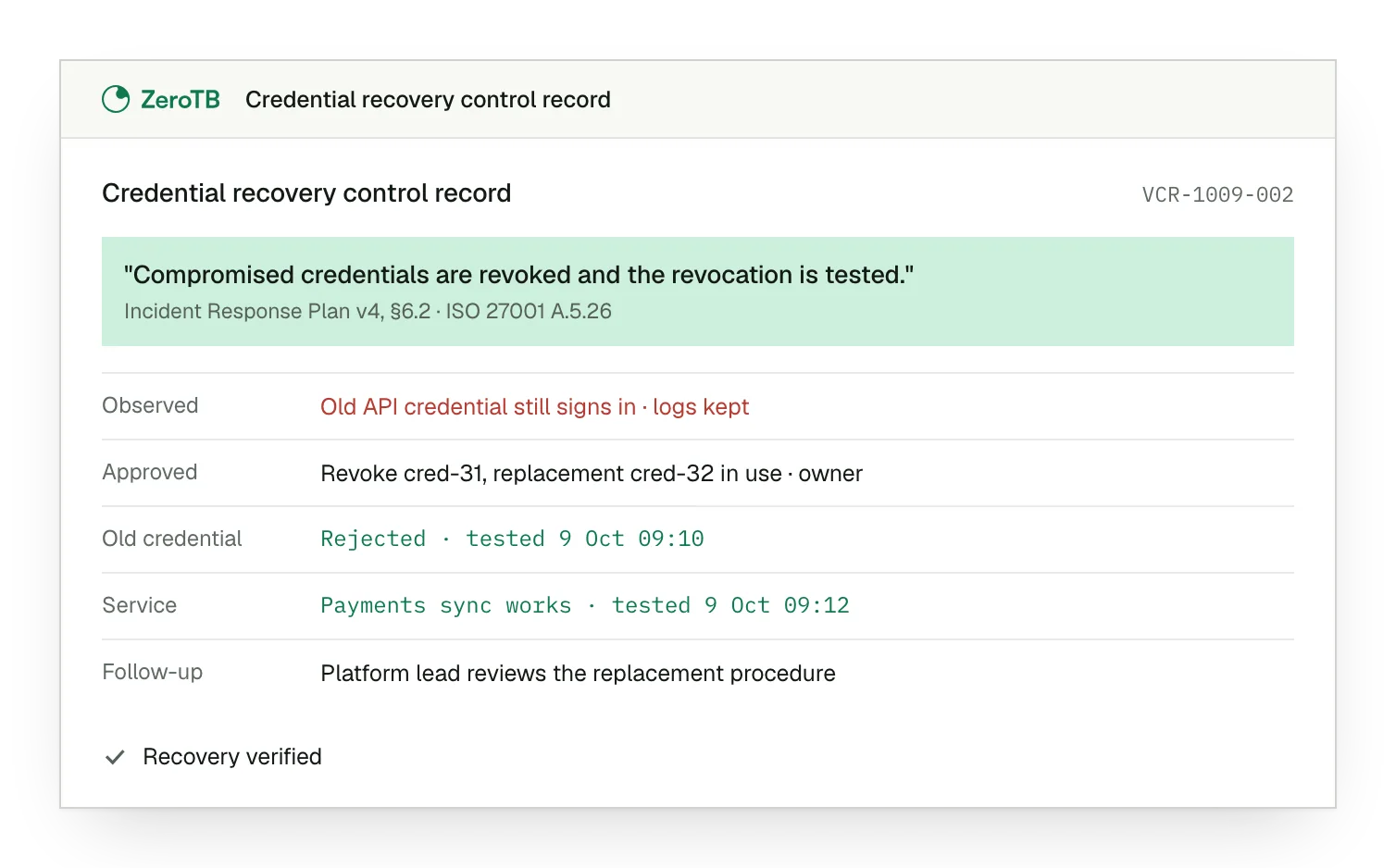
Retained observation. The first entry records successful authentication with the old credential and retains the relevant logs.
Authorized correction. The approval identifies the old credential for revocation and confirms the replacement is in use.
Verified recovery. The results show that the old credential is rejected and the required service operation works.
Recorded follow-up. An assigned owner will review the replacement procedure, with the completed repair linked as evidence.
Incident response review checklist
Read the procedure against the systems involved and the decisions made, noting where responders needed to depart from it.
Check who can approve actions that interrupt service and where responders take decisions beyond their authority.
Check that retained observations identify their source and handling history, especially where recovery has changed the affected system.
State which security conditions and service operations must pass before recovery is accepted, with dated results for each.
Check that each unresolved gap has an owner and review point, and that completed repairs retain approval and verification.
Sources
- ISO, ISO/IEC 27002:2022, 2022: guidance for information security controls.
- NIST, SP 800-61r3: Incident response recommendations and considerations, April 2025: incident management, evidence and recovery guidance.
- AICPA & CIMA, Trust Services Criteria with revised points of focus, 2022 revision: related SOC 2 criteria.
- HHS, Security incident response and reporting, 2016: response, mitigation and documentation under the HIPAA Security Rule.
Related pages
Organizational controls
Read the wider set of organizational responsibilities that surround incident response in the ISO 27001 library.
ISO 27001
See how individual control commitments fit within the information security management system and its scope.
Compliance frameworks
Find the control libraries for other frameworks that apply to the systems and information under review.
Start with the Pilot
Talk with our team about the control gaps that persist after recovery. The eight-week Pilot maps up to 25 commitments and takes two real gaps through approved correction and verified restoration, with a record of the work completed.