Claude Code security limits agents and reviews code
Claude Code security covers agent limits and code review. ZeroTB's software and team maintain post-audit SOC 2 controls for US software, AI, fintech and healthtech companies with 25 to 250 people.
Limit agent actions. Permission modes, the sandbox and managed settings determine what sessions can do
Review generated code. `/security-review`, the GitHub Action and Claude Code Security look for vulnerabilities
Control production changes. Branch protection and required reviews determine which changes reach production
Claude Code's safety depends on its permission mode
Claude Code uses Anthropic's security program, backed by a SOC 2 Type 2 report and ISO 27001 certificate. Permission modes govern actions without approval prompts.
Ask before actions. Manual mode starts read-only and asks before edits, tests or commands.
Classify automatic actions. Auto mode blocks actions its classifier judges unsafe, and organizations can disable it.
Retain deny rules. Ask and deny rules apply, and curl and wget are never auto-approved.
The Bash sandbox covers shell commands only
The sandboxed Bash tool enforces filesystem and network isolation at operating-system level for shell commands and their child processes.
Check other routes. File tools, MCP servers and hooks run outside the Bash sandbox.
Distinguish prompt boundaries. The working-directory prompt allows approved commands wherever the user has write permission.
Isolate cloud sessions. Each cloud session has an Anthropic-managed VM that never receives GitHub credentials.
Untrusted repositories and MCP servers carry the risk
Claude Code reads repository content and tool responses that can contain prompt injection. MCP servers also need review: Anthropic security-audits none of them.
Inspect trust prompts. Unfamiliar folders and project MCP servers require approval, which `-p` sessions skip.
Review plugin contents. Plugins add skills, hooks and MCP servers beyond those listed in `.mcp.json`.
Isolate unfamiliar code. A VM or dev container with restricted credentials limits access around untrusted repositories.
Claude Code data follows your account's terms
Claude Code's Team, Enterprise and API accounts use Commercial Terms. Free, Pro and Max use Consumer Terms, where users set training preferences.
Choose company accounts. Run company work through a Team, Enterprise or API account under Anthropic's terms.
Restrict sensitive files. Credentials and logs beside the task need access restrictions.
Store credentials securely. API keys and tokens use the macOS Keychain when available.
Managed settings enforce Claude Code enterprise security
Claude Code enterprise security relies on managed settings taking precedence over developers' configurations. An administrator can enforce the organization's standard across the team.
Share approved permissions. Version-controlled permission files distribute approved settings across the team.
Restrict MCP servers. Managed MCP configuration limits which servers can run.
Audit settings changes. OpenTelemetry metrics track usage, and ConfigChange hooks audit settings edits.
Anthropic's security review and scanner find code flaws
Claude Code security review examines current-branch changes through `/security-review`. The GitHub Action puts its findings on pull requests for developers to review.
Review trusted requests. The GitHub Action is intended for trusted pull requests and lacks prompt-injection hardening.
Inspect codebase findings. Claude Code Security reasons about code and suggests patches for human review.
Guide session reviews. The security guidance plugin asks Claude to review and fix its own changes.
Claude Code Security's limited Team and Enterprise research preview reasons beyond static rules and leaves patch application to developers.
A clean security review leaves branch rules unchecked
A Claude Code security review judges code. SOC 2 change management also needs branch protection and required reviews to hold on every repository.
Enforce GitHub rules. GitHub applies branch protection to cloud-session pushes through the connected access.
Inspect bypass permissions. A rule the connected access can bypass cannot block that session's push.
Catch later drift. New repositories can lack protection, and restored review rules can be removed again.
ZeroTB checks and restores controls Claude Code changes
ZeroTB carries failed SOC 2 controls through repair and verification. Daily checks read GitHub and other changed systems without a connection to Claude Code.
Start with observation. Access starts read-only, with revocable write grants scoped to each action class.
Review repair requests. Your team reviews and merges repairs, and AI cannot mark a control healthy.
Detect recurring gaps. The next check catches a review rule removed after restoration.
Settings, security reviews and ZeroTB cover different gaps
Claude Code settings restrict sessions. Security reviews inspect code, branch protection controls merges, and ZeroTB takes responsibility for repairing failed SOC 2 controls.
| Task | Claude Code settings | Security review tools | Branch protection | ZeroTB |
|---|---|---|---|---|
| What it controls | What a session may run and reach | Vulnerabilities in changed code | Which pushes and merges GitHub accepts | SOC 2 commitments, checked daily |
| What it leaves open | Which changes reach production | Whether required reviews still apply | Rules the connected access can bypass | Code vulnerabilities remain with security review tools |
| Who acts on a gap | Your admins, through managed settings | The developer, finding by finding | The repository owner | ZeroTB prepares repairs, your team approves |
| What the auditor sees | Logs of every cloud-session operation | GitHub Action findings on the pull request | Current rule without its repair history | A signed Verified Control Record |
Example of restoring required review
This example shows a branch after required review disappears. The Verified Control Record connects its requirement and failed condition with the change, approval and result.
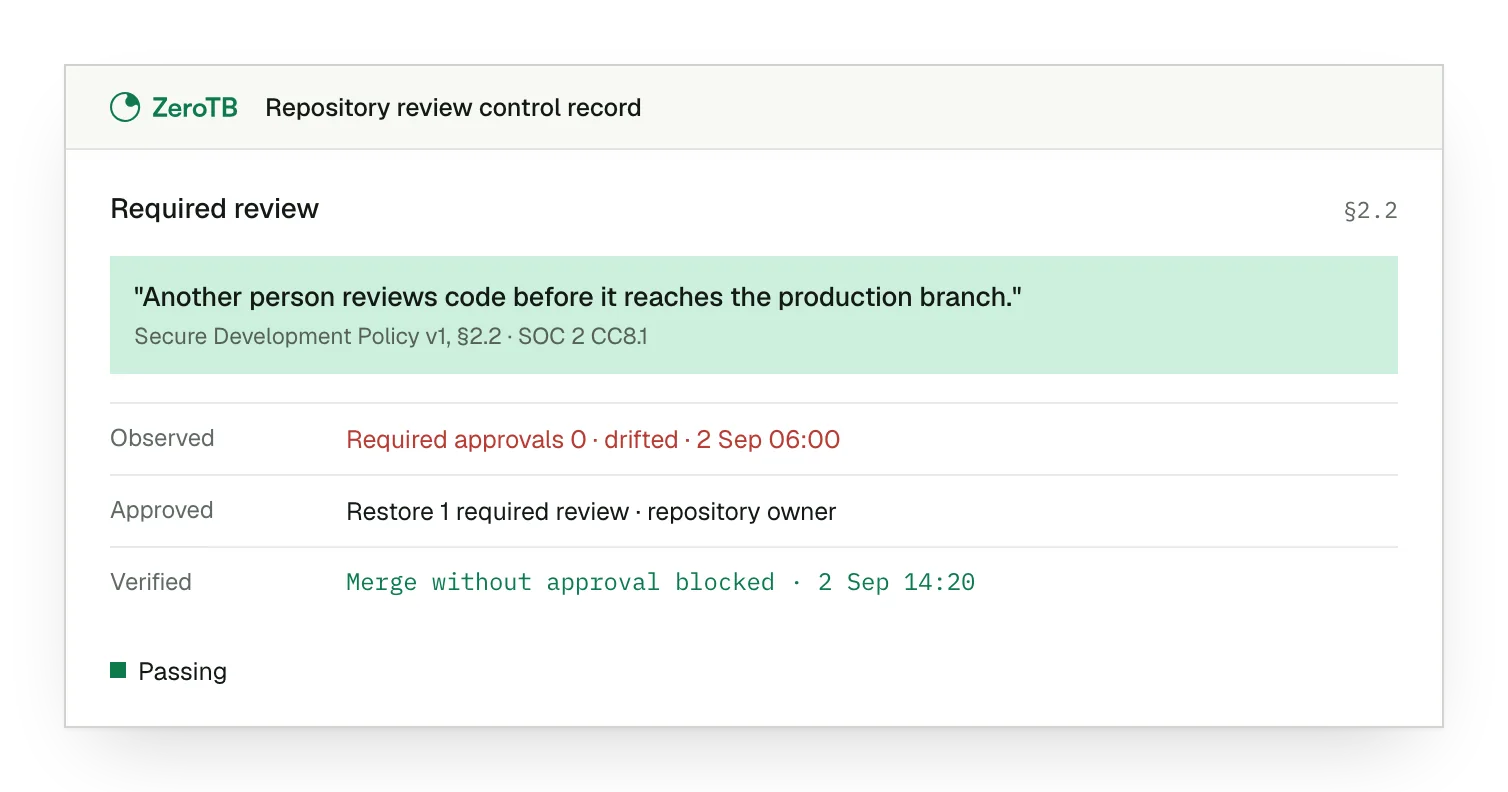
Required review. The approved rule requires another person's review before production changes.
Missing restriction. The branch setting has fallen to zero required approvals.
Approved correction. The repository owner authorizes restoring one required review.
Verified result. A dated test shows that the restored rule blocks an unapproved change.
Set five controls before rolling out Claude Code
Identify the SOC 2 requirement, its systems and its owner.
Choose Manual or auto mode and define deny rules.
Turn on filesystem and network isolation for shell commands.
Approve servers and plugins, then restrict them through managed settings.
Test branch rules after repairs and retain the results.
Sources
- Anthropic, Security, 2026.
- Anthropic, Permissions, 2026.
- Anthropic, Sandboxing, 2026.
- Anthropic, Data usage and Plugins overview, 2026.
- Anthropic, Automated security reviews in Claude Code and Use Claude Security, 2026.
- Anthropic, Claude Code Security, 2026.
- Anthropic, Security review GitHub Action, 2026.
Start with the Pilot
The eight-week Pilot maps up to 25 commitments and takes two real control gaps through verified restoration around agent-assisted development.