Home / Organizational controls
What does ISO 27001 A.5.16 require for identity management?
ISO 27001 A.5.16 concerns identity management throughout creation, changes and retirement. Accounts need to remain connected to the people or services they represent. Compare active accounts with current ownership and business use, then verify that lifecycle decisions reach every relevant system, including accounts outside the central directory.
A departure recorded in the directory can leave an account active elsewhere. A service can also retire while its credentials remain in use. Identity management connects those changes with the accounts they affect, so the team can explain what remains active and why.
Identity lifecycle
A.5.16 concerns the whole life of an identity, from its creation to the end of its use. That identity may represent an employee, a contractor or a service. Each needs a current purpose and someone responsible for decisions about its continued use.
The review covers the systems where that identity operates. A change in one system may require action in several others. Connecting those actions helps the team find accounts that remain active after a departure or service retirement and decide what should happen to them.
Account creation
An account should enter service with a known purpose and a decision that authorizes its creation. The creation record connects the account to a person or service, the system it belongs to and the reason it is needed. That connection gives later reviews a starting point.
Identity management also connects with authentication and access rights. The identity tells the system who or what is acting; authentication checks that claim, and permissions determine the allowed actions. Keeping these decisions connected helps reviewers distinguish an unnecessary account from a necessary account with excessive rights.
Identity records
Identity records need enough detail to connect accounts across systems without confusing different people or services. A display name alone can be ambiguous. A stable reference to the person or service, linked to each account identifier, makes changes easier to trace.
The record should preserve the connection when someone changes their name, moves teams or receives a separate administrative account. Reviewers can then follow the same person through those events and identify accounts whose purpose needs further investigation.
Application coverage
A central directory covers only part of the identity lifecycle when applications maintain their own accounts. Local accounts and service identities may need separate handling. Reviews of Okta or Google Workspace should therefore include the applications where those identities operate.
Account provisioning can carry changes from a directory into an application. Microsoft's provisioning documentation describes creation, maintenance and removal in connected systems. The practical check is whether the intended change reached the application. A directory update by itself leaves that destination's state unresolved.
Role changes
A role change can leave an identity valid while making some of its accounts unnecessary. Continued employment explains why the person still has a work identity. It does not explain why an account for the previous role should remain active in a particular application.
The review should identify which accounts still serve the new role and which need retirement or a revised purpose. Where an account remains necessary, its permissions may also need review. Recording the decision keeps later reviewers from treating every retained account as an overlooked departure.
Service ownership
A service identity needs an owner who can explain what uses it and when that use should end. Its lifecycle follows the service, which can continue after its original developer leaves. An employee departure should therefore prompt a review of service ownership as well as personal accounts.
The owner needs to identify dependencies before retiring the identity. A scheduled job may still use credentials created for an older service. That job may need a different approved identity before the old one can be disabled. Without an owner, the account can remain active while that decision waits.
Separate accounts
Separate accounts can serve legitimate purposes when their records explain why each one exists. An administrative account may have a different purpose from an everyday work account. Both should remain connected to the same person, with their separate uses clear to the reviewer.
Unexplained duplicates need investigation before removal. Similar names can represent different people, while different names can belong to one person. Where shared use is necessary, document the reason and responsibility for it. The review still needs a way to explain who can use the account and why.
Retirement decisions
Retiring an identity requires a decision about both unwanted access and the work that still depends on it. The proposed change should identify affected accounts, any remaining service dependency and the intended state afterward. The responsible owner can then approve a correction with those effects understood.
Disabling an account can end its use while preserving the history needed for review. Deletion may be appropriate later under the organization's requirements. If an account must remain active temporarily, record its purpose, responsible owner and review conditions so the exception has a clear reason to end.
Verification after retirement
Retirement is complete when the affected systems confirm the intended result. Check that retired accounts can no longer provide the access being removed. Where a service depended on an account, also check that the approved replacement supports the work that must continue.
The result should identify the system checked, the time and the observed state. A failed or unavailable check leaves the gap open. A removal request can succeed before the application reflects the change, so the reviewer needs to see what the application did.
Lifecycle evidence
A reviewer should be able to follow an identity from its origin through each significant change. Keep the creation decision, account identifiers, ownership changes and retirement decision connected. The record explains why an account existed and how the team decided its use should change.
Evidence of a correction also needs the state before and after the action, its approval and the verification result. ZeroTB keeps these together in the Verified Control Record. Account references belong in that history; passwords, tokens and other credentials should stay outside the evidence presented for review.
Continuing checks
Lifecycle checks need to continue as people, applications and services change. Compare active accounts with current personnel and service records, then investigate mismatches. A new application or an unowned service can otherwise introduce accounts that the existing process never reaches.
Repeated gaps can reveal a missing connection in that process. An application that retains departed users needs a review of how retirement reaches it. Correcting that connection gives future departures a reliable path, while subsequent checks show whether the same gap has returned.
Identity management evidence
Use these records to explain why an identity exists, how its status changed and how the resulting state was checked.
| Requirement | What an auditor asks for | Where it comes from |
|---|---|---|
| Authorized creation | The account's purpose, represented person or service, and approval to create it | Account requests, approval records and the relevant personnel or service record |
| Account coverage | The accounts connected to each identity across the systems in scope | Directory exports, application account lists and records of local or service accounts |
| Current ownership | The responsible owner and reason for retaining each active identity | Personnel changes, service ownership records and documented decisions on exceptions |
| Controlled retirement | The decision to end use and the treatment of remaining dependencies | Departure records, service retirement decisions and approved account changes |
| Verified outcome | Dated results showing removed access and any necessary service operation after the change | Application observations and service checks linked to the correction's approval |
Related framework controls
| Framework | Control | What it covers |
|---|---|---|
| ISO 27001 | A.5.16 | Identity management through creation, changes and retirement across the systems where identities operate |
| SOC 2 | CC6.2 | Authorization before access is granted and removal of access when it is no longer authorized |
| HIPAA | 164.312(d) | Authentication of people or entities seeking electronic protected health information; a related requirement with a different scope |
Example of retiring a service account
A retired service can leave an active account behind when another job still uses it. In this example, a scheduled export depends on that account. The correction moves the export to an approved identity before ending the old account's use.
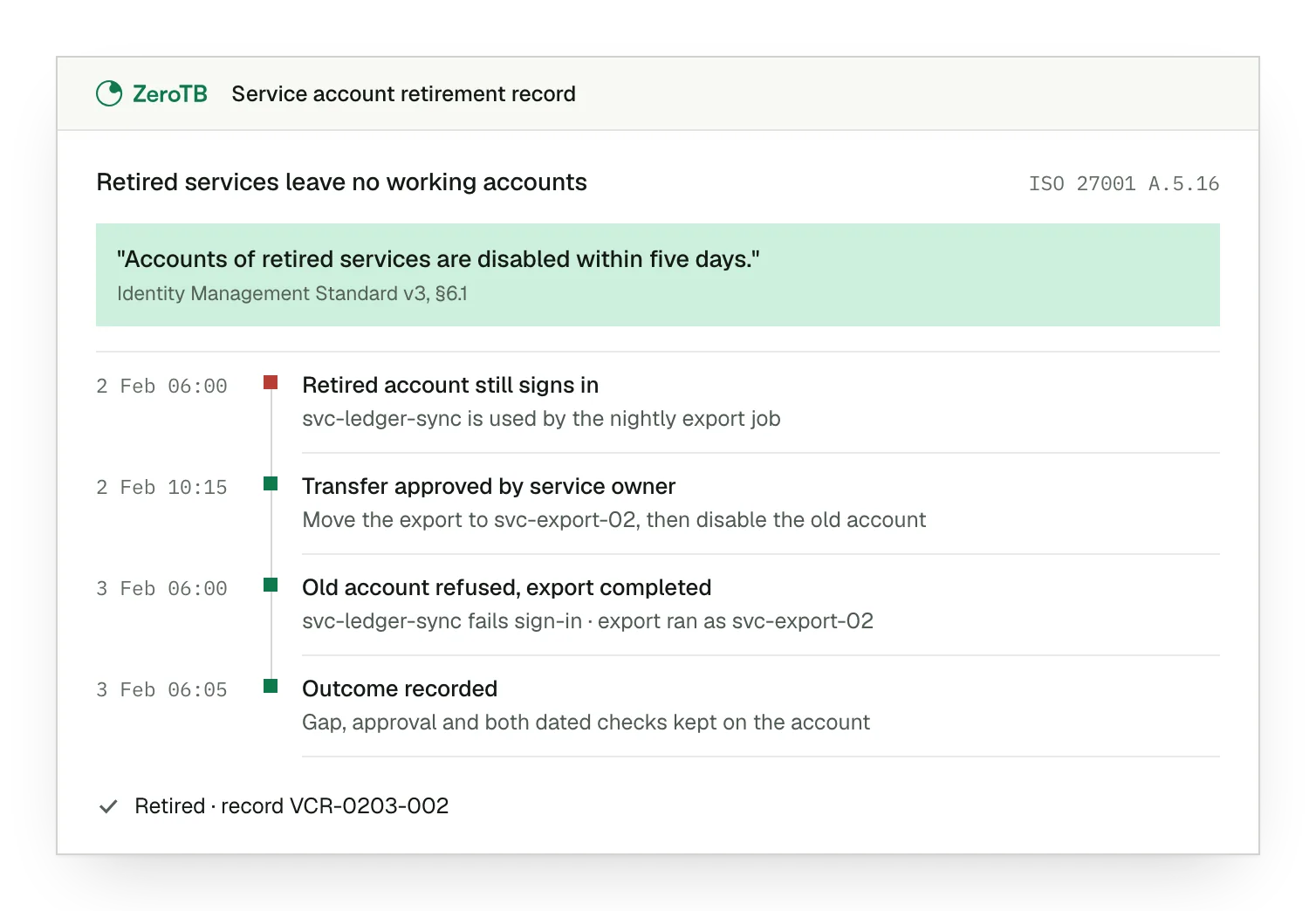
Remaining dependency. The retired service's account still authenticates because a scheduled export continues to use its credentials.
Approved transfer. The service owner approves moving the export to its replacement identity and disabling the old account.
Verified retirement. The old account fails authentication, while the export completes successfully using the approved replacement identity.
Recorded outcome. The account's history retains the observed gap, approved change and dated results from both verification checks.
Identity review checklist
Compare directory accounts with application and service records to find identities that the existing lifecycle process misses.
Identify the person or service behind unexplained accounts and obtain the owner's decision on continued use.
Check what still uses an account before removal, including scheduled work that needs an approved replacement identity.
Confirm that retired access is blocked and necessary services still operate after the approved change.
Trace repeated findings to the lifecycle step that missed them, then check whether the correction holds.
Sources
- ISO, ISO/IEC 27002:2022 control guidance, 2022.
- Microsoft, How application provisioning works, accessed November 4, 2026.
- AICPA & CIMA, Trust Services Criteria with revised points of focus, 2022 revision.
- HHS, HIPAA audit protocol, 2018 update.
Related pages
Organizational controls
Place identity management alongside the organizational controls that define responsibilities across the wider security program.
ISO 27001
Explore the framework that connects individual controls with the organization's information security management system.
Compliance frameworks
Find guidance on related requirements across SOC 2, ISO 27001 and HIPAA control libraries.
Start with the Pilot
Talk with our team about the identity gaps that keep returning. The eight-week Pilot maps up to 25 commitments and takes two real control gaps through approved correction and verified restoration, with evidence of the completed work.