ISO 27001:2022 has 14 physical controls in Annex A.7. They cover the premises, equipment and media that hold or carry information. Use this library to find the control behind a physical finding, understand the repair it calls for and see what evidence shows that protection is working again.
Physical control guides
A.7.1
Site boundaries
The perimeter defines where a protected area begins, including the entrances and other openings along its boundary.
A.7.2
Entry permissions
Physical entry controls govern admission to protected areas, with permissions and entry arrangements for employees, visitors and contractors.
A.7.3
Protected rooms
Room protections reflect the information and equipment inside, with access restrictions suited to how each space is used.
A.7.4
Intrusion monitoring
Monitoring detects unauthorized entry and connects the detection to someone who can respond to the event.
A.7.5
Environmental protection
Safeguards address physical and environmental threats at each location, including damage that could interrupt equipment or expose information.
A.7.6
Restricted-area work
Rules for work inside protected areas govern permitted activities, supervision and restrictions while people are present.
A.7.7
Desk and screen protection
Secure storage and locked screens protect information when a workspace is unattended or visible to other people.
A.7.8
Equipment placement
Equipment placement reduces exposure to nearby hazards and unauthorized access, including when devices move to another location.
A.7.9
Off-site assets
Assets retain appropriate protection away from company premises, including during transport, storage and use at another location.
A.7.10
Media handling
Handling rules protect storage media throughout their life, from receipt and use through transfer or disposal.
A.7.11
Utility continuity
Power, cooling and other supporting utilities sustain equipment operation, with arrangements tested against the load they support.
A.7.12
Cable protection
Protected cable routes reduce opportunities for damage, interference or unauthorized access to power and communications connections.
A.7.13
Maintenance safeguards
Maintenance preserves equipment operation and security, including checks on affected protections before equipment returns to service.
A.7.14
Equipment release
Equipment leaves for reuse or disposal only after stored information receives the required sanitization or destruction.
Gaps after workplace changes
A change in how a room is used can undo its physical protection. Sensitive equipment may remain there after the room opens to more people. An earlier inspection can still appear in the evidence file, even though it describes conditions that have changed.
A room changes use
Access restrictions stay unchanged
Sensitive equipment becomes exposed
Control work with ZeroTB
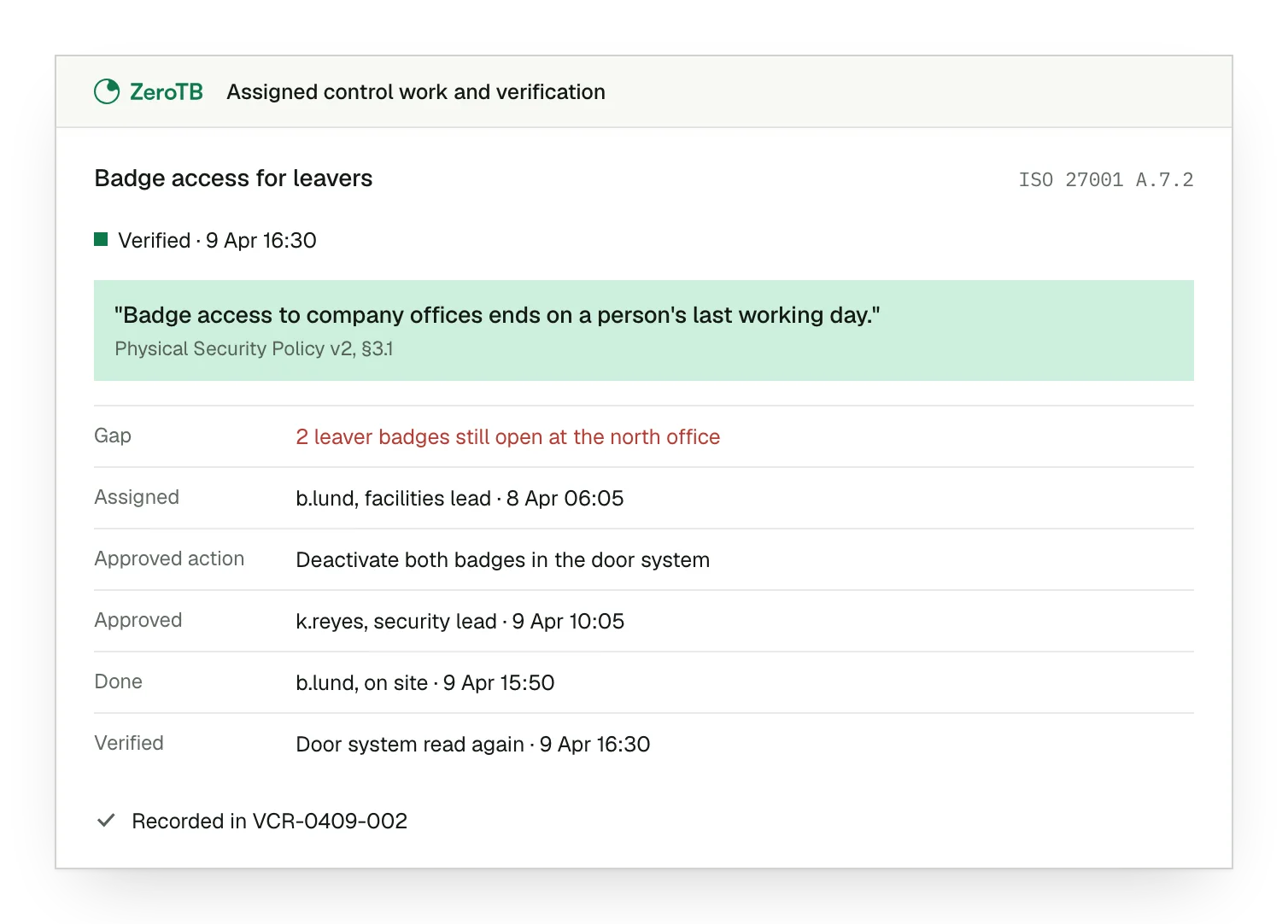
ZeroTB checks whether policy commitments hold and helps carry failed controls through repair. Our team proposes the fix for approval and works with the responsible owner. We check the result before recording the commitment, approved action and verification in a signed Verified Control Record.
Facilities teams and providers perform on-site work
People approve material changes to controls
Control records stay in ZeroTB
Talk to our team
Tell us about the physical findings that recur and the work involved, including repairs that depend on a landlord or provider.
FAQ
Do physical controls matter for a remote company using cloud services?
Yes. Using a cloud provider does not remove the need to protect devices and information where employees work. A laptop in a shared office and paper records stored at home remain physical assets. The safeguards depend on the setting, even when the provider operates all the servers.
How do shared offices and outsourced facilities affect responsibility?
The agreement and the way the premises operate determine who handles each safeguard. In a shared office, the building entrance may be managed by the landlord while a tenant controls its own rooms. That division also affects who can arrange repairs and whose inspection or maintenance records explain the work.
Can one workplace change affect several physical controls?
Yes. The same equipment move can create an access problem, expose a cable and change the cooling load. Each affected control addresses a different part of that move. Checks therefore need to cover those separate effects; a successful entry test alone says nothing about the equipment's power or cooling.
What should evidence show after a physical repair?
It should show what was repaired and whether the protection now works. The location or asset connects the original finding to the authorized work and the later check. After an entrance repair, for example, testing who can enter answers a different question from a receipt showing that a lock was replaced.
Where does ISO 27002 fit when implementing these controls?
ISO 27002 explains how information security controls can be implemented. It accompanies ISO 27001, which sets requirements for the information security management system. The physical guides here focus on individual controls. For the rest of the program, see the ISO 27001 hub; other standards appear in the framework library.
Is ZeroTB a fit when the same physical finding keeps returning?
ZeroTB fits teams that need continuing control work after an audit. The initial conversation establishes the commitment, where protection fails and which owners or providers can act. That helps identify work suited to the Pilot and the checks needed to establish whether a repair holds.
Start with the Pilot
The eight-week Pilot maps up to 25 commitments from your report and takes two real control gaps through verified restoration. You receive working controls and portable evidence records showing the work completed and the result checked.