What does ISO 27001 A.7.2 require for physical entry?
Under ISO 27001 A.7.2, physical entry to protected areas follows an access decision: who may enter, where they may go and why. That decision applies to staff, contractors and visitors. Review credentials against current approvals, and test the affected entrance after removing access that has ended.
An active badge can outlast the work it was issued for. Closing a contractor's work account does not necessarily change the door permissions. When reviewing physical entry, include credentials that have been unused for some time: they may still let someone into the office.
Physical entry scope
Physical entry starts with the boundary around the information being protected. Identify the relevant areas and the routes into them before reviewing individual permissions. Someone allowed through the building reception may have no reason to enter the equipment room inside the office.
Those areas need separate access decisions if they protect different information or equipment. The review can then follow each credential through the doors it permits someone to open. Other physical controls protect the premises in different ways; A.7.2 concentrates on permission to enter the areas within scope.
Current access permissions
An access list is useful when each permission has a current reason and someone who can approve it. Match active badges, issued keys and other entry credentials to the people authorized for the area. Record which owner can resolve a mismatch.
Entry logs answer a different question: who used the recorded access route during the period reviewed. A badge with no recent activity may still work. Read the logs alongside current permissions and approvals. This comparison reveals access that is still available even when nobody uses it.
Visitor arrangements
Reception needs a usable entry procedure for visitors. It should identify who can approve a visit, where the visitor may go and when an escort is needed. A host's approval for a meeting does not automatically permit entry to every protected room.
Keep the arrival record connected to the end of the visit. A temporary badge may be returned or expire under the agreed procedure. If neither has happened, the host or reception needs to establish whether the visit continues and whether that badge can still be used.
Access after departures
Facilities can remove a badge only when it knows that the access should end. A departure recorded elsewhere may never reach the person who manages the doors. That missed handoff leaves physical access in place after the person's work account has closed.
Compare departures and role changes with the permissions that badges still hold. Ask the access owner about any mismatch before deciding the correction. An extension for unfinished work may be legitimate, but it needs an approval that explains the remaining areas and purpose of access.
Shared premises
At shared premises, the control needs an owner on each side of the building's access arrangements. A landlord may manage the building pass while the company controls its office door. Removing one permission can leave the other access route available.
Agree who receives removal requests, who changes each permission and who provides the resulting evidence. The same question applies when a service provider controls entry to a facility. A completed request should identify the access it removed and any permission that remains under another owner's control.
Approved corrections
An access correction starts with a decision about the person's remaining work. The owner may approve ending all entry permissions or retain access to a particular area. Facilities needs that decision before it changes the credential, together with any exception the owner has approved.
The action will depend on what opens the door. Facilities can disable an obsolete badge, but a missing key or exposed shared code may require a lock or code change. Keep the intended access clear in the request so that the resulting check has a specific target.
Checks at the entry point
A correction is complete when the affected entrance rejects obsolete access and still admits the people who need it. Ask the responsible facilities or service owner to test or inspect the result. A permission export alone cannot show whether a physical door closes correctly.
Keep the test specific to the correction: the credential, entrance, expected result and observation date. Record who performed the check and any remaining problem. If the observation is missing or the access still works, keep the gap open with a responsible owner and next action.
Continuing control ownership
Recurring access reviews need someone who can pursue a correction after finding a mismatch. The reviewer may depend on facilities or a building manager to change the permission. Agree how that handoff works, including who follows a request that has received no reply.
Some checks can use system records; others need an inspection at the premises. Choose the observation that establishes whether the control works. The control restoration process carries that finding through to a result, with departures, lost credentials and new entry arrangements prompting attention between scheduled reviews.
Evidence and privacy
A later reviewer should be able to trace why access changed and what the change achieved. Keep the earlier permission, the owner's approval and the dated result together. Without that connection, a closed request may say little about the access that remained.
Keep visitor information under the organization's access and retention rules. The evidence needs enough detail to explain the entry decision, but copying an entire visitor register into each repair ticket adds unrelated personal information. Refer to the relevant record where possible and restrict who can read it.
Physical entry evidence
An auditor can use these records to compare the agreed entry rules with the access that was available.
| Requirement | What an auditor asks for | Where it comes from |
|---|---|---|
| Defined access scope | The areas and entrances included in the control, with the owner of each access decision | The approved access policy, premises records and the allocation of responsibility to facilities or service owners |
| Current authorization | The people permitted to enter, the credentials they hold and the reason for their access | Current permission lists and key issue records, checked against staff status, contractor records and access approvals |
| Controlled visitor access | The approved visit, the area the visitor could enter and how temporary access was ended | The relevant visitor entry, host approval and record of the temporary credential's return or expiry |
| Approved access removal | The permission identified for removal and the access decision facilities was asked to carry out | The departure or role-change notice, owner's approval and facilities' record of the completed action |
| Verified correction | The observed result at the affected entrance, covering the removed permission and the access retained | The dated local test or inspection, retained with its approval in the Verified Control Record |
Related framework requirements
| Framework | Control | What it covers |
|---|---|---|
| ISO 27001 | A.7.2 | Entry permissions and procedures for the protected areas used by staff, contractors and visitors |
| SOC 2 | CC6.4 | Physical access restrictions for facilities and protected assets in the system under review |
| HIPAA | 164.310(a)(1) | Limits on access to facilities housing electronic protected health information systems, while allowing authorized entry |
Example of ending obsolete badge access
In this example, a contractor's project has ended, but the issued badge still opens the office entrance. Facilities disables the badge after the access owner's approval. The record remains open until a local test confirms that the old badge fails and current staff access works.
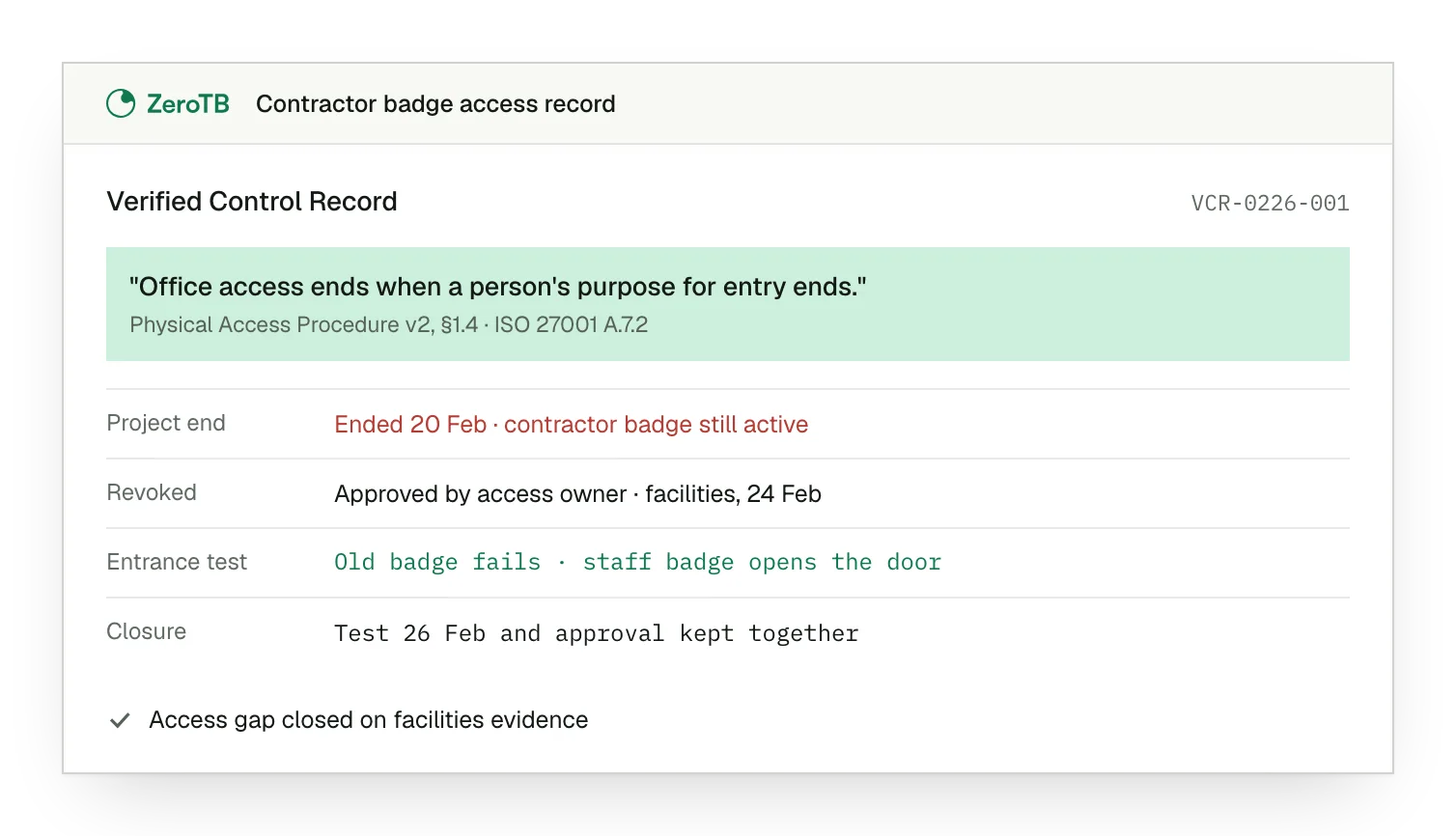
Expired access purpose. The project end record shows that the contractor no longer needs office access.
Approved badge removal. The access owner approves revocation, and facilities records the change to the issued badge.
Entrance test results. Facilities confirms that the old badge fails while an authorized staff badge still opens the door.
Recorded closure decision. The dated test and approval remain together as the evidence for closing this access gap.
Physical entry review checklist
Locate the entrances in scope and confirm who decides whether a person has a reason to enter.
Read the current permission list alongside access approvals and departure records, including badges with no recent entry activity.
Agree the intended access with its owner before asking facilities to change a badge, key or shared code.
Record a local test or inspection showing that the affected entry route now applies the approved access decision.
Identify who follows later changes in access and who pursues any correction that still lacks a verified result.
Sources
- ISO/IEC, ISO/IEC 27002:2022 standard overview, 2022.
- NIST, SP 800-53 Rev. 5, PE-2, PE-3 and PE-8, 2020, with release updates in 2025. Supplementary physical-access guidance.
- HHS, HIPAA audit protocol, facility access controls, updated July 2018.
- ZeroTB, Continuous control monitoring guide, 2026.
Related pages
Physical controls
Continue through the physical control guides for the premises where company information and equipment are kept.
ISO 27001
Read the framework guide for the information security program that this physical entry control supports.
Compliance frameworks
Compare the framework guides to understand where related requirements may draw on the same control evidence.
Start with the Pilot
Talk with our team about the controls that need attention between audits. The Pilot runs for eight weeks: we map up to 25 commitments and take two real control gaps through verified restoration. The record keeps each approved correction and its verification result.